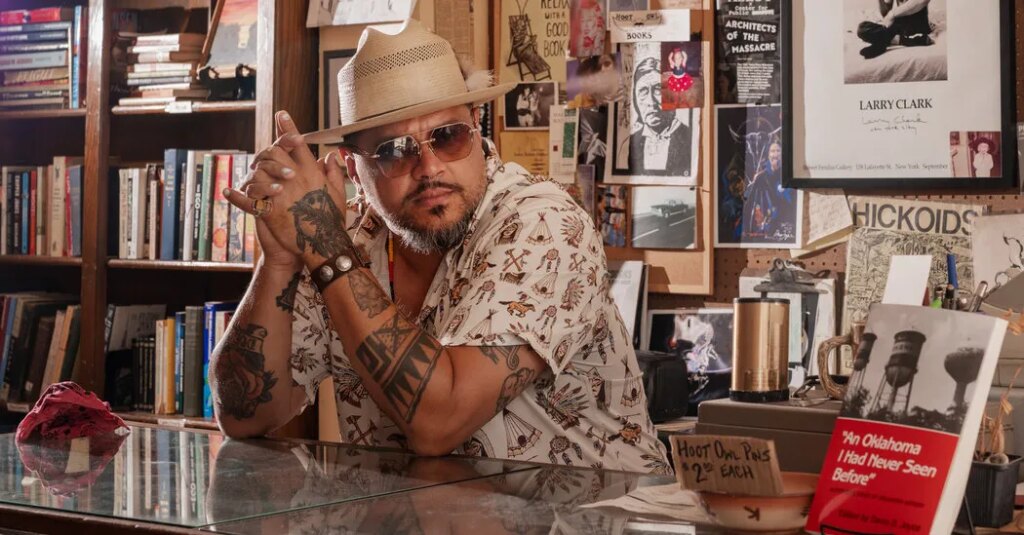
Outside the historic Oklahoma Natural Gas Company Building, an Art Deco spire in downtown Tulsa, a line of white vans idled. Inside the vaulted lobby, Sterlin Harjo, the writer and showrunner, and probably the most famous current resident of the city — “certainly the most famous person you could plausibly bump into shopping for cereal at the Reasor’s at 15th and Lewis,” as one local publication put it — leaned against a marble balustrade and watched two of his crew members attempt to maneuver a crate of equipment through the double doors. In less than five minutes, Harjo was due upstairs for the first shoot of the day, after which the “entire circus,” as he calls it, would have to be hauled to the opposite side of town for a second session, which he expected to last late into the night — a 10-hour grind in all, given that it was not yet noon.
Still, Harjo wore a wide grin; he looked beatifically unfrazzled. “It’s something about my chemical makeup,” he mused, nudging up the brim of his white Stetson. “Like, I definitely have O.C.D., and in the run-up to any new project, I’ll have a boardroom of voices arguing in my head. Then production starts and everything becomes very clear.”
I followed him to the third floor. Near the elevator bank, Ethan Hawke, who plays Lee Raybon, the citizen journalist hero of Harjo’s latest FX series, “The Lowdown,” was huddled with Betty Gilpin. Today, Harjo explained, Hawke and Gilpin would be filming a scene in which Gilpin’s character, Ginger, a veteran public defender and potential new love interest for Lee, accompanies him to the dentist to address a tooth he broke during a brawl. Hawke raised his front lip, exposing the cracked prosthetic incisor. “Sterlin can’t stop assaulting me,” he told me. “I’m like, ‘Dude, can we maybe go just one episode with my face fully intact?’”
“Nope,” Harjo deadpanned. “Has to be done.”
Lee’s status as human punching bag is one of several running jokes in “The Lowdown,” which adheres to the time-honored beats of classic noir: A detective type sets out to solve a homicide and ends up — at predictable cost to his own personal well-being — uncovering a vast conspiracy. In Season 1, the victim was a wealthy bibliophile named Dale Washberg, and the conspiracy the theft of valuable land from its rightful Native owners; in Season 2, which premieres Oct. 14, the apparent villain is a corrupt sheriff. “But any good piece of noir, of pulp, it bends the genre,” Hawke told me. “Something else is happening under the surface.”
In the case of “The Lowdown,” that something is America itself, shrunk down to the borders of Tulsa, and rendered by Harjo as a kind of conflagration of subcultures, including conservative oilmen and Christian nationalists, white hipsters and Native activists, each of whom is afforded a degree of emotional depth unusual for a mainstream TV show. “It sounds silly, but every time someone comes onscreen, you smell them,” the actor Michael Hitchcock told me. “You know, without being told, that Lee washes his pants once a month, just like you know my character” — a smarmy antiques dealer — “wears fine cologne he bought at a cheap garage sale. That’s Sterlin’s genius. He’s writing real people. And real people can be brave, they can be pathetic. They can make you howl with laughter.”
As a rule, Harjo tends to be skeptical of straightforward exposition, preferring to allow the plot of “The Lowdown” to advance through dialogue that feels lived-in, and a little shaggy, in the manner of an overheard conversation. The tone vacillates between the ribald (“Tulsa: Spelled backward, it’s ‘a slut,’” a character thunders over the opening montage of the new season) and the deeply moving. Blood is spilled, drugs are imbibed and the camera lens shimmers in and out of focus, resolving to reveal the tremor of whiskey in a tumbler or the pattern the wind carves into an empty pasture. “I remember finishing a week’s work and calling my best friends and saying, ‘I feel like we just shot a Cassavetes movie,’” Hawke told me later. “And that comes from the complexity, the visual intelligence and the understanding of human nature that Sterlin has. Take Lee: He’s falling forward, he’s wreaking havoc wherever he goes. He’s noble, he means well, but he’s so full of flaws. And I love that about him. It’s like, ‘This guy is gonna break your heart.’”
Back on set, someone shouted, “Action!” A producer scrambled out of the way of the camera, which, mounted on a dolly, rumbled a few feet ahead of Gilpin and Hawke, tracking their progress down the carpeted hallway and toward the door of the dentist’s office. A few yards away, on the other side of the wall, Harjo watched the scene play out on a monitor. Technically the script had been locked the day before, but a significant portion of “The Lowdown” ends up being ad-libbed, and between takes, Harjo and the episode’s director, Scott Teems, traded ideas about how to best tweak Ginger and Lee’s banter. Lee, Harjo argued, needed to appear truly terrified, and Ginger unruffled.
“He’s stalling,” Harjo said. “He’s trying to hold out as long as he can.”
After a few additional takes, Hawke wandered backstage and, picking up Harjo’s battered acoustic guitar, strummed the opening verse of “The Wurlitzer Prize,” by Waylon Jennings. “I don’t want to get over you,” he sang, drawing out the last word into a plaintive howl. On the monitors, the crew was already preparing for the next scene, in which a dentist, Johnny, played by Rafael Casal, would tend to Lee’s tooth.
Originally, Harjo told me, the dental procedure itself hadn’t been written into the series, but he needed a venue for Ginger to disclose a crucial piece of information — she has a lead to share with Lee — and he was intrigued by the comic possibilities of it happening while his protagonist was stuck in the chair. “There are layers to it,” Harjo said. “There’s the relationship between Lee and Johnny,” who is married to Lee’s ex-wife, Samantha, and who shares custody of Lee’s daughter. “And there’s the dynamic of having the three of them together. You’re getting the plot details across, but in an entertaining way.”
Setting down the guitar, Hawke joined Casal and Gilpin in the adjacent room, which was decorated with an array of watercolors and admonitory posters (“Plaque is whack!” one read). As the cameras rolled again, Casal, in a mustache and medical jacket, approached Gilpin and took both of her hands in his. “Hi!” he bellowed. “You must be his lady.” To Lee, sotto voce: “Oh, my god. She’s gorgeous.” To Ginger again: “ I’m Johnny. I’m the co-dad.”
“We’re not co-dads,” Hawke corrected him.
“And I’m not his lady,” Gilpin cut in.
Egged on by Harjo and Teems, Hawke experimented with a range of reactions to the sight of the reclining chair: It was like something out of a medieval dungeon, it was an alien probe device. “Did you see ‘Marathon Man,’ with the Nazi dentists?” Hawke inquired.
Harjo cackled in appreciation. “What do you guys think?” he said, turning to a trio of new arrivals: Harjo’s own dentist, Dr. John Fonder, and two of Fonder’s staff members, both in scrubs, who had been summoned to the set to provide technical advice on the scene.
“Sometimes, under sedation, they try to get undressed,” one staffer said.
“It’s wild,” the other agreed. “But it does happen.”
“Let’s try it,” Harjo shrugged.
Casal triggered the faux canister of laughing gas and offered the mask to Hawke, who took a deep drag. He reached down to unsnap the buttons of his shirt but, thwarted by Gilpin, removed his boots instead. His face, rubbery and slack, filled the frame.
The room detonated with backslapping and cheers of approval. Ducking through the commotion, Harjo descended the stairs to the street. “There’s a shot of fulfillment I get when something clicks,” he said. “But there’s also the thrill that comes from looking over and seeing the boom-mic guy shaking with laughter, or the dolly grip burying his face in his hands. We’ve got all these different artists in one room, all trying to service the same story. And there’s, I don’t know” — he searched for the right word — “magic in that.”
Harjo has described “The Lowdown” as a “love letter to Tulsa,” in the same way his previous FX show, “Reservation Dogs” — a quasi-autobiographical coming-of-age series that established his reputation in Hollywood and helped win him a MacArthur “genius” grant — was a “love letter to rural Oklahoma.” But this feels only half right; like calling “The Grapes of Wrath” a love letter to the Dust Bowl. Harjo’s Tulsa may be radiant — witness the tenderness with which he films the juke joints and back alleys — but the radiance is often only surface-deep. Underneath, a sordid and violent history seethes.
In one particularly memorable scene from last season, Dale Washberg’s pompous brother, Donald (Kyle MacLachlan), who is running for governor, presides over a re-creation of the Land Run of 1889, when the United States government gave tens of thousands of white settlers carte blanche to seize land that already belonged to various tribes. But there’s a twist: The “settlers” in this re-creation are small children, and they are interrupted by a troupe of Native protesters, one of whom approaches Washberg and accuses him of whitewashing the past. For what purpose? she wonders. “To mock us? To rub in our face that this land was outright stolen?”
“We’re just trying to re-enact some bit of Oklahoma history,” Washberg says, squirming.
“Some things,” the protester shoots back, “should not be celebrated.”
When I brought up the scene over lunch at a restaurant in downtown Tulsa, Harjo laughed. “Yeah, it’s funny — that was one of the earliest ideas I had,” he said. As a child, he explained, he heard about similar re-creations. “They still happen, in fact. And that’s the thing about Oklahoma, you know? It’s a land of secrets — of a perpetual clash between the powerful and the disenfranchised. And there’s this historical underbelly that gets pushed down and not talked about.”
He mentioned the Tulsa Race Massacre of 1921, which is depicted, through flickering black-and-white archival footage, in Season 2 of “The Lowdown.” “That took place not far from where we’re sitting now,” Harjo went on. “A community was burned down, people were killed in the streets, and it was hidden for so long. And all of that history, all of that conflict, all of those attempts to rewrite the past, I figured it was the ideal backdrop for a piece of noir.”
Hawke suggested to me that this sense of place was integral to the appeal of “The Lowdown.” Harjo, he pointed out, isn’t a tourist jotting down his impressions of a foreign city. (I stopped counting the number of times various cast members reminded me that the Paramount series “Tulsa King” is filmed in Atlanta.) Harjo is an insider, and “he’s inviting you into his world,” Hawke continued. “You can’t do a single scene without finding out that, like, the bartender is based on his cousin Gary or whatever.”
Harjo, who turns 47 this fall, grew up primarily in Holdenville, Okla., a hundred miles south of Tulsa, on the border of the Seminole nation (from which he is descended) and the Muscogee nation (of which he is a citizen). He had a noisy, peripatetic childhood. He spent it, he told me, “commuting” between his grandparents’ and parents’ places. His mother ran a hair salon, and his father operated a taekwondo studio.
“The earliest memories I have — really, the best memories I have — are of sitting around a table and listening to my aunts and uncles and grandparents and parents tell stories,” Harjo recalled. “And the way they told them — there was so much joy, so much humor, so much sadness. And I’d just be over there in the corner, a little kid, listening, being a sponge, absorbing the structure and the cadence. I think it was probably the most important part of my education.”
Some of the stories he heard involved the Trail of Tears — the forced march, in the early 19th century, of hundreds of thousands of Harjo’s ancestors from the American Southeast to Oklahoma. “And those would be the stories my grandparents told quietly, reverently,” Harjo said. “The women who threw themselves into the river, the mothers who nearly smothered their crying babies because they didn’t want the soldiers to come along and grab the babies by the ankles and smash them against the trees.” It wasn’t until he got to college that he learned how the march fit into broader patterns of treatment of the Indigenous population. “And that kind of blew me away,” he said. “Because no one had ever said, ‘This is what the Trail of Tears was.’ It’s a Western idea, to have books, lessons. In Native communities, everything is transmitted through storytelling — through the recounting of lived experiences.”
Yet for nearly all his adolescence, Harjo did not dare to imagine that he might go on to become a professional storyteller himself. He was a popular kid — a talented football player and martial artist, a halfhearted student. “Me and my friends, we mostly just walked and walked and walked. We walked train tracks, we drove around on dirt roads, we tried tobacco of all forms, we snuck into our parents’ supply of moonshine,” he told me. “We swam in drainage ditches. We went to barn dances. We got lost. And that was wonderful.”
What artistic impulses he had were initially directed toward painting and the obsessive consumption of old movies. “My dad’s friend worked for the cable company, and we got a box for free, and we’d sit there and watch for hours on end,” he told me. “War stuff. Westerns. ‘The Lost Boys’ and ‘Stand by Me.’ It got to the point we could recite every line.”
Later, Harjo borrowed a camcorder, and requisitioning a trailer owned by his parents, he and his cousin filmed a handful of comedic sketches in the mode of “Saturday Night Live.” “But it was just something we did, you know? I wasn’t under the illusion that it was, like, a transferable skill.”
In the fall of 1998, Harjo left Holdenville to study painting at the University of Oklahoma, in Norman; to fulfill an elective requirement, he enrolled in a remedial writing class. His first assignment was to compose a personal essay on a formative childhood experience. “That part was easy,” he recalled. “I knew I wanted to write about my grandma” — a Native woman who had hosted scary-movie nights for all her grandchildren, and who made a habit of sneaking out of the house midway through the film and reappearing at the window in a long coat and hat, a stocking pulled over her face. “We knew it was her, but we’d freak out all the same,” he said. “And then she’d come into the house and chase us all around while we screamed.”
When Harjo was 14, his grandmother, whose name was Johnnie Mae, started dating a new man — a Jehovah’s Witness with a cruelly zealous streak. “The first time I met him, he was burning books at the edge of the yard — books about Seminole Indian medicine,” Harjo said. “Gradually, my grandma changed. She got brainwashed. And then eventually the guy goes off his medication and he hits my grandma, makes her strip down. He tied her to the ground and was about to put lighter fluid on her and burn her. The way my grandma told it, a calm came over her, and she said to herself, ‘Well, if he’s got to do it, he’s got to do it.’” Her reaction seemed to disturb the man. He stood up and told Johnnie Mae he was going into town for some tobacco.
“He said, ‘If I come back and you’re not still here, I’m going to kill your kids,’” Harjo said. “But my grandma had dropped a knife under the bed, and she managed to cut her way out and took off running through the woods.” A neighbor phoned the police, who intercepted the man near Johnnie Mae’s house. Cornered, he poured the lighter fluid on himself. “He burned himself to death in that car,” Harjo said. “Which is where my essay ended.”
The next time the class met, the teacher took Harjo aside; she wanted to read the piece to the other students. “That’s when I learned: Oh, OK. Wow. Maybe I can write,” Harjo said.
After his sophomore year of college, Harjo’s girlfriend told him she was pregnant with his first child. Harjo was 20, and he and his girlfriend moved into a rented house, near campus. Having a daughter, Harjo discovered, focused his attentions. “I didn’t have much spare time, and what spare time I did have, I wanted to make the most of,” he said. He took out an additional student loan to cover the cost of a camera and computer and editing software, and soon set himself a goal of making a movie in two years.
“Of course, I had no concept of what I was doing. I just ripped stuff off from everybody that I liked,” including the director Jim Jarmusch. Still, he discovered he had a natural aptitude for melding the absurd and the poignant — the uproarious and the tragic — and an eye for the small gestures that define a character for the audience. More than that, he had his own archive of personal stories to draw on.
In 2001, the Cheyenne and Mescalero Apache film producer Bird Runningwater came to the Norman campus to deliver a lecture about filmmaking. “And he mentioned this program,” Harjo remembered. “Sundance Labs, it was called” — a prestigious talent incubator that counts Chloé Zhao and Ryan Coogler as graduates. Harjo applied and was turned down; a couple of years later, after attending a workshop sponsored by the institute, he was invited to try again. This time he submitted a script for a project called “Four Sheets to the Wind,” about a young Native man trying to recover from the recent suicide of his father, and got back a rapid reply: He was in.
At Sundance, one of his mentors was Frank Pierson, the Oscar-winning screenwriter of “Cool Hand Luke” and “Dog Day Afternoon.” “Frank looked at my scripts and he said: ‘Good news, bad news situation. The good news is that you’re a writer. The bad news is that you’re not a screenwriter yet. But more good news: You can learn to be a screenwriter; you can’t learn to be a writer.’” Harjo cackled. “And he was right. He was super, super right.”
Through the early 2000s, Harjo scraped together enough money to make a series of low-budget independent films, the most accomplished being “Barking Water,” which follows a dying Native man, Frankie, on his final pilgrimage to his ancestral home — an idea informed by Harjo’s own experience with his sick grandmother. “She was in the hospital,” Harjo told me. “She said: ‘If I get worse, I don’t want to be hooked up to these machines. I want to go home and live the rest of my life there.’ And I thought that idea was so beautiful. The whole script came out of that.” (Harjo’s grandmother survived an initial bout with cancer and lived long enough to see “Barking Water,” before passing away at home, as she had wanted.)
Harjo’s early work was received appreciatively, by critics and festival audiences, but commercial success eluded him. He and his daughter’s mother split; he did some documentary work and was hired for a spell as a videographer at This Land Press, a crusading left-wing outlet. He helped form a sketch comedy troupe; he poured coffee at a Borders bookstore in Tulsa. Then, through the film festival circuit, he was introduced to the New Zealand writer and director Taika Waititi. The two men had grown up on opposite sides of the world, but they shared a comedic sensibility, and what Harjo calls an “outsider’s perspective.”
“One day I was at his place, and he was like: ‘I have this overall deal with FX. If you have anything, let me know,’” Harjo recounted. He pitched Waititi a half-formed idea about a reclusive martial-arts instructor who agrees to help a group of reservation kids fight back against their bullies; Waititi responded with his own setup, involving an Indigenous teen vigilante. “We ended up sort of marrying those two concepts — and that evolved into the pilot for ‘Reservation Dogs,’” Harjo told me.
The finished show, which debuted in August 2021 on FX, retained few traces of the original brainstorming sessions, but the wit remained, as did the adolescent yearning for escape — in Season 1, the show’s four protagonists, reeling from the loss of a close friend, devise a plan to quit Oklahoma for California, far from the bounds of what they perceive as a dead-end reservation existence. In subsequent seasons, the scope of the show widens, slowly but capably, to include a Dickensian cast of supporting characters — spirit guides and gang members, health clinic counselors and conspiracy-minded tribal cops — who help show the protagonists that what they’re searching for isn’t on some Californian beach; it’s at home, on the reservation.
“Reservation Dogs” was an unqualified hit for FX, commercially and critically; it went on to win a Peabody Award and an Emmy nomination for best comedy series. For Harjo, the developments were profoundly disorienting. “I didn’t grow up with money,” he told me. “And all of a sudden I had a TV show and I could buy a house. I could buy a truck. It was just a crazy time. There was a lot of drinking, a lot of mushrooms. A lot of ‘Let’s just get through this.’”
After “Reservation Dogs” ended, in 2023, Harjo, now with his own overall deal at FX, began casting around for his follow-up. He considered another show set in rural Oklahoma, but he was wary of being pigeonholed, and anyway, he had other sorts of stories he wanted to tell. “And I loved noir,” he said. “I thought, What if I made one set in Tulsa, with all the subcultures here?”
As a guide to the city, he devised a detective character inspired in part by the self-taught painter Bill Rabon, a committed chronicler of Tulsa’s underworld, and in part by Lee Roy Chapman, a local journalist in the Hunter S. Thompson “Gonzo” mold. Chapman had published a number of influential pieces for This Land Press, among them an exposé on the Tulsa founder W. Tate Brady’s involvement with the Ku Klux Klan and the Race Massacre. “I’d known Lee Roy personally,” Harjo told me. “He was a person who worked hard for the truth. He wasn’t afraid. And after he died” — by suicide, at age 46 — “I thought, I want to honor that spirit.”
In 2024, Harjo pulled together a few preliminary character sketches and wove them into a pilot — in addition to being a citizen journalist, he had decided, Lee should own an independent bookstore, Hoot Owl Books. “His pitch was ‘Chinatown’ but in Tulsa, and funny,’” Hawke recalled.
As he had with previous projects, Harjo rounded out the cast with friends and family members — his father, Brownie, got a cameo as Smoking Elder (exactly what it sounds like) in one episode, and Cody Lightning, a childhood buddy, was given the fan-favorite role of Waylon, a chronically useless “security guard” at Lee’s bookstore. Watching these relative amateurs perform alongside more seasoned performers like Hawke, or Jeanne Tripplehorn or Tracy Letts — both of whom are Tulsa natives — became one of the abiding pleasures of the show.
“He’s an incredibly collaborative, casual director,” Hitchcock told me. “I remember watching an early scene with Killer Mike,” a.k.a. the rapper Michael Render, who plays Cyrus Arnold, a newspaper editor. “And Killer Mike is not known for acting. He was nervous. But Sterlin just told jokes, laughed with him, and pretty soon Mike was totally at ease.”
That cooperative spirit extends to the writers’ room, where staffers are often given a setting and scene and are invited to render it in their own voice. Yet the most stirring material usually originates with Harjo himself. A good example, Hawke told me, is the relationship between Lee and his daughter, Francis, an eye-rolling teenager who adores her father but comes to resent his relentlessly blinkered pursuit of justice, and the toll it takes on her and her mother. “That dialogue, it’s a product of Sterlin being a dad himself,” Hawke said. “Right? He’s lived it.”
Harjo, though, was a little more circumspect. “The way I’d put it,” he said, “is that everything I do, every character I write, is a little bit me. They’re avatars. And that’s the point.”
In my time in Tulsa, I met more people with a connection to “The Lowdown” than without. Bartenders and restaurant staff had stories of serving Hawke, or Tripplehorn, or Tommy Lee Jones, who joined the cast for Season 2 in the role of Lee’s long-lost father, Lee Raybon Sr.; many had been pressed into service as extras themselves. Scenes have been shot at Dot’s Cafe, a popular downtown greasy spoon, and on the grounds of the Philbrook Museum of Art.
But outside the city proper, Harjo and his crew remain something of a novelty, and when I arrived for a day of shooting in the farming city Collinsville, 45 minutes outside Tulsa, I found crowds lining the sidewalks. As crew members fought to keep them at bay, Hawke, as Lee, crossed the street, cursing at an incoming vehicle and striding purposefully toward a small brick storefront bearing the logo of a fictional newspaper. Harjo was around back, in a windswept tent, sipping from a cup of coffee. He filled me in: “Lee is looking for more information on the murder, and that’s led him to another reporter. It’s a standoff of sorts.”
The journalist in question, Dale, was played by the musician Steve Earle, resplendent in faded denim and waiting stonily for Lee at an old wooden desk littered with marked-up manuscripts and nicotine packets — he knew Lee, having earlier picked him up hitchhiking on the side of the road, and he has anticipated the reason for the visit. But he was not about to make it easy on his fellow reporter. How the scene resolves I won’t disclose here — it involves crucial plot points from later episodes. Suffice to say that the whole thing is luminously amusing.
“The Dale character, I got to him by thinking about people I knew growing up, and I came up with a couple models,” Harjo told me. “One was the editor of my hometown paper — this guy who would brag that he ate exactly one Subway sandwich every day. Kept him from getting fat, he said. I liked that. That was who he was — stubborn, set in his ways. Then there was another guy, and that guy was sober, but he’d go to the bar and sit there with his Diet Pepsi and wait for drunk guys to need a ride home. Steve is famously sober, so I thought that might add some texture, if the character was the same, and picking up Lee is how they meet.”
After five solid takes, Harjo was satisfied. He headed off to find some food; he hadn’t eaten since breakfast, nearly eight hours earlier. Standing in line at the catering station, I asked him about the reception to “Reservation Dogs” and the first season of “The Lowdown,” which has a near-perfect rating on Rotten Tomatoes and cult status among fans (if not yet the awards to match). Had he been approached with any high-paying offers for mainstream commercial fare — a superhero flick, for example? Harjo paused, considering. “I’m probably going to get in trouble for saying this,” he told me, “but when the Barbie movie came out, my agents were like, ‘Hey, would you be interested in a Hot Wheels movie?’ And I said, ‘[Expletive] no. I’m not doing that.’” (The film is now reportedly in development, with Jon M. Chu of “Wicked” attached as a producer.)
Harjo made clear that he didn’t begrudge his peers for taking on big-budget fare — it just wasn’t him, and never would be. Anyway, all his attention, for the time being, was on “The Lowdown,” although, he allowed, he gets “bored of doing the same thing a lot.”
And already he was thinking about what might come next — he was collaborating with the Native author Tommy Orange on a screenplay, and he’d been tapped to adapt the 2025 horror novel “The Buffalo Hunter Hunter,” by the Blackfoot writer Stephen Graham Jones. But if neither of those projects ever got off the ground, he said, he’d be fine with that, too. “I know where I came from, and that if all of this vanishes tomorrow, I’ll be totally fine.”
He took a sip from his coffee. “I have so many sides to me,” he continued. “There’s a part of me that wishes I was still in my hometown, making documentaries about my people. There’s part of me that wishes I was just hunting with my dad. There’s part of me that wishes I was the painter I wanted to be when I was younger. And the truth is, all of those things are still possible.”
Matthew Shaer is a contributing writer for the magazine based in Atlanta. His most recent story was about the fate of the American electric vehicle and the future of the auto industry.
The post Sterlin Harjo’s Oklahoma is a ‘Land of Secrets.’ He’s Revealing Them One by One. appeared first on New York Times.