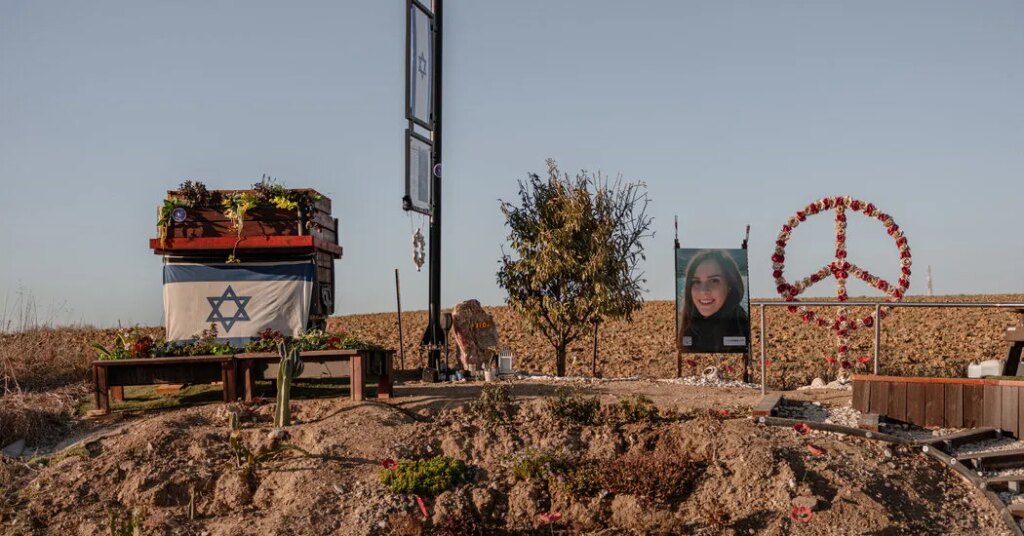
For one day last week, much of Israel united to commemorate the anniversary of the deadliest attack in the country’s history.
But when Israelis head to the ballot box this month, they will be carrying sharply disparate versions of who is to blame for failing to prevent the Oct. 7, 2023, Hamas-led assault. Though the attack traumatized Israel, it did not produce the kind of rage that would create a political transformation, leaving the country more polarized than ever.
The political divide is nowhere clearer than among the Israelis living closest to the Gaza border, where thousands of gunmen overran communities, army bases and a music festival.
In Nahal Oz, a pastoral kibbutz half a mile from the border, the gardens are blooming again with the return of residents evacuated during the war. Many in this liberal bastion are likely to vote against Prime Minister Benjamin Netanyahu and his hawkish policies, holding him responsible for failures leading to Oct. 7, said Daniel Rahamim, 72, a spokesman for the community, who survived the assault along with his family.
“We don’t have the privilege of giving up on peace,” he said.
Barely eight miles away in the working-class town of Sderot, the scene of a fierce firefight during the Hamas-led attack, Mr. Netanyahu remains a hero. In the view of many residents, he was let down — or even betrayed — by his security chiefs in the run-up to Oct. 7 and on the day of the assault.
“If the left wins, we’re done for, it will be the end of Israel,” said Shlomi Aragon, 55, referring to anybody critical of Mr. Netanyahu.
The election, set for Oct. 27, will be the first since Hamas militants and their allies surged across the border from Gaza, killing about 1,200 people, mostly civilians, according to the Israeli authorities, and taking 251 hostages.
Israel’s devastating war in response reduced much of the Palestinian enclave to rubble and left more than 74,000 people dead, including thousands of children, according to Gaza health officials, who do not distinguish between civilians and combatants.
Many Israelis view this month’s vote as the most momentous since their country’s establishment nearly eight decades ago, and for reasons that are not limited to Oct. 7. Mr. Netanyahu’s right-wing coalition, Israel’s most hard-line and religiously conservative, has undermined the country’s democratic foundations, critics say, and left it diplomatically isolated.
Hanging over the election most intensely are questions about the missteps in the prelude to Oct. 7 — for the policies aimed at fostering quiet in Hamas-run Gaza in the years before the attack and for military and intelligence lapses that left Israel vulnerable. These failures have profoundly shaken people’s confidence in the state’s ability to protect them.
The wars that spread from Gaza to Lebanon and Iran in the aftermath of the Oct. 7 attack remain unfinished. Three years on, Israel’s enemies are battered but not out, defying Mr. Netanyahu’s promises of total victory.
Yet all this upheaval has not produced the radical shift that would upend Israel’s politics.
“Like everyone, after Oct. 7, I thought there would be an earthquake,” said Tamar Hermann, a professor of political science and expert in public opinion at the Israel Democracy Institute, a nonpartisan research group in Jerusalem.
Instead, she said, it has reinforced people’s previously held positions as they retreated to their political “comfort zones.”
Like past elections, this one, too, revolves largely around the question of “Yes Bibi or no Bibi,” Ms. Hermann said, using Mr. Netanyahu’s nickname, and the choice between a “more Jewish or more democratic” Israel.
The Netanyahu camp, for its part, says Israel’s security services failed to respond to the grave threat posed by Hamas, not the prime minister or the policies of his ruling Likud party.
There is little argument among most Israelis over the government’s new willingness to carry out sustained attacks beyond the country’s borders and occupy territory in Gaza, Syria and Lebanon. A majority of Israelis fear a repeat of Oct. 7, according to a recent survey by the Institute for National Security Studies at Tel Aviv University.
But that view does not extend to confidence in Mr. Netanyahu’s leadership. Surveys indicate a split electorate and a typically tight race with a high likelihood that neither Mr. Netanyahu, Israel’s longest serving prime minister, nor his chief rival, Gadi Eisenkot, a centrist and former military chief, will secure an easy path toward forming the next government.
A Tale of Two Communities
On the Israeli side of the Gaza border, the air of renewal masks sharp disagreements over the lessons of Oct. 7.
During the attack, 15 people in Nahal Oz were killed, and eight residents were kidnapped, including one who died in captivity. Most of the residents have since returned to the kibbutz. At night, the lights of Israeli army positions visible along a ridge inside the Gaza Strip provide some sense of security.
Mr. Rahamim, the Nahal Oz spokesman, has a fresh tattoo on his arm bearing the date of the attack and the words, “On the path of hope.” The image of a sunflower climbing his forearm symbolizes a local crop — and hope, Mr. Rahamim said, “because it always faces the sun.”
In the last national election, held in 2022, 83 percent of the voters in Nahal Oz supported centrist and left-leaning parties. In the upcoming election, Mr. Rahamim said he and many neighbors will likely vote against Mr. Netanyahu again.
Mr. Netanyahu’s handling of Gaza is not the only reason. Mr. Rahamim also pointed to the government’s efforts at curbing the powers of the judiciary and at the influence Mr. Netanyahu’s ultra-Orthodox Jewish allies have over him, leading Mr. Rahamim to ask, “Will Israel be a liberal democratic state or gradually turn into a religious or fascist state?”
Some attitudes have hardened here, too, since the Oct. 7 attack. “If there is a consensus here in community, it is that Hamas has to be destroyed,” Mr. Rahamim said.
Unlike many in Mr. Netanyahu’s camp, Mr. Rahamim also said he believes that Israel must eventually negotiate an accommodation with moderate Palestinian leaders. “We have an obligation to our grandchildren,” he said.
In Sderot, forests of construction cranes rise from new neighborhoods. A serene memorial park has replaced the police station where a deadly battle raged. More than 50 people were killed in the city, including civilians, police officers, firefighters and soldiers.
Sderot has historically been a stronghold of Mr. Netanyahu’s Likud party, and in the last election, 79 percent voted for the right-wing and strictly Orthodox parties that made up his governing coalition.
Here, residents espouse conspiracy theories spread by Mr. Netanyahu’s camp that treasonous generals and security chiefs kept the prime minister in the dark about the start of the Hamas attack.
Mr. Netanyahu has asserted that Israeli security officials had chosen not to awaken him in the early hours of Oct. 7, despite worrying signs from Gaza.. He has blocked the establishment of an independent inquiry into what went wrong, despite a strong public demand for one.
Mr. Aragon, who owns a shawarma restaurant, said he narrowly escaped death on Oct. 7 when gunmen drove behind him and started shooting. About 20 years ago, he said, his house was hit by a rocket from Gaza that severely injured his wife.
He described Mr. Netanyahu as “the war leader of a generation” and suggested that the Israeli air force, if activated, could have halted the Hamas invasion within an hour. “There was a betrayal. It’ll come out,” he said.
Living opposite the site of the destroyed police station, Evelyn Sayada, 60, whose son-in-law survived the assault on the music festival, said she felt constant anxiety because Hamas had not been disarmed. But she said she would almost certainly vote for Mr. Netanyahu, as her family has always done.
“I don’t think he failed,” she said. “There was treason.”
‘Afraid of change’
One of the worst-hit Israeli border villages was Kfar Aza, home to Yonatan Shamriz, 36. His brother, Alon, was taken hostage and later killed accidentally by Israeli soldiers in Gaza who had mistaken him and two other captives for militants.
Mr. Shamriz emerged from a life of relative obscurity and founded a grass-roots movement to cultivate new leadership and change called “Kumu!” — Hebrew for “awaken!” or “rise up!”
Faced with what they call government efforts to blur and forget, he and Kumu organized Israel’s main Oct. 7 memorial ceremony for the last three years, embracing families of victims from across Israeli society — left and right-wingers, religious and secular, Jews and Arabs. Tens of thousands attended this year’s memorial, and Israel’s leading television channels aired it live.
Mr. Shamriz now lives far from the Gaza border, in a trailer with his wife and three young children in a kibbutz on the coast north of Tel Aviv. He said he believes another attack like the one on Oct. 7 is a matter of time. “If not next year, then in 10 years,” he said.
Last year, Mr. Shamriz announced that he was entering politics, aiming to create a new, unifying force with a vision based on the lessons of Oct. 7. “Something young and fresh,” he said.
In September, he quit, concluding that Israelis weren’t ready to leave their old politics behind.
“For now, people are afraid of change,” he said. “Everyone wants to vote for an experienced politician or general — someone they know.”
The post The Oct. 7 Attack Changed Israel, but Not Its Politics appeared first on New York Times.