Maybe it’s a measure of Ukraine’s wartime success that President Donald Trump has moved from deriding President Volodymyr Zelensky more than 18 months ago as a weakling with “no cards” to protesting his devastating attacks on Russian refineries.
Last weekend, Trump’s abiding irritation with Zelensky led him into a diesel oil deal with Moscow that sharply undercuts a Russia sanctions law that Trump just signed. And the White House is threatening even worse — a cutoff in crucial intelligence support for Kyiv that a European diplomat conceded to me would be “hard to replicate.”
But like so many Trump eruptions, this latest Ukraine flap obscures what may be a more important development: The United States and Europe are moving slowly toward a joint peace proposal that would deliver financial and security benefits to both Ukraine and Russia as a baseline for a territorial settlement that falls short of both sides’ war aims.
The rationale for this vexed peace initiative draws on the maxim: Whenever you run into a problem you can’t solve, make it bigger. U.S. negotiators are trying to frame a package that addresses Ukraine’s and Russia’s postwar needs in a way that ends the bloodbath and leaves both countries better off — as a sweetener for a territorial compromise neither side will like.
“We need to make the problem and the solution bigger to help both sides see what the postwar situation would be — and then make concessions,” explained a U.S. official familiar with the talks who gave me this detailed summary.
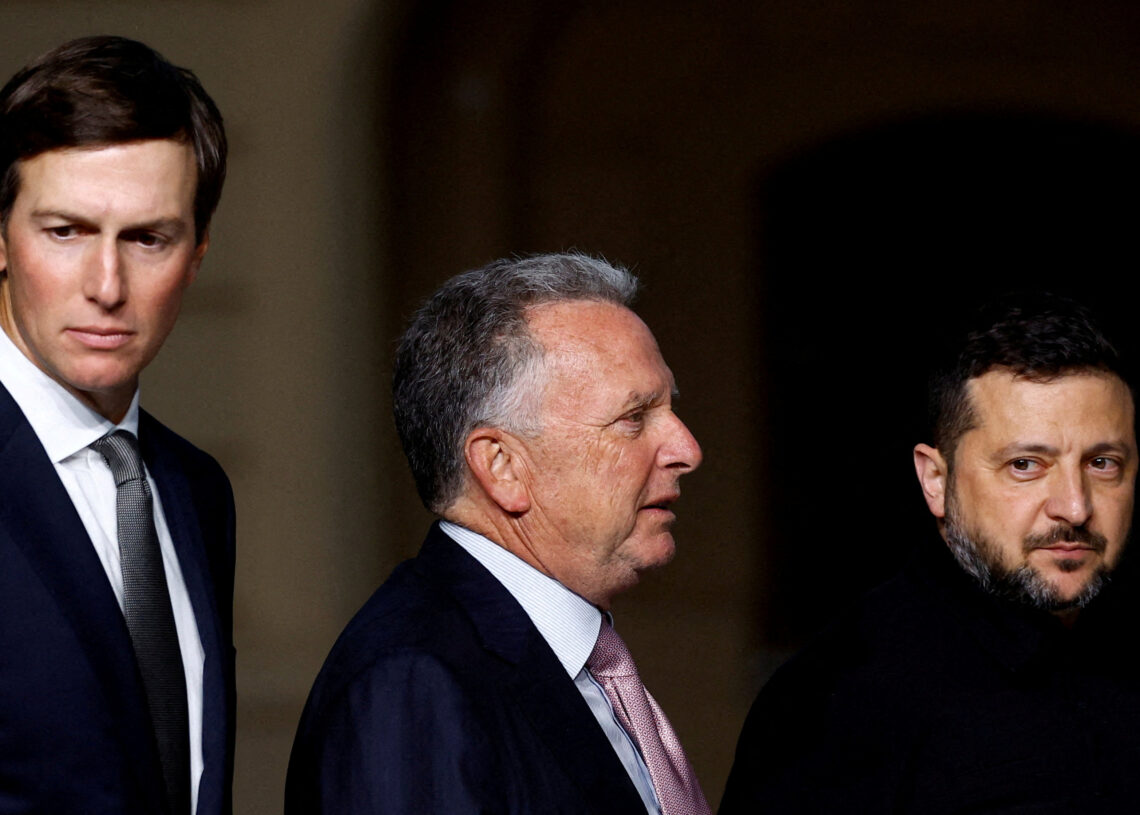
The diplomatic push came during a six-hour meeting last Friday in Florida hosted by U.S. envoys Jared Kushner and Steve Witkoff. The meeting, which included Ukrainian officials and representatives of Britain, France and Germany, was held at the Shell Bay Golf Club, a development owned by Witkoff in Hallandale Beach.
Trump wants Ukraine and Russia to stop bombing each other’s refineries as a condition for the U.S. peace initiative. That’s easy for Russia — Ukraine’s biggest refinery has already been battered by Russian attacks. But for Zelensky it would mean holstering one of his strongest weapons. “Clearly, the Ukrainians’ ability to strike refineries is having impact on Russia’s economy,” the European diplomat said. “It has increased Zelensky’s leverage.”
Kushner and Witkoff asked the Ukrainians to halt refinery attacks at Friday’s meeting and warned that Trump would do the diesel deal, according to the American official; the official said that U.S. negotiators had made the request a half-dozen times in recent months, as diesel oil prices spiked. What followed was predictable: Zelensky balked; Trump did the deal (with the nakedly political aim of lowering prices as the midterm elections approach); Zelensky derided Trump’s decision as “weak”; and Trump threatened to cut off intelligence support.
If Zelensky agrees to halt refinery attacks, “we’re back in, and we go to Moscow,” the American official told me. But what would Ukraine get — and give up — as part of the U.S.-European settlement that has been taking shape?
The package would have four basic components, according to the U.S. official. The message to Putin would be: Don’t just end the war with Ukraine. Make an economic and security deal with Europe that would restore stability to the region after an upward spiral of escalation.
Ukraine’s reconstruction would be the first pillar. The World Bank and the investment firm BlackRock want to create a framework for meeting Zelensky’s myriad cash needs — for rebuilding the devastated areas of the country, providing benefits for families of dead and wounded soldiers, and restoring a shattered economy.
Negotiators have asked Kyiv for detailed cost estimates — and assurances that this money wouldn’t be looted by postwar profiteers. So far, the Ukrainians haven’t provided numbers, but they’re expected to in the next few days unless the peace effort collapses.
Security guarantees would be the second essential component. Ukraine would get a pledge from the United States and European nations that they would respond militarily if Russia attacked again, which the U.S. official described as equivalent to NATO’s Article 5. The official said Russia would also negotiate agreements with Europe that would address its security concerns, though it’s not clear what this would involve.
A third pillar would be economic integration of Russia, Ukraine and Europe through an energy deal. One aspect might be a pipeline carrying Russian oil and gas to Europe, with Ukraine and Russia splitting the profits. Such a pipeline could sharply reduce European energy costs, the official said. In addition to providing Russia with “long-term access to the European energy market,” a peace deal would specify how and when existing economic sanctions would be removed.
The final piece of the deal would be the most unpalatable. Russia, which began the war hoping to conquer all of Ukraine, would agree to a ceasefire along the existing front line, or “line of control,” as negotiators describe it. For Ukraine, that would mean allowing Russia to control the territory it occupies — including the bitterly contested area known as Donbas. One hurdle is that the line of control is fuzzy, given small shifts in the front almost every day.
Though European leaders were angry about Trump’s diesel deal, they appear committed to continuing the diplomatic process led by Kushner and Witkoff. “It’s a moment to take heat out of the situation and get back to work,” explained the European diplomat.
The rationale for settling now is that this war has grown to become a nightmarish killing field. Russia has suffered more than 1.4 million dead and wounded. In August, Russia suffered 42,000 casualties, or about 1,400 per day, according to a British estimate. It’s a war of attrition, at enormous cost. This winter, it will become an economic slugfest as each side tries to ravage the other’s economy and increase the pain of civilians.
Trump has rightly tried to end the war ever since he took office. But he still seems unable to grasp that Putin, the aggressor, wants victory rather than a truce. “Putin doesn’t look like he’s serious about peace,” said the European diplomat, drawing on intelligence reports. In his sanctions-busting diesel deal, Trump is tragically making it easier for Putin to continue this terrible war.
The post ‘Make the problem and the solution bigger’: The plan to end the Ukraine war appeared first on Washington Post.