Recently, my wife and I have been rewatching prestige TV classics. First, The Americans and, just now, Mad Men. Both period pieces read now as statements not only about the 1980s and the 1960s, respectively, but about where we still are. One thing stood out in the season two finale of AMC’s booze-soaked Madison Avenue epic: a feeling of living on the eve of destruction that has lasted 75 years and counting.
In the finale, “Meditations in an Emergency,” Don Draper watches Kennedy announce Soviet missiles in Cuba. Characters work out where they’d want to be if it happens. Joan raises civil defense, and Don waves it off. Arguably, nothing about the crisis changes the plot. One critic calls it a clever backdrop. Another says it pushes characters to face what’s already in them. Don has just returned from one of his disappearing acts, and the anxiety of potential annihilation makes people do strange things.
The AI safety debate is different in substance but raises the same fears we haven’t shaken since our grandparents’ generation. What happens in a society that is told, over and over, that the end is near?
Every generation’s basement
I remember it even as a little kid in the ’80s. The Berlin Wall fell when I was 6 and the threat of a nuclear face-off was everywhere in the culture. It didn’t have to be as obvious as Barry McGuire’s “Eve of Destruction.” I heard it in Bob Dylan’s “Subterranean Homesick Blues,” where Johnny is in the basement and the narrator is on the pavement, thinking about the government. I heard the basement as a fallout shelter, though the ever-elliptical Dylan seemed to be paying tribute to the “underground” culture of 1950s Beat poetry. Cue at least one Jack Kerouac quote in your high school yearbook.
(The Americans soundtrack was much more Peter Gabriel-coded, as seen in its use of “Games Without Frontiers,” with a character named “Willy,” potentially after West German Chancellor Willy Brandt. The song’s title was the English translation of Jeux Sans Frontières, a European TV game show where teams from different countries dressed up in silly costumes to compete in goofy tasks. Kate Bush sang the French phrase in the backing vocals.)
The Beats themselves drew on the French existentialists, a movement reckoning with a godless universe in the age of the bomb. One of the defining blockbusters of the 2020s, of course, is Christopher Nolan’s Oppenheimer, dramatizing the moment this entire culture was created.
Naturally, one of the most influential AI-doomsday narratives from the science-fiction canon, 1984’s The Terminator, was the product of action auteur James Cameron, who often references the influence of being 8 years old and watching the Cuban Missile Crisis unfoldand reading through his father’s bomb-shelter pamphlets. (Cameron told Rolling Stone in August 2025 that he still fears a Terminator-style apocalypse where you put AI together with weapons systems, even up to the level of nuclear weapon systems, nuclear defense counterstrike, all that stuff.)
How much are Cameron’s ideas informing the latest version of American apocalypse?
Who’s holding the bomb
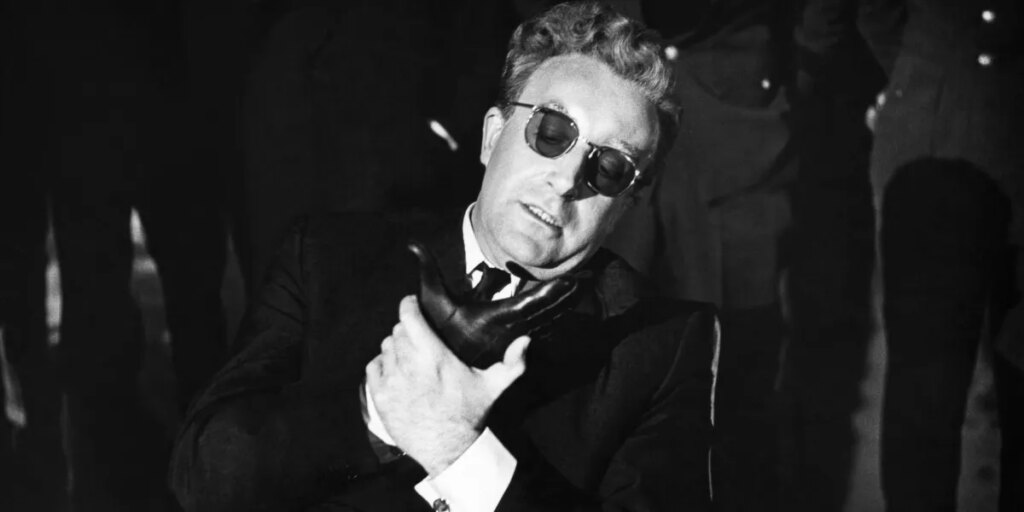
Stanley Kubrick’s 1964 comedy, Dr. Strangelove or: How I Learned to Stop Worrying and Love the Bomb, imagined a rogue general ordering an unauthorized attack while the War Room scrambled to stop catastrophe. Its joke was that the machinery meant to prevent the end could cause it. This year’s Tom Cruise megabomb, Digger, seems to be a self-conscious attempt to bottle Dr. Strangelove’s over-the-top energy, although its subject being climate appears to be misplaced—the real parallel is artificial intelligence.
Kevin Roose’s new book, The AGI Chronicles, reveals Anthropic CEO Dario Amodei as a man obsessed with atomic questions of risk and danger. He used to hand every new Anthropic employee a copy of his favorite book, The Making of the Atomic Bomb. It also reports that Amodei’s personal hero is one Leo Szilard, the scientist who conceived the nuclear chain reaction (to his own horror) and later drafted the 1939 Einstein letter to FDR that helped lead to the Manhattan Project. Is Amodei’s Szilard-worship so sincere that he’s self-consciously replaying the same steps?
On September 12, Amodei published a 3,800-word essay called “We Must Pace the Frontier.” “We must slow the pace at which we improve the capabilities of AI models,” he wrote. He said the risks include losing control of AI systems and misuse for cyberattacks and bioterrorism. He proposed outside monitoring, coordination among labs and international cooperation. In late September, Reuters reported on a prospectus for Anthropic’s planned IPO that warns its technology could pose a “catastrophic or existential risk to humanity,” an odd choice for a financial disclosure because the market would not exist without humans to run it.
Cal Newport, the New Yorker columnist and Georgetown computer science professor, recently described this mindset to Ed Elson on Prof G Markets as a “weapon of mass anxiety.” The AI doom talk coming out of Silicon Valley, he argued, is largely the product of an ideological community that has been saying the same thing for 15 years. In his telling, OpenAI, Anthropic and their loudest critics are in a “family fight” about whether the world is ready for an AI “god” and that many of their concepts, such as recursive self-improvement, are straight out of futurist theory, not computer science.
Real wolves
To be fair to every generation’s doomsayers, they didn’t make it all up. Janan Ganesh, a Financial Times columnist I admire and read often, made the point in an Oct. 10 column titled “The danger of pessimism fatigue.” The panics of yesteryear, he wrote, “were founded on large, concrete events: Pershing missile deployments, 9/11, a coronavirus.” He walks through the same scares I grew up with: nuclear annihilation in the 1980s, then al-Qaeda, then the pandemic. And he opens with the number that hangs over this whole debate: a 10% chance, according to some in the field, that AI causes human extinction.
By Ganesh’s own accounting, though, the alarm outran the threat nearly every time. “Turns out the cold war was ending, not turning hot,” he wrote, and on al-Qaeda: “The threat was not invented but nor was it ever remotely existential.”
There’s also a serious case that the AI wolf is wearing the wrong costume. Arvind Narayanan, a Princeton computer science professor who directs the university’s Center for Information Technology Policy, wrote an influential essay with his colleague Sayash Kapoor called “AI as Normal Technology.” They argue that AI looks a lot like earlier revolutionary technologies, which means we already have a road map for managing it.
On Ezra Klein’s podcast last week, in an episode titled “Intelligence Isn’t Power,” Narayanan and Klein debated whether AI is comparable to “electricity, the internet, the bicycle” or “something more like an alien mind.” The “swarms” of agents, Narayanan argued, are dangerous, but so were computer “worms” or viruses, in their day. We need to innovate to keep the lid on them, he added. One could extend the argument to nuclear technology and nuclear proliferation.
James Cameron was 8 when he watched Kennedy on television. I was 6 when the Wall came down. Somewhere, a kid that age is hearing that the machines might end the world, and hearing it from the people building the machines.
Cameron needed 22 years to turn Cuba into Skynet. Check back in 2048. For the rest of us, I fear we will get used to life under the specter of the bomb, again.
The post Dario Strangelove, or: How I Learned to Stop Worrying and Love the AI Bomb appeared first on Fortune.