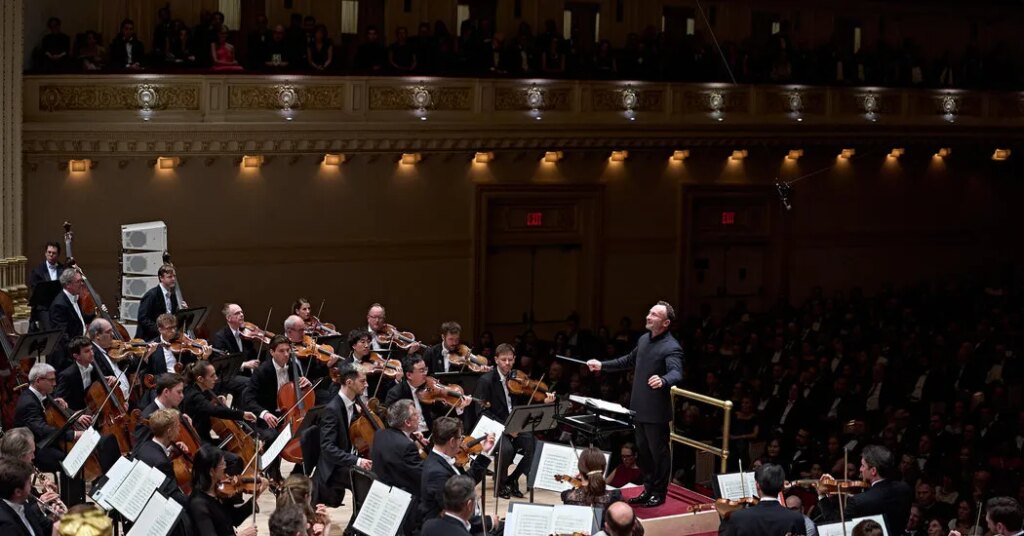
The Berlin Philharmonic opened Carnegie Hall’s season on Thursday night, and it did so with its typical gobsmacking brilliance.
There were three programs, all under chief conductor Kirill Petrenko: on Thursday, a gala of Italian music, with the tenor Jonas Kaufmann singing arias alongside Respighi’s “Fountains of Rome” and “Pines of Rome”; on Friday (and repeated on Sunday), a billing of German heavyweights with Brahms’s First Piano Concerto and Strauss’s “Also Sprach Zarathustra”; and, on Saturday, Elgar’s “Enigma Variations” as a preface to Tchaikovsky’s Fourth Symphony.
The last time the Philharmonic came to New York, in 2024, it came bearing the bad news of cuts in its subsidy from the city of Berlin. This time, it came with gladder tidings, including a recent announcement that the German federal government would not only increase its funding for culture in Berlin, but also provide 225 million euros (about $250 million) for a needed renovation of the Philharmonic’s concert hall. Reports suggest that the project could be arduous, with one study putting the cost at $900 million, with an additional $400 million to make Tempelhof Airport fit for concerts during the eight-year refurbishment.
Still, the Philharmonic’s players looked as though they were having fun over the weekend. The orchestra is a lot of things at once, but always striking is its visual contrast with the almost mechanical style of American ensembles. The Berliners perform more conspicuously as a collective of individuals than, say, the musicians of the Cleveland Orchestra, who are more of a singular corporate entity. But they pair off, form groups, notice one another, compare notes under their breath. If the timpanist Vincent Vogel has the same rhythm as the double basses far to his left, he will fix them with a stare; wind players turn to one another as they play, then break into a smile.
But your eyes, and the attention of the players, keeps being drawn back to Petrenko. Seven years into his tenure, it might not yet be clear what defines his leadership of the Philharmonic, except that he so patently has the trust of his players, and that he so palpably enjoys being himself. He isn’t interested in becoming a celebrity, and he gives no impression of being a visionary. He isn’t even trying to make a thing of not being a thing. The most enduring image he left in these concerts came during the gala: While Kaufmann was feasting on a long and sympathetic ovation, Petrenko stood next to him, quietly rearranging the scores on his music stand.
Nothing about Petrenko suggests anything except a focus on the music. He is a busy if not terribly stylish conductor. If he makes a movement, it is intended to do something specific. So responsive is the Philharmonic now that the tiniest adjustment in how his baton moves through the air changes the sound rushing past it, sending a shock through a section of the strings, or drawing one brass instrument out more than another. Chords begin exactly as his body would imply, and they end that way, too.
On Saturday, Petrenko made sure that the Tchaikovsky did not get too carried away. Yet you felt the desperate pain of a first movement that sometimes drew perilously close to inertia, as if it were curling into the fetal position and refusing to move, and you felt the deliverance of a manic, exhilarating finale. He treated the “Enigma Variations” as though it were Strauss, and if the outright virtuosity was tremendous in “Troyte” and the golden flow in “Nimrod” almost liquid, the characteristic Elgarian sense of certain things being left unsaid went, well, unsaid.
The actual Strauss on Friday’s program was ideally effective, each section of the piece poetically filling out its own character but contributing to the whole. Brahms’s concerto, with Vikingur Olafsson as the soloist, was sensible and interesting, like everything Olafsson does. If some of it was rather severe and square in its phrasing, the slow movement was a marvel of delicate touch. The Respighi pieces on Thursday had about as much depth as anybody could find in them; Kaufmann was in unfortunate form.
All in all, then, this was another sensational display of orchestral mastery. But did anybody really need such a plain reminder of how good the Berlin Philharmonic is? Is the usual Brahms, the usual Strauss, the usual Tchaikovsky, plus the usual Elgar and the usual Respighi, really the best that we can do when the Philharmonic comes to town, drawing sellout crowds whatever the ticket prices, whatever the repertoire?
Scroll through Carnegie’s archive, and you will find that this was the 25th time that the Philharmonic has toured to the hall. On its first visit, in 1955, it was met with protests outside the hall and a trio of pigeons flying inside; the orchestra played three programs, and they contained, among other things, a Strauss tone poem, a Tchaikovsky symphony and some Brahms. The Philharmonic has performed Brahms on another 11 visits since.
Obviously, the Berlin Philharmonic should perform Strauss and Brahms; the orchestra should be savored on its own terms. But one of the many oddities about the classical music industry is that the negotiations and the practicalities involved in touring tend to lead to programs that present an orchestra at its least creative, not at its most ambitious.
If we are going to burn all that jet fuel, could we hear the Philharmonic as Berliners do? Where on this visit, for example, was the orchestra that recently came out with an amazing series of Schoenberg recordings, the one that in a few months will release a survey of Josef Suk? The one that places Brahms in dialogue with Scriabin, or with Pascal Dusapin and Bernd Alois Zimmermann; that puts Bruckner in the context of Wolfgang Rihm? The one that holds a biennale?
The Philharmonic, in other words, as it actually is?
The post The Berlin Philharmonic Is Brilliant. It Could Be Even Better. appeared first on New York Times.