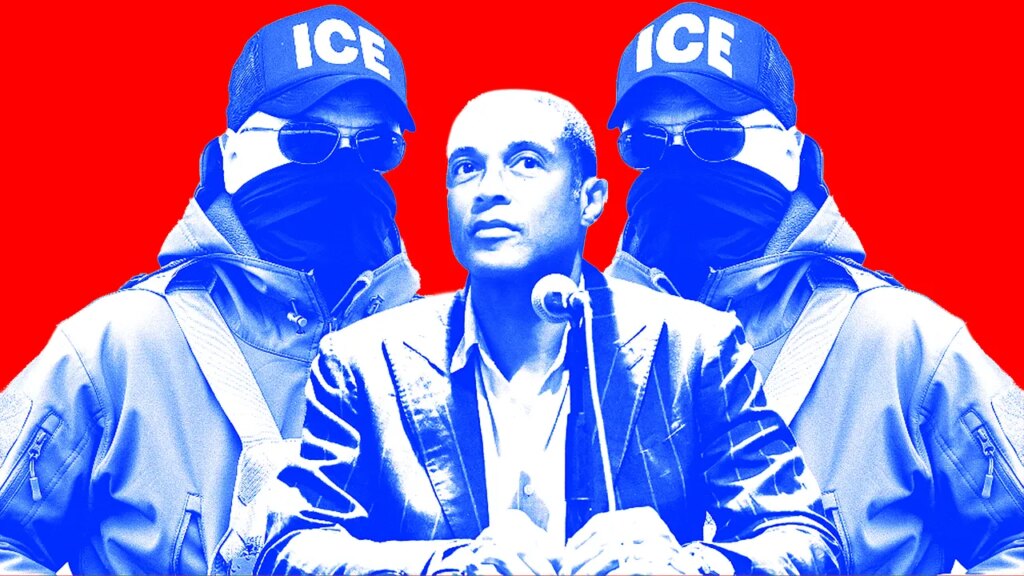
US law enforcement agents obtained authorization to use a controversial surveillance device capable of intercepting cell phone signals to find and arrest a 21-year-old college student who helped produce journalist Don Lemon’s coverage of an anti-ICE protest, court filings show.
The former student, Jerome Richardson, who has since graduated from Temple University, is among 39 people charged with conspiring to violate worshippers’ civil rights and interfering with religious worship at Cities Church in St. Paul, Minnesota, in January. Protesters said they targeted the church’s January 18 service because one of its pastors, David Easterwood, also led ICE’s St. Paul field office. Those charged include journalists Georgia Fort and Lemon, a former CNN host, who say they were there to cover the demonstration.
Twelve days after the protest, judges in two states began signing warrants authorizing agents to use so-called cell-site simulators, commonly known as Stingrays or IMSI catchers, to target Richardson’s phone: one in Minnesota on January 30 and another in Pennsylvania the next day. The purpose, his lawyers wrote in a motion seeking to exclude the tracking evidence, was “locating and arresting him.”
Agents also applied for cell-site simulator warrants targeting the phones of Fort and Jamael Lundy, then a Minnesota State Senate candidate. They separately sought pen register orders, which can log the numbers a phone contacts, for Fort and a number WIRED traced to Lemon. It’s unclear whether a judge approved any of those applications.
The records reviewed by WIRED do not establish whether investigators actually deployed a cell-site simulator to locate Richardson or whether judges approved the applications targeting Fort and Lundy. In a July letter filed in court, Fort’s lawyers said prosecutors “did not know” whether the surveillance applications had been authorized or had yielded evidence.
Cell-site simulators impersonate cell phone towers to locate a target’s phone. In doing so, they can also collect identifying information from any nearby cellular device, including those belonging to people who aren’t suspected of a crime. That indiscriminate collection has made the devices controversial among privacy advocates, who describe them as dragnet surveillance tools.
The use of cell-site simulators has long been shrouded in secrecy. FBI records released in 2023 showed that police borrowing its simulators had to agree to keep details of their use secret, even in court. Privacy advocates have long warned that the devices could be turned against protesters and journalists.
“Using an advanced surveillance capability such as a cell-site simulator against members of the free press for reporting stories that are unfavorable to the president is an appalling attack on the First Amendment,” says Cooper Quintin, senior staff technologist at the Electronic Frontier Foundation, a tech-focused civil liberties nonprofit. Quintin has spent years researching the devices and developing tools to help people detect them. Using EFF’s detection software, WIRED found evidence suggesting a cell-site simulator was deployed near the 2024 Democratic National Convention in Chicago, though who operated it and for what purpose remain unknown.
Attorneys for Lemon, Lundy, and Fort did not respond to requests for comment. Richardson’s attorneys declined to comment on the record.
The previously unreported warrants are a product of a campaign of contentious investigative tactics waged by federal agents in pursuit of people connected to the protest at Cities Church. According to court records, the Department of Homeland Security demanded journalists’ telephone and YouTube records under a customs authority that requires no prior judicial approval. Agents also sought records identifying everyone who had purchased a particular beanie at REI in the Minneapolis–St. Paul area over a period of more than two years. Defense attorneys have identified 92 customs summonses and are challenging the government’s authority to issue them.
The cell-site simulator warrants raise serious questions about both the accuracy of the information investigators presented to judges in their effort to obtain authorization for surveillance tool’s use, as well as why they sought such intrusive tracking to find Richardson in the first place.
The affidavits supporting the applications to track Richardson claimed video showed Fort, Lemon, Richardson, and others “chanting with agitators.” Prosecutors have since conceded that Lemon and Fort did not chant. According to her lawyers, the government acknowledged that the false claim appeared in at least 15 warrant affidavits.
DHS policy says cell-site simulators are deployed only “in the fraction of cases in which the capability is best suited to achieve specific public safety objectives,” but it’s unclear what specific public safety reason justified its use in this case. Investigators obtained a second simulator warrant to locate Richardson, then a senior at Temple University, two days before he walked up to a federal courthouse in Philadelphia and voluntarily surrendered. He was released on bond that afternoon.
The Justice Department responded to WIRED’s request for comment by writing in an email that the department “speaks through its court filings.” DHS declined to discuss ongoing investigations or investigative methods and referred questions to the US Attorney’s Office for the District of Minnesota, which did not respond to a request for comment.
The warrant was signed January 31, the same day Richardson posted a YouTube video saying he expected to enter federal custody “in the coming days,” suggesting he had no intention of fleeing. It is unclear whether the warrant preceded the video, leaving questions about why investigators sought such an intrusive tool to find someone who was publicly anticipating his arrest and whom prosecutors agreed to release the day he surrendered.
While Richardson’s suppression motion asks to suppress evidence obtained from the phone tracking, it does not specify whether agents used a simulator or obtained evidence through either.
A former federal prosecutor who spent a decade working on counterterrorism cases says using a simulator to locate someone is not necessarily unusual. But based on the court records they reviewed about Richardson’s case, they called the government’s tactics aggressive: “I don’t understand why it would be at all necessary.” They spoke on condition of anonymity because they were not authorized to speak on the record
Richardson, a St. Paul native, had led an NAACP chapter at 16 and served as executive director of Minnesota Teen Activists, according to his fundraiser’s organizer. He described his work for Lemon as handling logistics and connecting him with local contacts. He drove the journalist to Cities Church, where Lemon livestreamed the demonstration and interviewed protesters and churchgoers. Prosecutors allege Richardson joined chants and obstructed congregants.
In his video, Richardson defended his role. “I was proud to support his work,” he said of Lemon. “This is the price of being unapologetic about humanity and love of Christ.”
The government’s initial effort to obtain arrest warrants met resistance from judges. A magistrate judge refused five of eight warrants, and after an appeals court rejected the Justice Department’s bid to override that decision, the department withdrew its request. In a filing with the appeals court, the chief judge wrote that two of the five “were not protestors at all; instead, they were a journalist and his producer” and that there was “no evidence that those two engaged in any criminal behavior.” Prosecutors later secured a grand jury indictment on January 29.
The way the government chose to arrest some defendants has also drawn objections from defense lawyers. Lemon’s attorneys say in court filings that prosecutors rejected their offer to arrange his surrender; agents instead arrested him shortly before midnight at a Beverly Hills hotel while he was covering the Grammy Awards. Fort’s lawyers say agents arrested her at home rather than allowing her to turn herself in.
The post Feds Got Warrants to Use Fake Cell Towers to Hunt Down Don Lemon’s Producer appeared first on Wired.