Handmade quilts have often been seen primarily as heirlooms, but a new exhibition celebrating African American quiltmaking shows how the textiles can also be potent expressions of cultural heritage and even memorials to elders.
“For my mother, she had to make quilts to keep us warm, but I get to make it as an art quilt, to tell a story,” says Ora Clay, an Oakland, California-based artist featured in “Routed West: Twentieth-Century African American Quilts in California” at the National Museum of Women in the Arts.
Encompassing nearly 80 works by more than 70 artists and spanning 120 years, “Routed West” explores how intergenerational ties have kept African American quiltmaking alive, even as it has largely evolved from a practical skill to a tradition carried on for cultural and artistic purposes.
“What I think is important for people to know is that quilts always can be functional and beautiful objects at the same time, things that one can look at,” says curator Elaine Y. Yau of the Berkeley Art Museum and Pacific Film Archive, where the exhibition was first displayed last year.
“Routed West” examines quiltmaking in the context of the Second Great Migration, when nearly 5 million African Americans left the South between 1940 and 1970 seeking better-paying jobs and increased social equality. Many headed to the San Francisco area during the shipbuilding boom that began in World War II.
The exhibition draws from a bequest to the Berkeley museum from Eli Leon, who amassed a 3,000-strong collection of African American quilts, with an emphasis on improvisational abstraction. Leon’s collection is complemented by work from contemporary Bay Area artists, including Clay, who are taking quiltmaking in more representational and figurative directions.
Unlike the quilts of Gee’s Bend — an African American community in Alabama that has been acclaimed for its quiltwork for many years — those displayed in “Routed West” tell a different story, one of maintaining the practice over great distances and time amid the trajectories of migration. A map shows the quiltmakers’ Southern birthplaces and where they ended up in the West.
The exhibition features a number of patchwork quilts made in the South in the first half of the 20th century, including at least one sewn by a woman born into slavery, an untitled leaf appliqué by Hattie Mitchell. Many were later carried West by family members and cherished as reminders of home.
These early examples vary widely in style, design and materials. Some employ well-known patterns, such as Anna Nicholson’s intricate folded “log cabin” quilt, while others appear more spontaneous and improvised, including one by Susan Pless of geometric blocks in an array of sizes and colors.
Quiltmakers repurposed whatever they had on hand, as seen in Minnie Skinner’s cozy all-denim patchwork and a puff quilt in which Annie Crawford fashioned 540 Durham tobacco pouches into a checkered pattern. Replicas of sections of Crawford’s quilts and others allow visitors to feel different fabric textures and see how they were stitched together.
Pieces created in California in the ensuing decades reflect their makers’ distinct aesthetics and interests. Gerstine Scott’s assemblage of colorfully patterned neckties feels almost luxurious, while a gorgeous quilt by Rosie Lee Tompkins mixes denim triangles and swatches of floral patterns; her accompanying pillows also use fur. Lily Chiles incorporates repeating cutouts of Africa in the red, green and black colors of the Pan-African flag.
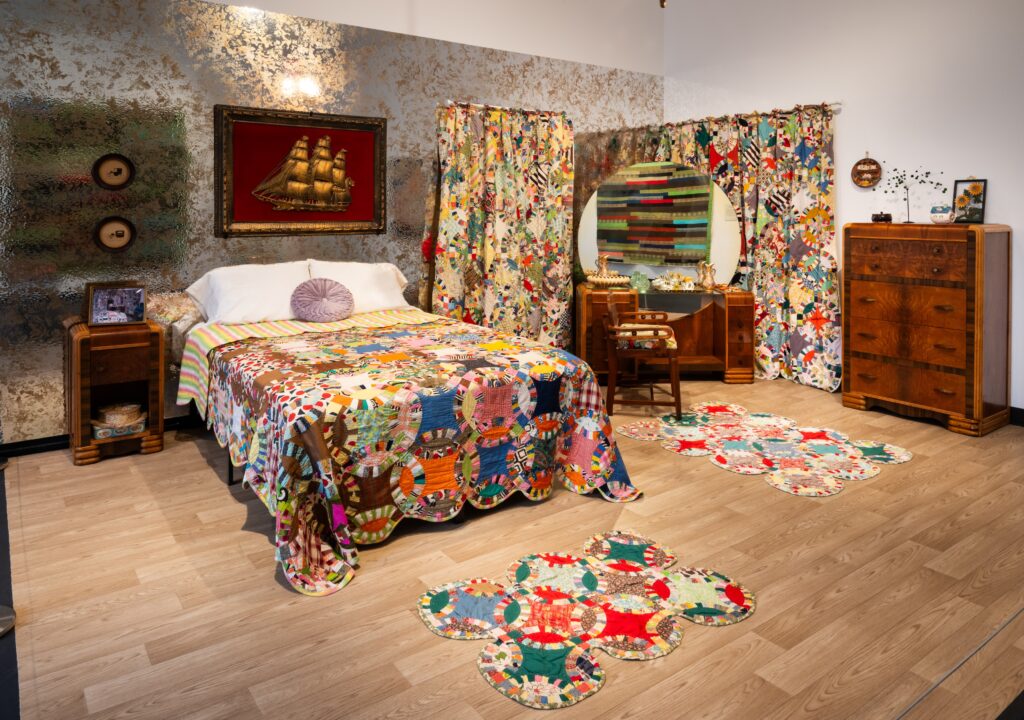
One installation re-creates the vibrant bedroom of Isiadore Whitehead, a shipyard welder who later became a school bus driver, in Oakland circa 1970. The intimate space is decorated with a bedspread, drapes, a chair cushion and floor mats, all quilted by Whitehead in a colorful “double wedding ring” pattern.
“Routed West” highlights several lineages of quiltmakers, including four generations of a seven-generation quilting family. On view are a small heart-shaped rug crocheted by Gladys C. Durham-Henry (1906-1996); an abstract quilt by her daughter Laverne Brackens, born in 1927 and still sewing; and granddaughter Sherry Ann Byrd’s “Cultural Merger at Crossroads, USA,” a striking composition of Marimekko fabrics in bold red, oranges, blue and black. Great-granddaughter Bara Byrd-Stewart contributed an untitled quilt she made at age 12.
Although the quilts from Leon’s collection are almost all nonrepresentational, one that Alice Neal created in the 1950s is a moving portrait of her late mother, Mary Bright. It combines an embroidered depiction of Bright, leftover fabric, and lace and buttons from the dress she wore in the photo on which it was based, as well as quilted symbols meaningful to Bright.
Neal’s tribute to her mother is powerfully paralleled in several works by contemporary artists that honor forebears and family history. Oakland-based Anita Carse’s stunning mixed-media textile collage, “Invisible Migration #3, Anaconda 1910,” reproduces a photo of her maternal grandmother taken in 1910 in Montana — where the family had moved for employment — next to a map of the state, along with cowrie shells, connecting threads and painted swaths of fabric.
“I thought about what it must have been like to bear 13 children, and lose three children in infancy, and carry on,” Carse says. “I used cowrie shells to symbolize her resourcefulness, her creativity and her connection to her family.”
Clay’s quilt “My Migration” represents her own solo journey from Alabama to California in 1962 as a teenager in pursuit of an education. She appliquéd maps of both states, along with photographic images, including a black-and-white one of her mother, onto one of her mother’s quilts — itself a patchwork of older dresses and shirts that was among the possessions Clay took on her move out West.
“Quilts were for beds. That was our only definition of a quilt,” she says. But unlike her mother, who made quilts out of necessity, for Clay quiltmaking is an opportunity to record the past for future generations.
“If we don’t tell our story, how can we expect someone else to tell it? Nobody else can tell this story except me.”
Routed West: Twentieth-Century African American Quilts in California Through Jan. 17 at the National Museum of Women in the Arts, 1250 New York Ave. NW. nmwa.org.
The post These African American quilts did more than keep people warm. They told stories. appeared first on Washington Post.