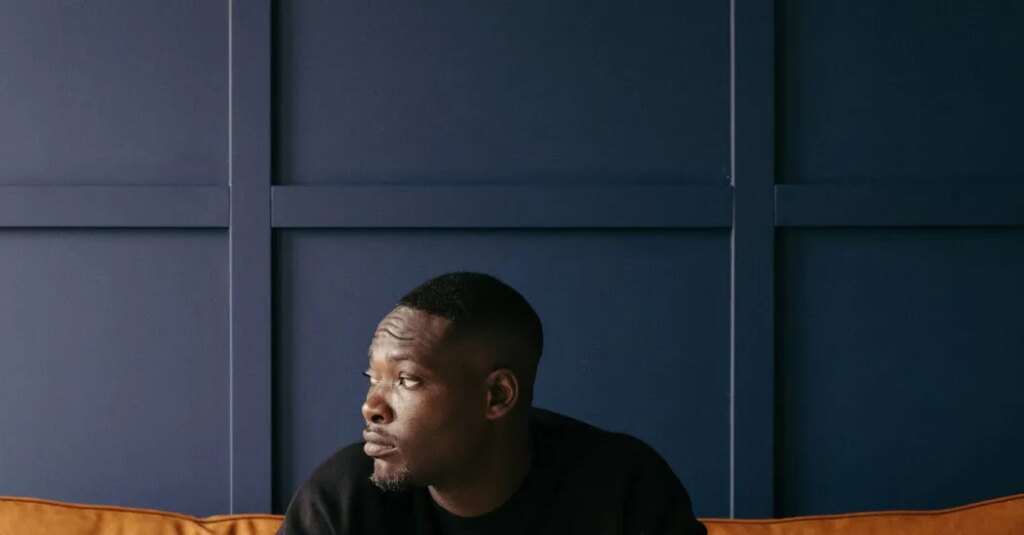
When Kier Gaines has speaking engagements at colleges, he sometimes tells the students: Raise your hand if you would ever look at me and guess I’m a therapist.
He has yet to see a hand.
“We have a narrow idea of what healing, wellness and clinical practice look like in this country,” Mr. Gaines writes in his new book “It All Starts When You Do: How to Do the Real Work of Self-Healing.” And it’s not, he says, “a middle-aged Black man who was probably listening to trap music before you walked through the door.”
Mr. Gaines, a licensed professional counselor from Washington, D.C., with a prominent presence on social media, enjoys cursing, both online and sometimes dropping a “damn” in session. He’s been known to conduct therapy in a sweatshirt that paraphrases the rapper Jay-Z: “I’ve Got 99 Problems … ”
Yet one of his core messages is that being vulnerable is healing. (The sweatshirt’s tagline: “But I Know I Can Call 988 If I Feel Overwhelmed.”)
As both a public figure and a therapist working in a private practice, Mr. Gaines is something of an anomaly. Black male therapists are a rarity in the field, accounting for less than 1 percent of the psychology work force, according to the American Psychological Association.
He is also a suburban dad who films video clips in his kitchen while he clears away the breakfast dishes. His straightforward advice and notable candor about his own challenges with relationships, self-esteem and mental health have helped him rack up 2.5 million followers across social media.
Mr. Gaines met me on the doorstep of his house outside Washington on a sweltering day in late summer. His home was strewed with the colorful detritus of family life: backpacks, water bottles, books. He explained that his wife, Noémie Gaines, a lawyer who now manages the growing family business, had just left with their daughters.
We dove right into a wide-ranging conversation about his how his life experiences have informed his book’s message: that knowing yourself better can lead to happiness, peace and connection with others. Mr. Gaines encourages readers to face and examine the uncomfortable truths about themselves that they may have spent a lifetime avoiding.
“Ignoring your feelings doesn’t make them go away,” he told me. “It makes them unfamiliar to you.”
‘Socialized to be Strong’
In addition to his reach on social media, Mr. Gaines, 40, has collaborated with the surgeon general’s office, NASA and John Gottman, the renowned psychologist and co-founder of the Gottman Institute. He has a popular podcast for men called “Learned the Hard Way”; and his first book, released last month, quickly became a best-seller.
Many of the online commenters on Mr. Gaines’s posts are men who share their worries in the space he has created. Taylen Williams, 22, a student from New Jersey who has been following Mr. Gaines for two years, said that he appreciated Mr. Gaines’s transparency.
“As a young Black man, sometimes you don’t know how to express how you feel, and especially how to sit with those feelings,” Mr. Williams said. “And he shows you by example.”
Samuel T. Beasley, an associate professor of counseling psychology at the University of Louisville, said that following a therapist online should not be a substitute for clinical therapy, but that it could be helpful for people who experienced barriers such as cost and access.
“They may watch some of Mr. Gaines’s videos and say, ‘Oh, actually that resonates with me,’” he said.
Dr. Beasley studies the obstacles that men of color may face to entering the therapeutic world. His research has found that men view psychology — “particularly the helping side,” such as counseling — as a job for women, he said.
“And psychology, just broadly, has not always focused on issues that impact Black people,” such as the effects of racism and unequal access to health care, Dr. Beasley added.
Acknowledging mental health struggles can be seen as weak, said Derrick Gordon, a professor of psychiatry at Yale School of Medicine and the director of its Research, Policy and Program on Male Development initiative. Black men in particular “are socialized to be strong, like, ‘I should be able to manage this by myself,’” he said.
Mr. Gaines witnessed this sort of stoicism growing up. “And it wasn’t helping my family,” he said. “It was hurting us.”
As a result, one of his missions, which connects to the themes in the book, is to “live my life in the open,” he said.
‘My Depression Is Kicking My Ass’
Mr. Gaines grew up in Southeast Washington and was raised by a single mom. He described his mother, Sheila, as an “artistic hippie flower child who was ahead of her time in terms of just being a listening, validating, hugging, kissing, loving parent.”
When Mr. Gaines was 18, she died after a brief illness. An only child, he was suddenly on his own. He was so steeped in grief that he still can’t remember much about that time.
He worked as a manager at a community-based job training program to pay his rent and college tuition at the University of the District of Columbia. In 2015, when he was working with special education children at a Washington public school, he met a few therapists who treated the students.
“They were wonderful, and looked and sounded like me,” Mr. Gaines said. He decided to apply to grad school to become a therapist himself.
In 2020, after he had become a therapist, he began posting candid videos about mental health on social media, often filming at his kitchen counter or during a walk with his daughters, Emery and Sydney.
While Mr. Gaines shared many aspects of his life online, he initially held back from revealing publicly that, five years ago, he had been diagnosed with clinical depression.
But last year, he was asked to speak at the Black Health Connect conference in Washington.
“Kier said to me, ‘I’m supposed to do this keynote to encourage people to live their best lives, and my depression is kicking my ass right now,’” his wife, Noémie, told me later on the phone.
After Mr. Gaines spoke up about his depression during his speech, he said that dozens of people rushed the stage to share their own experiences.
Mr. Williams, the student, said that he trusted Mr. Gaines even more after hearing him talk about his depression on a podcast episode.
“The fact that an established therapist was vulnerable enough to express that to us?” Mr. Williams said, “That’s strength.”
The post Kier Gaines Isn’t Your Textbook Therapist. He Likes It That Way. appeared first on New York Times.