Perched at the front line of California’s fight against wildfires is a 41-year-old named Colby Nicholson and three other roaming MacGyvers in “Alert California” work shirts.
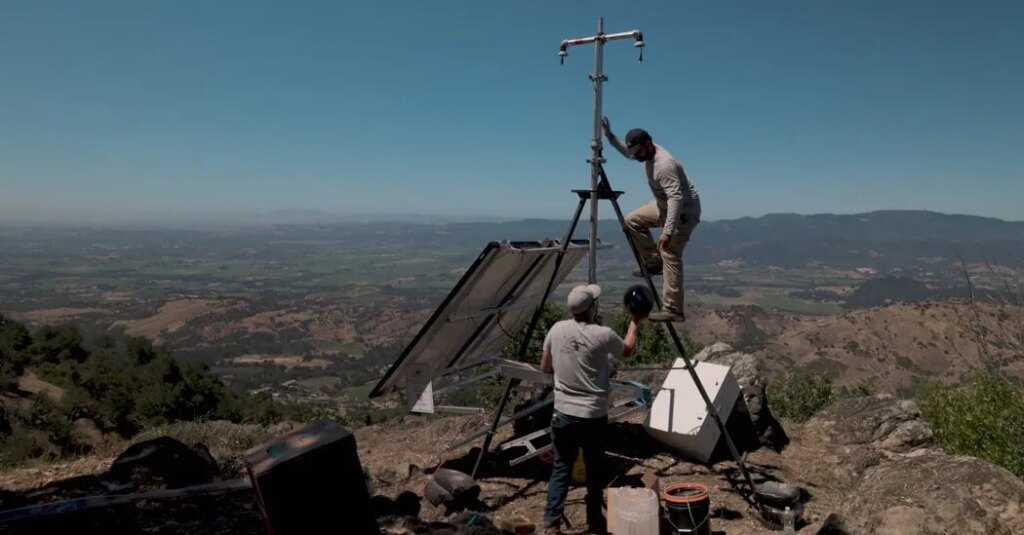
On this warm June morning, they were on a cliff 1,500 feet above the vineyards and small towns of Napa Valley. Several major fires had ripped through this area in the past decade.
Mr. Nicholson and the others peered past the toes of their boots. They pointed toward a winding, dead-end road connecting houses and steep driveways in a scrubby, miles-long chasm called Soda Canyon.
That was the blind spot that local fire officials wanted to see.
“Let’s put it here,” Mr. Nicholson said.
By day’s end, there was a 12-foot tripod holding two cameras inside protective globes, powered by solar panels and battery packs. The cameras were connected by satellite Wi-Fi and joined a growing network of nearly 1,300 remote, unblinking eyes on the most fire-prone landscapes of California.
These are the fire spotters of today — remote, high-tech cameras attached to communication towers, old lookouts or purpose-built tripods on high vantage points. Alert California’s viewpoints have become a vital tool for firefighters and a ubiquitous presence in emergency coverage. Mr. Nicholson and his crew are the ones who put cameras in place and keep them running, so that everyone else can see.
Wide-view surveillance cameras, from highway traffic cams to ski-area webcams, are not new; Alert California’s origins go back 25 years. But now, injected with the latest technology and placed in our most remote locations, these systems are increasingly the clearest eyes on today’s worsening disasters.
Since 2023, artificial intelligence has instantly scoured Alert California camera footage, spotting wildfires before a 911 call is received in most cases. Officials then use the camera feeds to monitor the fires, coordinating teams at the scene. Real-time views are available to anyone on the Alert California website, and screen grabs and time-lapse footage help fuel fire incident pages and popular apps like Watch Duty.
“This system has changed the world of response,” J.C. Greenberg, deputy chief of Napa County Fire Department, said as he watched the Soda Canyon installation. “We have instant visibility and instant information that we need to make response decisions.”
Some fires grow quickly out of control no matter how soon they are spotted. That was evident in some of the state’s biggest fires, like the Eaton and Palisades fires of 2025, fueled by exceedingly dry terrain and high winds. Alert California cameras on rooftops in Los Angeles captured the Palisades blaze, but that wasn’t enough to prevent the tragedy.
But for those whose careers and lives depend on what the cameras display on screens across the state, Mr. Nicholson’s crew delivers the view from the other end of the lens — the dirty job of providing high-tech, real-time, open-source wildfire surveillance from places humans rarely venture.
They drive tens of thousands of miles around the state each year in a Ford F-150 pickup and a van. They install and maintain camera systems on public and private land, in places like rock ledges, 300-foot mobile phone towers, water towers and rooftops.
“Most trips end up with someone bleeding,” Mr. Nicholson said. He shrugged and smiled, his usual disposition.
Mr. Nicholson has been doing this for 12 years. His role as senior engineering supervisor is to set up all the IT components of the systems in the field while maintaining a contagious can-do vibe for his crew.
These days it includes John Connolly, a talkative 30-year-old ex-Marine who does most of the tallest tower climbs; Jim Conley, a burly 63-year-old who surfs, rides motocross bikes and acts like a construction foreman; and Kai Erwin, 30, the quiet, self-described “gofer” of the group.
Their boss, Neal Driscoll, is principal investigator at Alert California and a University of California, San Diego, professor. He has a woolly mustache and looks a bit like the actor Nick Offerman in “Parks and Recreation.”
“I hire for attitude,” Dr. Driscoll said. “I want people who don’t give up, who exploit other people’s strengths and not their weaknesses and who like a cold beer at the end of the day.”
Spotting a Fire in Its Infancy
Alert California is based at U.C. San Diego and the field team works out of a nondescript building within steps of the Pacific Ocean. Mr. Nicholson pointed to the beach where he surfs.
“That’s why I love this job,” he said. “Not only do I get to travel and help people, but I have an office here.”
He and Mr. Connolly stood in a storage room lined with Costco-like shelves filled with equipment — surveillance cameras, solar panels, satellite dishes, 80-pound batteries, modems, plus wiring and cables, nuts and bolts, wrenches and clamps, sledges and shovels, and anything else that might prove useful in attaching heavy equipment to structures in the wild.
Summer is especially busy. The crew may install cameras at a dozen sites during a two-week trip, come home to repack, then do it again. Along the way, they repair cameras that have gone dark because of dead batteries, rodent-chewed cables, lightning strikes, last winter’s blizzards or the latest wildfire.
Some of the most captivating footage comes when fire engulfs the cameras. Other popular images show nesting California condors.
The network of remote sensors that eventually grew into Alert California began in 2001 to detect and communicate seismic activity around San Diego. When the 2003 Cedar fire near San Diego burned more than a quarter-million acres and killed 15 people, it was clear cameras would be useful. A local utility asked to have more than two dozen installed.
State officials, utilities and fire departments were convinced that investing in more cameras was a smart move, and linking them into one open-source, nonprofit system made the most sense. Alert California’s budget can approach $14 million per year, Dr. Driscoll said, funded mostly by Cal Fire, the state’s firefighting agency, and large utility companies.
Fire officials cite examples of little-known fires that were snuffed out quickly thanks to early detection.
“The greatest success stories are the fires you’ve never heard about,” said Falko Kuester, co-director of Alert California and an engineering professor at U.C. San Diego.
Spotting a blaze in its infancy allows officials in command centers to determine whether the smoke is truly a wildfire, and not from a rancher burning debris or fog rolling through a valley. They can decide how many firefighters to send, whether to strike by air or let the fire burn while being monitored.
Dr. Driscoll pointed to October 2017, when fires in Napa and Sonoma Counties were the most destructive in state history at the time — since overtaken by several other fires — and killed dozens of people. Two years later, new cameras in parts of the same region helped lead to quick detection and remote management of the huge Kincade fire. There was less destruction and no fatalities.
Dr. Driscoll wants to grow the network to 1,800 cameras and fill gaps in coverage. Local and regional fire officials have worrisome spots, like Soda Canyon. More and more, people request cameras on their property.
Each installation involves two cameras, in case one of them fails. They have different strengths — to see long distances, to capture crisp images at night, to see through thick smoke.
One camera is set up to spin 360 degrees every 2 minutes, capturing six frames per rotation. The other can be controlled remotely by fire officials who want to aim certain directions or zoom in tight on specific spots.
Artificial intelligence, introduced to the system in 2023, is a growing part of surveillance. Dr. Driscoll said this summer that 51 percent of California wildfires are first spotted through A.I. and the ratio is growing quickly.
“We are the science of risk reduction,” Driscoll said. “I love that phrase.”
A Well-Rehearsed Choreography
The field team woke up at a Holiday Inn in Visalia. It had installed cameras that week on a mountaintop fire station, on a cellular tower and on an old lookout at nearly 7,000 feet.
Lightning and high winds are persistent worries on installation days. Simply reaching the site can be the scariest part. There are stories of trucks stuck on precarious dirt roads and tires hanging off cliff edges. Long hikes to the sites are not an option. The heavy equipment can’t be carried far.
On this day, the road to the work site got higher, narrower, windier and dustier before ending atop Shadequarter Mountain. The four-story tower, sheathed in peeling sheet metal, was built in 1964 and abandoned in the late 1980s because of budget cuts.
It stood 4,000 feet above Visalia and California’s vast Central Valley. There were mountains in every other direction. The view was pocked with black splotches and burned-out trees, where the 2015 Rough fire, the 2021 KNP Complex fire and the 2024 Coffee Pot fire combined to burn about a quarter-million acres.
If only the system had been in place back then, maybe the response might have been different. Faster.
In a sunny spot at Shadequarter, the crew, with the silent choreography of a blue-collar dance troupe, built the tripod — a retrofitted, off-the-shelf deer stand — and anchored the legs with 60-pound bags of Quikrete. Digging holes can violate regulations regarding historic and Indigenous locations.
They attached an array of solar panels. They bolted on a large metal cabinet to house electronics, including two 80-pound lithium batteries. A StarLink satellite receiver was fixed atop the apparatus.
A fire official mentioned that a rancher sometimes ran cattle atop Shadequarter. The crew discussed whether cows would use the setup as a scratching post.
“I don’t think they’ll tip it over, but they might break a solar panel,” Mr. Nicholson said. “Cows are heavy.”
It was decided: Local officials would build a short chain-link fence the next day.
The crew ran wires through the cow-proof conduit about 30 feet to the tower. Mr. Connolly scaled the outside to string wiring to the top. Others, climbing interior stairs splotched in rodent feces, attached each camera to its own pole in front of now-broken windows.
Back on the ground, Mr. Nicholson sat at the tripod, holding a laptop. He could see the view from the cameras. He could move them, zoom them, spin them — just as remote fire officials would be able to do. He spotted smudges on the cameras and sent someone to clean them.
With a series of commands and passwords, the cameras were connected to the system. Suddenly, anyone in the world could see the view from the top of the fire tower.
The field team snaked downhill in a cloud of dust. Mr. Nicholson and the others didn’t know where they were headed because the schedule was in flux. They didn’t have a hotel for the night and they didn’t have dinner plans.
But they could use a cold beer.
The post The Wildfire Hunters Putting Eyes in the Sky appeared first on New York Times.