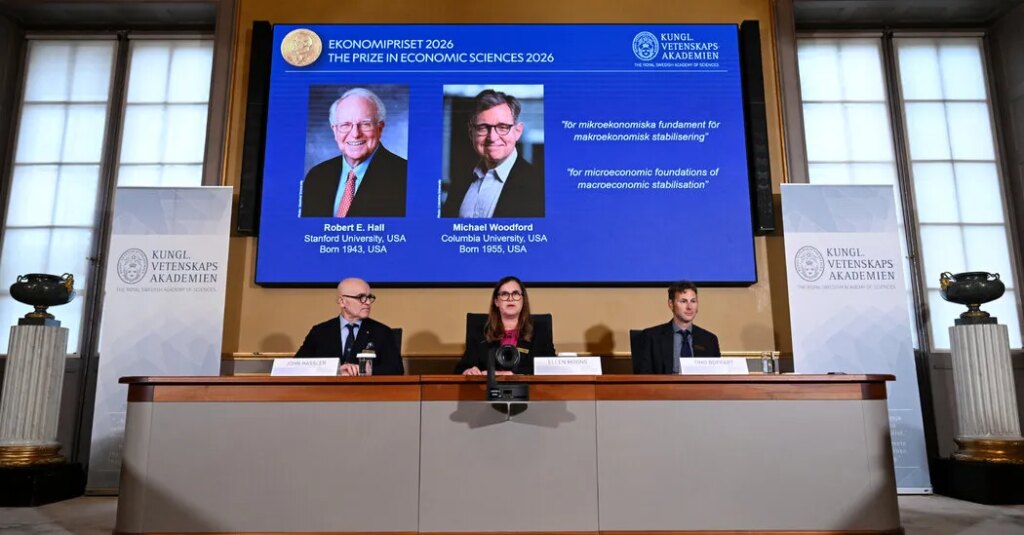
The Nobel Memorial Prize in Economic Sciences was awarded on Monday to Robert E. Hall and Michael Woodford, two American professors, for their research that helped to guide policies aimed at reducing economic volatility.
Who are the winners?
Mr. Hall is a professor at Stanford University and Mr. Woodford is a professor of political economy at Columbia University. They were awarded the prize for “for microeconomic foundations of macroeconomic stabilization,” the awarding committee said.
Mr. Hall studied demand to develop his models, while Mr. Woodford studied the supply side of the economy, looking at the price-setting behavior companies.
They will receive 12 million Swedish kronor, about $1.2 million, which will be split equally between them.
Mr. Woodford said on the phone at the news conference announcing the award that he was elated. “It’s a tremendous honor,” he said. “It’s a surprise but I feel very good about it.”
Why did the committee say they received the prize?
The Royal Swedish Academy of Sciences said they received this award because their work leads to fiscal and monetary policy measures, by governments and central banks, to help reduce volatility in economies, so there are fewer peaks and troughs.
Their work means “we are better equipped to deal with shocks in the economy, such as energy crises or sudden changes in how much households consume,” said John Hassler, chair of the Committee for the Prize in Economic Sciences.
Who won the Nobel Prize in Economics in 2025?
Last year, Joel Mokyr, Philippe Aghion and Peter Howitt shared the award for their work on how innovation drives growth. The prize was given for research that explained the relationship between technological progress and sustained economic growth that has improved living standards, health and quality of life for people around the world.
Who else has won a Nobel Prize this year?
-
The Nobel Peace Prize was awarded to Navi Pillay, a South African human rights lawyer and international judge, for what the committee called her efforts to uphold a system of international law that is increasingly under attack.
-
Anne Carson, a Canadian poet and essayist, was awarded the prize for literature for her “bold and inventive oeuvre.”
-
The prize for chemistry was awarded to Henri Kagan and Kenso Soai for solving a longstanding mystery about mirror images in molecules.
-
Francis Halzen was awarded the prize in physics for pioneering a telescope that paved the way for a new kind of astronomy.
-
The prize for physiology or medicine was awarded to Karl Deisseroth, Peter Hegemann and Georg Nagel for their discovery of a transformative neuroscience tool that may one day lead to a treatment for blindness.
The post Duo Share Nobel in Economics for Work on Guiding Economies Through Booms and Busts appeared first on New York Times.