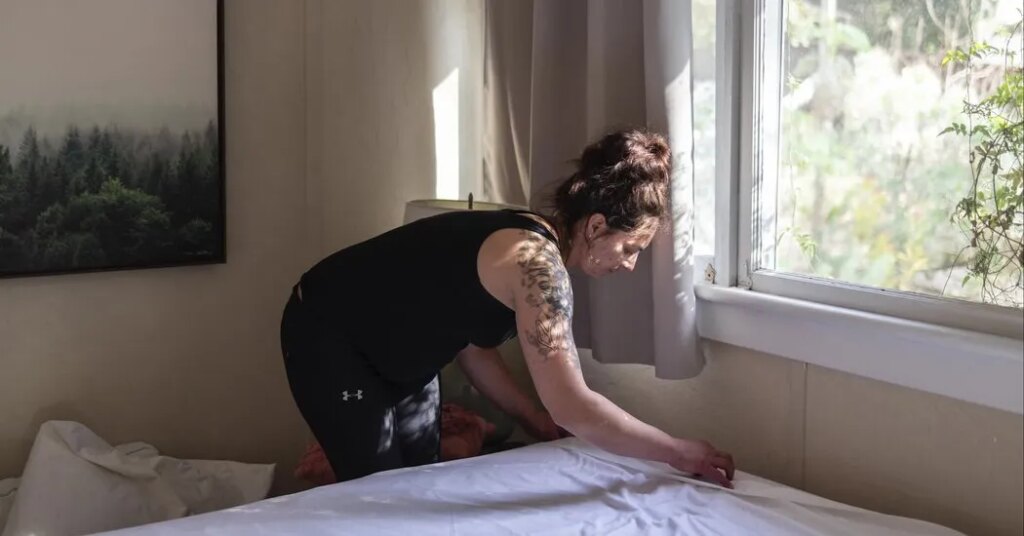
One morning in December 2024, Mikole Weeks, then 35, received a phone call with surprising news. She had been chosen for an experimental program called guaranteed basic income, and it came with cash: $1,330 a month for an entire year, with no strings attached for how it could be spent.
“It felt like another chance to turn my life around,” said Ms. Weeks, a single mother and a part-time house cleaner in Santa Cruz, Calif.
Only it did not turn out to be quite that simple.
For decades, people have debated the merits of guaranteed income programs, also called universal basic income, as an alternative or complement to traditional welfare. Driving the efforts is the idea that the most effective way to improve people’s lives is to give them cash and let them spend it how they want.
The concept resurged in popularity a decade ago, driven by fears of automation and rising wealth inequality. Proponents argued that permanent payments would raise the standard of living for those on the margins, and ultimately lift millions off welfare. Critics contended that giving people money unconditionally would deter them from working in the first place.
In the age of artificial intelligence, these programs have again become a hot topic. Tech titans including Elon Musk, Sam Altman of OpenAI and Dario Amodei of Anthropic have hailed basic income as a solution to A.I.-fueled job losses. In April, Mr. Musk posted that “universal HIGH INCOME” was the best way to deal with unemployment caused by the powerful technology. In June, Dr. Amodei suggested a tax on A.I. companies as one way to fund these payments.
Across Silicon Valley, experimental guaranteed income programs have quietly taken off. Google began funding six different initiatives in 2022 as part of a $50 million donation to nonprofits in the San Francisco Bay Area, saying basic income could be a novel way to prevent homelessness in one of the nation’s most expensive locations. Each program has hundreds of participants who receive around $1,000 a month, and academics study the results. State and federal tax laws limit the lengths of the programs and the payment amounts.
The studies have found that most basic income programs improve short-term employment and mental health while reducing food insecurity. But while data from these efforts has been closely tracked, less is known about the individual journeys of participants.
In October 2024, after The New York Times contacted two social services providers that received Google’s funding, the organizations offered reporters the chance to follow basic income recipients in real time. The Times ultimately shadowed three people, including Ms. Weeks, to better understand their guaranteed income experiences, from their first payments through last month. All of the program participants, including the ones The Times followed, were previously homeless and transitioning off a housing stipend that paid for a portion of their rent, and many received the payments on top of other social assistance like food stamps.
The Times’s findings mirrored the academic studies. For all three recipients, the instant benefits of basic income were clear: They had breathing room for groceries, rent and other expenses. But the success of the payments in another area — giving people more free time and opportunity in the long term — was mixed.
“It’s a lot to ask of someone to get their life together in 12 months, when a lot of these issues are structural or systemic,” said Jennifer Loving, who runs Destination: Home, a nonprofit that administers basic income programs in Silicon Valley. “And the world around them isn’t getting cheaper.”
Mikole Weeks
Ms. Weeks was homeless in 2023, living in a tent with her boyfriend at the time while struggling with drug addiction. “I was waiting for something to save me or kill me,” she said.
Then it came — she became pregnant with her son, Sky.
Ms. Weeks saw the pregnancy as a sign to turn her life around, and she did. She got sober and secured a $2,100 monthly housing stipend through Abode, a social services provider, for an apartment in Santa Cruz, a beach town about 40 miles south of Google’s Silicon Valley headquarters. She started working part time as a house cleaner for $20 an hour.
In December 2024, when Abode told her that she had been chosen for the basic income program, Ms. Weeks almost broke into tears.
The first trip she made after receiving the initial payment was to Target, where she filled her cart with organic banana baby snacks ($2.69) for Sky, then 14 months old, and a push bike ($61.99) to take him around the neighborhood. She loaded up on diapers that were softer for his sensitive skin than the ones she normally got for free at a food bank.
Then she called her mother, Christine Schell, now 60, who lived with Ms. Weeks’s now-23-year-old sister, Joanna McCall, in Elizabethton, Tenn. “Mom, do you want to see your grandbaby?” she asked.
Ms. Schell and Ms. McCall, who were living on social assistance, had never been able to afford the cross-country flights. A month later, Ms. Weeks received a call from her mother and sister: Her grandfather had died, and his house, where they lived, was being foreclosed on. What if they moved to Santa Cruz?
With the guaranteed income payments and more babysitting for Sky, Ms. Weeks said, she thought she could make the arrangement work.
Ms. Schell sold her belongings and drove from Tennessee to California with Ms. McCall. “It was chaotic, the emotions of leaving and also starting something new,” she said. “But we knew we’d be together.”
By April 2025, they were all living together in Ms. Weeks’s two-bedroom apartment. She slept on an air mattress in Sky’s bedroom, while her mother slept in Ms. Weeks’s bedroom and her sister on the couch in the living room.
As Ms. Schell cooked dinner one night, Ms. Weeks wrote a list of things she wanted to accomplish in the next 10 months with the help of the money. At the top was going to community college to study communications, a degree that could help her become a social worker.
“It feels like I’ve been given a head start,” Ms. Weeks said to her mother. Her ultimate goal was to be financially independent so she could give Sky opportunities that she never had.
She used some of the basic income money to pay for swimming lessons and music classes for Sky; on the weekends, they visited museums or a nearby aquarium. What she felt most was relief, she said, no longer having to wait until her food stamps reloaded every month to go to the grocery store. She could also afford to treat herself occasionally, getting her hair and nails done without worrying about paying for the electricity bill.
Seeing Ms. Weeks go to college also inspired her younger sister, Ms. McCall, who decided to enroll alongside her.
“It made me want to pursue our dreams together,” Ms. McCall said.
In a recent study of 3,000 universal basic income participants by OpenResearch, an organization partly funded by Mr. Altman of OpenAI, money spent supporting friends and family increased 26 percent, the most of any category. That was more than the increases for food (6 percent) and child care (11 percent).
But as the program went on, supporting two extra relatives — who had some social assistance but were also living on Ms. Weeks’s payments — weighed heavily on her. Ms. Weeks’s parenting style often clashed with her mother’s, leading to fights about how to raise Sky. Balancing college classes with a part-time job and parenting was harder than she expected.
By September 2025, “it had become a lot of change happening at once,” Ms. Weeks said. She moved her bed into the living room for more space and found herself saving less of the money than she had planned.
With one month to go until the payments ended, Ms. Weeks briefly relapsed into drugs. In November, sitting on her bed next to Sky’s giraffe stuffed animal, she told her mother that she needed to drop out of community college to focus on her health.
“I’m doing all I can do,” she said, burying her head in her mother’s chest.
“Mothers aren’t perfect by any means,” Ms. Schell said. “You’re doing your best.”
The payments ended in December. Ms. Weeks managed to save $2,000 from the program and continued to houseclean. Five months later, Ms. McCall moved into her own apartment, and Ms. Weeks, Ms. Schell and Sky used their savings to move into a house twice as big as their old place in cheaper, nearby Watsonville, with a yard for Sky to run around.
Ms. Weeks began feeling more settled. In August, she got a job at a hotel restaurant in Santa Cruz, working 32 hours a week making $24 an hour plus tips, health care benefits for herself and Sky and membership in a union.
She also re-enrolled in community college, taking one course at a time online instead of in person. Her first class began last month.
Nicholas Marquez
Nicholas Marquez, 44, could barely walk up the stairs to his Santa Cruz apartment one morning in mid-December 2024, his body still exhausted from open-heart surgery a week earlier. His power was shut off because of an unpaid electric bill, and his refrigerator was empty until more food stamps would arrive on Jan. 1.
Then he got the news from Abode that he had been selected for the guaranteed income program. “It felt like I had won the lottery,” he said.
He immediately called his mother, Denise Wiscowiche, now 66, a caretaker in Santa Cruz who had become his caretaker, too. “Mom, I have good news,” he told her. “I’m going to need your help.”
The $1,330 a month from the program immediately went to basics, like paying off his $500 utility bill to get the power back on. Mr. Marquez and Ms. Wiscowiche also went to the grocery store to buy high-calorie protein shakes, the only thing he could eat after his dialysis appointments on Tuesdays, Thursdays and Saturdays.
His heart and kidneys had been declining for years, he said, “punished by a lifetime of bad decisions” and a drug addiction. Unable to work, he was living on social assistance of around $800 a month on top of a housing stipend.
At the end of each month, Mr. Marquez had to choose whether to pay for electricity, for laundry or for groceries. With the basic income payments, he could do all three. It was the first time he could pay to do laundry in six months.
“There are a lot of little things that you don’t realize you need until you can’t afford them,” he said.
When his second payment hit in February 2025, Mr. Marquez brainstormed things he wanted to buy next. A new television and a PlayStation 4, to entertain him on days spent on the couch after dialysis; curtains for the living room; a blender to make smoothies.
Ms. Wiscowiche wrote reminders about each item on paper plates taped up around the apartment, covering his refrigerator and calendar with smiley faces and delivery dates. What the payments gave Mr. Marquez most of all was a sense of independence, he said. He could afford to take a friend out for a meal on occasion. He did not have to ration toilet paper.
But the extra money could not reverse the damage to his heart and kidneys. In March 2025, Mr. Marquez’s health took a turn for the worse, and his mother moved into his apartment to care for him.
At the end of that month, she stood by his bedside, crouching against a wall filled with skateboards and fishing rods from his childhood and posters of his favorite heavy metal bands.
“Mom, if I can’t do this anymore, you have to let me go,” he told her.
“I’ll never let you go, Nick,” she said.
A few weeks later, after returning home from the grocery store, Ms. Wiscowiche found Mr. Marquez unconscious on the floor. He had gone into cardiac arrest and died later that day.
Ms. Wiscowiche moved out of the apartment that month. Her other son, Benjamin Marquez, was struggling with a fentanyl addiction somewhere on the streets of Northern California. She could not imagine losing both sons.
She eventually tracked Benjamin down. “He told me to come save him,” Ms. Wiscowiche said.
Mr. Marquez had saved $900 of the payments for an e-bike to ride along the ocean. In May 2025, Ms. Wiscowiche used the sum and the rest of her savings to put Benjamin into a $15,000 drug rehabilitation program. With no money left, she moved into a tent in her stepmother’s backyard in Greenfield, Calif., a rural town about an hour south of Santa Cruz.
Benjamin finished his rehab program last fall. In July, he enrolled in a forestry job training program. Ms. Wiscowiche, who lives on Social Security, said she was still looking for the next place to live.
KaMesha Staples
In the spring of 2024, KaMesha Staples, now 40, was financially stuck. She was making $800 a week as a part-time drug addiction counselor in Vallejo, Calif., a working-class city 30 miles north of Oakland. But she was spending $1,000 a week on child care for her two daughters.
“It felt like we were at a standstill, like crabs in a bucket,” Ms. Staples said. So she decided to quit her job and rely on social assistance.
Every few months, a new obstacle seemed to keep her from financial independence. Sometimes her car broke down, costing hundreds of dollars to repair on top of the Uber and Lyft rides she needed as a replacement. She had moved to Vallejo from Oakland because of the cheaper cost of living, but now she had no reliable public transportation. Her older daughter, Vera, a fifth grader, would often have to walk two miles to school.
In June 2024, Compass Family Services, a social services provider that offers housing assistance, told Ms. Staples that she had been chosen for the basic income program. When she received the first $1,000 payment that month, she set a goal: Get a higher-paying job in education, a field she was passionate about. That September, with her daughters back in school and extra cushion from the payments, she enrolled in community college.
One year of payments was “just enough time not to get comfortable,” she said, and the urgency motivated her.
Ms. Staples’s situation — just on the edge of financial independence — is common among basic income recipients, said Erica Kisch, the chief executive of Compass Family Services. The hope is that the payments can be “the thing that pushes them out of poverty and into some kind of stability,” she said.
“One of the things that we’ve been learning is how one very small thing can actually become a giant thing that derails your entire family’s life very quickly,” Ms. Kisch said. “Being poor is actually really expensive.”
In October 2024, Ms. Staples joined her community college’s “job club,” which helped her make a new résumé and a LinkedIn profile and practice mock interviews. She applied for jobs to be a coordinator or teaching assistant at nearby schools. She also applied for Vera to attend nearby charter schools for middle school.
“The payments made it feel like my 10 problems turned to nine,” Ms. Staples said. “I had more time to think about the life I wanted to start living.”
For Vera’s 12th birthday, Ms. Staples took the family to Vallejo’s Six Flags amusement park, just two miles away, for the first time. They had so much fun that she bought her daughters season passes, a $70 expense that she would have never splurged on before.
As the months passed, however, Ms. Staples did not save as much of the basic income money as she had expected.
“I got used to spending what I had,” she said. “That was my biggest regret.”
She also miscalculated how long the program would last. When the last payment hit in May 2025, she had planned for one more.
The program’s end is what researchers often call “the cliff” and the first test of its long-term success. It hit Ms. Staples hard. She missed a car payment and needed help from her grandmother to pay it off. A week later, she was short on money again, so she started driving for DoorDash.
Just as things seemed to worsen, Ms. Staples got an offer in August 2025 to be an after-school coordinator making $30 an hour, $5 more than her last job. The same week, Vera was accepted to a charter school.
In the year since the program ended, things have not been easy, Ms. Staples said, but her life feels more stable. In August, her younger daughter, Xavea, enrolled in the same charter school as Vera, meaning a reprieve from child care costs.
On a recent afternoon, she drove to pick up Xavea’s school uniform, her daughter giddy in the back seat to try it on for the first time. Returning to their house, Ms. Staples sighed in relief.
“Less helpless is how I feel now,” she said.
The post What a Year of Free Money Meant: Softer Diapers, Clean Laundry, a Visit to Six Flags appeared first on New York Times.