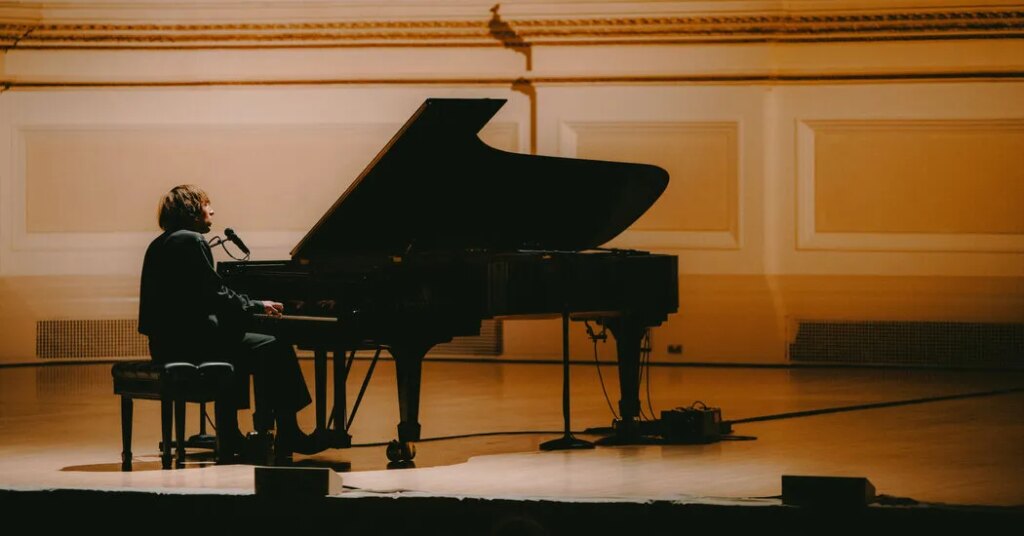
How did Cameron Winter get to Carnegie Hall? On a brisk Thursday night last December, when the then-23-year-old troubadour — and frontman of the popular art-rock band Geese — sat at a Steinway grand and played a solo set on one of music’s most hallowed stages, the question hung in the air like a cosmic joke.
This was a place meant for prodigies and virtuosos, symphonies and chamber orchestras, not necessarily buzzy young artists whom people like to argue about on the internet. Occasionally an upstart pop singer-songwriter headlines Carnegie, but we’re talking about the voice-of-their-generation greats: Bob Dylan in 1963, Joni Mitchell in 1969, Carole King in 1971. Winter is a guy with a hangdog baritone who likes to troll people by saying that he recorded “Heavy Metal,” his obliquely poetic, cult-beloved 2024 solo debut LP, on display equipment at various Guitar Centers.
As if that weren’t enough, rumors swirled in the days leading up to the Carnegie show that a certain revered filmmaker was shooting a documentary about Winter. It proved true as soon as we entered the cavernous, honey-lit hall — for there, behind a hulking 35 millimeter camera at the back of the orchestra section, was Paul Thomas Anderson, pausing his “One Battle After Another” award-season victory lap just to film Winter’s Carnegie concert. (The film will tour select movie theaters through January, while a live album of the Carnegie performance was released last week.)
An air of chosen-ness — deserved to his admirers, absolutely maddening to his detractors — has hung around Winter for some time. His band signed a record deal when they were still teenagers. “Heavy Metal” was a word-of-mouth sensation, and Geese, especially after its swaggering 2025 album “Getting Killed,” has been frequently described as “Gen Z’s first great rock band.”
But there is a paradox to those accolades that nobody mentions: The obvious markers of modern life are all but absent from the musical worlds Winter creates. There are no mentions of smartphones on “Heavy Metal” or “Getting Killed.” No Trump or Covid-19 or A.I. slop. I don’t even think there’s an internet on these albums.
There is, instead, a grappling with the timeless human concepts that all those things distract us from. God. Purpose. Death. Love — and not the casual, swipe-right, take-it-or-leave it sort, either. As Winter sings on the great “Love Takes Miles,” he means the kind that “will take you by your pants and swing you over his head and kick you back and forth.”
Some — including plenty of people I love and whose opinions I respect — find Winter’s voice unbearably monotonous. Others find something about its cadences mesmerizing, as if he is lulling you into an alternate world.
In a rare moment of self-reflection during a GQ interview last year, the usually wily Winter said, “I like the feeling of hearing people struggling against their own limits, like trying to break through. They go to the very tippy-top of what they think they’re capable of, and that’s why it’s beautiful.” That’s precisely the sort of ambitious and strained beauty that I heard, and was quite moved by, during Winter’s Carnegie performance.
WINTER’S SONGS dance on the thin line between nonsense and subconscious revelation, like remembered moments of a particularly perceptive dream. They are full of odd images, liquefied language and striking insight delivered with such insouciance that they feel almost accidental. “Like Brian Jones, I was born to swim towards a month ago,” Winter sings in an ungainly croon on the opener of “Heavy Metal,” a strangely regal ballad titled, of all things, “The Rolling Stones.”
What he played at Carnegie Hall was a radical reimagining. On “Heavy Metal” the song is a cracked pastoral, driven by a pretty acoustic guitar riff over which Winter warbles hammily, like an Elvis impersonator who showed up to work very drunk. Onstage, though, Winter’s voice sounded more muscular, pure of tone and impassioned, like Rufus Wainwright attempting to cover a Daniel Johnston song.
The line between concert-hall polish and punk passion smeared provocatively. In the middle of the song, Winter made great flourish out of a pretty straightforward ascending arpeggio and then plinked a single high note for nearly half a minute — pantomiming virtuosity for deadpan comedic effect. The crowd applauded, whooped and then, as the bit dragged on into absurdity, fell into awkward titters of laughter.
A defiant wryness runs through Winter’s persona. Reverence and irreverence overlap inscrutably. The gatefold inside the live album’s LP packaging features a painting of Winter French-kissing Andrew Carnegie.
Quite a few of the old songs, though, revealed new depths in their concert-hall finery. “Try As I May,” restrained by a plodding arrangement on “Heavy Metal,” transformed into an affecting tragicomedy about the limitations of lunkheaded masculinity. Sings Winter, with an aching tenderness, “You were born to hold my cannonball brain like the Lord holds the moon.” (Though Winter has slotted into, with privileged ease, music’s familiar role of the latest boy genius, he is at least good at mocking what it means to be perceived as a boy, or a genius.) “Cancer of the Skull,” which flirts with monotony before swooping into a harmonically satisfying chorus, is a fractured portrait of an Everyman and an off-kilter meditation on songwriting. “I painted over the perfect nose,” Winter sings, humorously evoking his own quest toward artistic perfection.
Blessedly, he’s still painting noses. Winter played a trio of new, or at least previously unreleased, songs at Carnegie that all suggest he is moving even further in the direction of eternal themes and spiritual musings. The devil is the only named character in the excellent “If You Turn Back Now,” a wrenching ballad of the heart’s illogical pushes and pulls: “I might love you again if you leave me alone,” he sings in an elongated howl at the end of one verse.
The opening number, “It All Fell in the River,” is an abstract song of sacrifice and salvation. “Emperor XIII in Shades,” my favorite of the three, sounds like a Laurel Canyon folk tune written by a God-fearing extraterrestrial. “I don’t like what happened to Jesus,” Winter sings in the song’s final moments, “but I sure do like Saturday morning.” I want somebody to tell Randy Newman about that lyric.
Winter has said that while making “Heavy Metal,” he listened daily to Leonard Cohen’s 1967 debut: “It definitely was the album I held up in my head as the standard I wanted to hold myself to.” (The mouth harp on “Cancer of the Skull” also suggests he is a fan of Cohen’s “Songs From a Room.”)
Winter’s music possesses both a reverence for his forebears — Cohen, Dylan, Nilsson — alongside a wincing self-consciousness about how painfully obvious it is to admire the greats. Born at the beginning of the 21st century, he knows that there is something absurd about picking up a guitar or sitting behind a piano, aiming to say something original and worthwhile about the human condition this far into pop musical history. The Tower of Song has in recent years become an exclusive and gerontocratic co-op with no vacancy, but here comes this kid, submitting his application to the board anyway. How audacious, how ridiculous. How refreshing.
I WAS CONFUSED about his shirt. From my seat, I could not tell if it was a beautifully draped blouse of some exquisite silk, or a zipped-up nylon windbreaker impulse-purchased at a gas station. Something about Winter’s whole coy perspective exists in that misunderstanding, in the space of possibility between those two extremes. I leaned toward gas-station buy, but I don’t want to ever know for sure.
Thankfully, Anderson’s film keeps this and other well-guarded mysteries of Winter’s soul intact. It is an appropriately minimalist work, featuring long close-ups of Winter’s face — all Bert-and-Ernie eyebrows and bird’s nest hair — and a few memorably dynamic camera movements that marvel at the sanctity of the space. But Anderson’s emphasis is on the songs themselves, which Winter focuses on with an almost monastic intensity.
“Explain to me why this is good,” a colleague said to me, slightly exasperated, after we left a screening of the film. It was a request I had heard before; Winter’s music is not for everybody. “I just feel like he’s playing a joke on me,” he added.
I told him I had bad news. I couldn’t exactly prove that Cameron Winter wasn’t playing a joke on us all, and — even worse! — that is part of why I think the performance is “good.”
Winter’s music is poised in a precarious balance, far from humorless but incredibly serious about its aims. He is living at a time when irony and sincerity are both equally ridiculous, so he has invented a voice that speaks both of those languages simultaneously. Winter knows that “greatness” is cringe, an antiquated idea to be laughed at, a construct to be kept within the mocking force field of scare quotes. The punchline is that he keeps aspiring toward it anyway, devotionally — practicing, practicing, practicing.
The post Is Cameron Winter Serious? appeared first on New York Times.