The intensifying war in the Middle East threatens to further strain a weary energy industry that has already endured waves of disruptions and could test a market resilience built on a series of extraordinary government and private-sector measures.
Over the weekend, the Iran-backed Houthi militia attacked an international airport in Saudi Arabia’s capital, Riyadh, including one strike that killed at least 12 people and injured hundreds. It was the deadliest attack in a Gulf Arab country since the U.S.-Israeli war with Iran began in February and brought the war to the center of the Middle East’s oil industry.
The attack forced the temporary suspension of operations at the airport just as energy executives and government officials were set to arrive in Riyadh for a major business and policy conference. The event, the World Petroleum Congress, proceeded as planned although some attendees were diverted to other airports and others, including U.S. Energy Secretary Chris Wright and ministers from Italy and Japan, addressed the conference by video link.
Many oil industry leaders — including the chief executives of Exxon Mobil and BP — canceled their trips to Saudi Arabia, according to two industry officials who were not authorized to discuss executive schedules.
In remarks on Monday, Prince Abdulaziz bin Salman, the Saudi energy minister, acknowledged that recent attacks have “tested our infrastructure, or institutions, our resilience.”
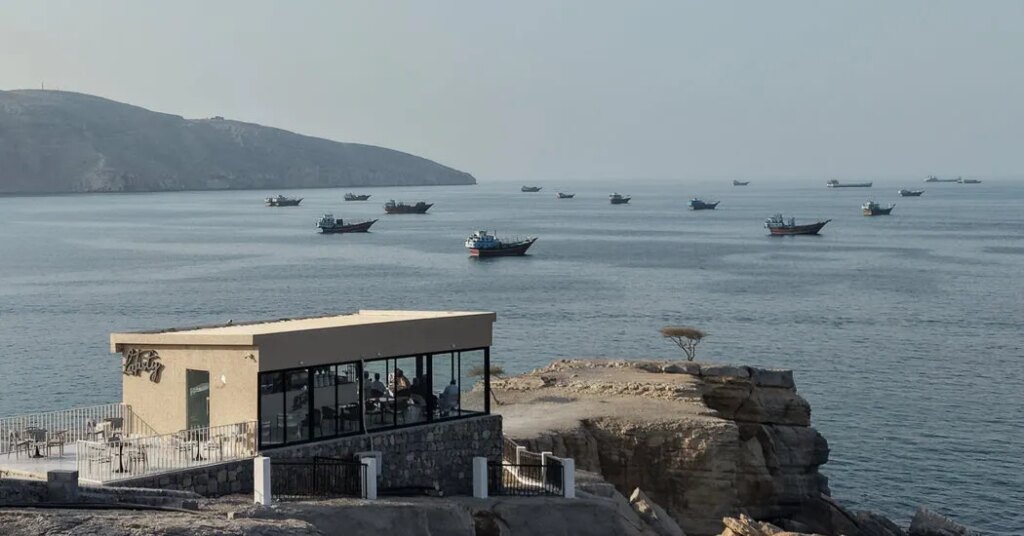
Meanwhile, oil tankers are facing persistent peril while attempting to transit the Strait of Hormuz — the narrow passage between Iran and Oman that was a fairly uncomplicated excursion before the war. At least 16 vessels have been attacked this month.
The widening of the fighting between Saudi Arabia and the Houthi militia in Yemen, amid no public signs of a diplomatic resolution between the United States and Iran, underscores the potent two-front threat facing energy infrastructure in an area crucial to global supplies of crude oil and its many byproducts like diesel and gasoline.
Just last month, oil exports from the region started increasing to nearly their prewar levels. More ships were getting out of the Strait of Hormuz, close to the Oman coast, through the protection and guidance of U.S. forces.
It is not yet clear if the most recent attacks on tankers around the strait will cause a notable drop in exports as ship operators recoil from the risk. Regardless, the U.S. military effort is a costly endeavor that experts say can’t last forever.
Before the Riyadh airport came under attack, an Iranian-backed militia in Iraq had already targeted a critical Saudi pipeline, which the kingdom was using to export oil instead of going through the Strait of Hormuz.
All told, the rebound in crude exports masks headwinds that could keep prices elevated, oil executives and analysts say. The benchmark global oil price was trading at about $ $104 a barrel on Monday, up from just under $70 on the eve of the war.
“We are in a permanently changed energy world right now,” said David L. Goldwyn, a former State Department energy envoy. “We are entering an age of prolonged insecurity,” he said.
And the world’s crude cushions are being drained. The use of reserves of unrefined petroleum held by oil producers and governments has helped stabilize the market. Dozens of countries came together in March for the largest ever coordinated release of stockpiles. But those reserves are beginning to have limited effect, in part because the world’s capacity to refine oil is stretched to the max.
The price of diesel has become a global flashpoint. Diesel is essential to global commerce, and a dearth of refineries has driven its price to record highs in many parts of the world including the United States. Facing political pressure, President Trump has allowed imports of diesel from Russia, undercutting American sanctions for a measure that experts say will have a negligible impact on global prices.
The world’s reserves have reached “scarily thin” levels, Amin Nasser, the chief executive of Aramco, Saudi Arabia’s national oil company, said at the Energy Intelligence Forum in London last week.
In another potential weight on the energy market, there are signs that China, the world’s biggest buyer of oil, is starting to buy more again. Earlier in the war, China had slashed its imports to, at the lowest point, around 7.1 million barrels a day from about 11.6 million barrels.
And Iranian crude — 90 percent of which once went to China — has virtually disappeared from the market since the United States imposed a naval blockade on the country’s exports.
Oil executives say they expect the turmoil in the oil market to last well into next year if not longer.
“I think it is going to be bedlam for the bulk of the end of the year and maybe 2027,” Tengku Muhammad Taufik, the chief executive of Petronas, Malaysia’s state-owned oil and gas company, said last week.
For decades, the Strait of Hormuz, was the most effective commercial route to send crude east across the Indian Ocean to Asian markets. Countries like Kuwait and Iraq used it for virtually all of their oil exports, while Saudi Arabia used it for about 80 percent.
When Iran effectively blocked the strait in March, Saudi Arabia, the region’s largest producer, leaned heavily on its other door to the world: the Red Sea. Each day, it sent four to five million barrels of oil through the 720-mile East-West Pipeline to deliver crude from eastern oil fields to the port of Yanbu on the Red Sea. From there, ships would move its oil through the Bab al-Mandab Strait to Asia.
Over the summer, the Houthi militia made that path dangerous when it threatened to effectively block any ships carrying Saudi oil. Then in September, the Houthis attacked the East-West Pipeline, forcing it to shut down temporarily.
“Ultimately, the resilience of the international system can only hold up for so long, and we’re fast moving toward that target,” said Shaikh Nawaf S. Al-Sabah, the deputy chairman and chief executive of the Kuwait Petroleum Corporation.
Mr. Al-Sabah said that before the war, Kuwait was exporting about 2.6 million barrels a day. Production has recovered to about 2 million barrels a day, about 75 percent of prewar levels, because more tankers are taking the risk of transiting the Strait of Hormuz.
Also notable was the warp speed at which Saudi Arabia worked to fix the East-West Pipeline after it was damaged. Mr. Nasser said Aramco had more than 10 teams, each with thousands of contractors and engineers, that repaired pumping stations in a matter of days.
Yet the region clearly remains heavily exposed.
“Producers still need a safer route, they need tankers, they still need buyers who are willing to accept the risk,” Aaron Brady, vice president of energy oil market services at S&P Global, a research firm, said at an S&P energy briefing in London this month.
Mr. Brady added, “A lot of oil is getting out in the Middle East, but there’s no longer that sort of secure workaround.”
The bottom line, Mr. Brady said, is that even though oil is getting to the countries that want it, the routes are more complicated and the costs continue to rise. He called it an “improvised” system.
“The flows are improving but I wouldn’t characterize this as a normally operating system,” he said.
The post World’s Energy Order Tested Again as Iran War’s Reach Extends Further appeared first on New York Times.