Times Insider explains who we are and what we do, and delivers behind-the-scenes insights into how our journalism comes together.
Victoria Jaggard remembers the moment she knew she wanted to spend her life writing about space: It was in May 2008, and she was at the NASA Jet Propulsion Laboratory in Pasadena, Calif., covering the Phoenix lander’s arrival on Mars.
“Just the electricity in the room and the energy of everybody as they’re holding their breath, crossing their fingers, really, really hoping that this multimillion-dollar thing that they built lands safely on another planet,” said Ms. Jaggard, who was National Geographic’s senior space editor at the time. “From that point, there was no going back.”
In the years since, Ms. Jaggard has covered the last space shuttle launch, in 2011; the 50th anniversary of the Apollo 11 moon landing; and the 2024 total solar eclipse. And last month, she secured her status as the cool relative at Thanksgiving, with a new job as The New York Times’s space editor.
“After the Artemis II mission captivated our readers — and after SpaceX’s huge I.P.O. underscored just how much the ambitions of the private space industry are going to drive America’s future exploration — it seemed clear to me that the Science desk needed one editor to coordinate and elevate all our coverage,” said Bill Wasik, The Times’s Science editor. Michael Roston, who is now a deputy breaking news editor, previously handled all things space.
In an interview, Ms. Jaggard shared how strong visuals can strengthen science stories, how artificial intelligence is changing space travel and whether she’d ever want to go to space. These are edited excerpts from the conversation.
How did you first become interested in space?
I’ve always been interested in science fiction and fantasy. I had dreams of being just like Kathryn Janeway from “Star Trek: Voyager.” I actually started out studying drama and musical theater, but my mother, being a very reasonable person, was like, “You need a job that makes money.”
I studied science writing in college, graduated with the idea of being an environmental science reporter and then ended up kind of tripping and falling into space and physics in my career. It’s so full of awe and wonder and joy. It was impossible to resist.
What fascinates you about the cosmos?
The No. 1 attribute for most journalists is an inherent sense of curiosity. All of us just want to understand how the world works. And some of the most interesting questions in science — to me, at least — are about space and the cosmos. Could we ever live in space? What would the lack of gravity do? Are there any other planets that could potentially host life? What is the universe even made of? That’s still an open question, which absolutely boggles my mind.
How is A.I. changing space travel?
We’re talking a lot these days about Starlink satellites and other satellite constellations that will provide internet access to more remote areas of the world. But there’s also a lot of discussion about what that means for the crowding of the orbital bands around Earth, and what kinds of risks that could pose.
Various tech companies have also been talking about putting data centers in space, and have even started to get the permissions to be able to launch prototype versions. On one hand, the argument goes, they’ll have continuous access to solar power, and they’ll have different ways of cooling. But it comes back to issues of potential overcrowding, and even how feasible the technology is.
What other space story lines are you watching?
NASA just launched the Nancy Grace Roman Telescope, which is going to provide some exciting opportunities for a better understanding of galactic structure and exoplanets. I’m also excited by the various planetary missions. Japan has one launching at the end of October to try to touch one of Mars’s moons and potentially bring back a sample, so we can get a better sense of how Mars got its moons in the first place.
What are your goals for the future of our coverage?
One of the things I’ve learned as a space journalist is the importance of visuals in connecting people with topics that can sometimes be a little hard to wrap your head around. I could try to explain to you the orbital dynamics of solar eclipses until the cows come home, but the instant I show you a little animation of how all the systems are moving, the lightbulb clicks on.
One of my biggest goals is to embrace the power of multimedia, to really bring home for readers the joy, wonder and profound nature of everything we’re discovering out there. I’m hopeful that we can engage with readers who wouldn’t necessarily think of themselves as space nerds, but who will find these kinds of stories interesting because we’re all human and we’re interested in our place in the universe.
If you weren’t a science reporter, what beat would you choose?
I might be most drawn to pop culture. Early in my career, I was working for a chemistry magazine, and I launched a feature that reviewed popular movies like “The Day After Tomorrow” based on their scientific merits. I guess it amused somebody because it ended up being profiled in The New York Times.
Would you go to space?
Oh, no. If there’s one thing I’ve learned from covering spaceflight, it’s that it’s a grueling experience on the human body. We are designed to live quite comfortably on the surface of Earth. And I’m quite comfortable sitting here and letting robots do the hard part.
Do aliens exist?
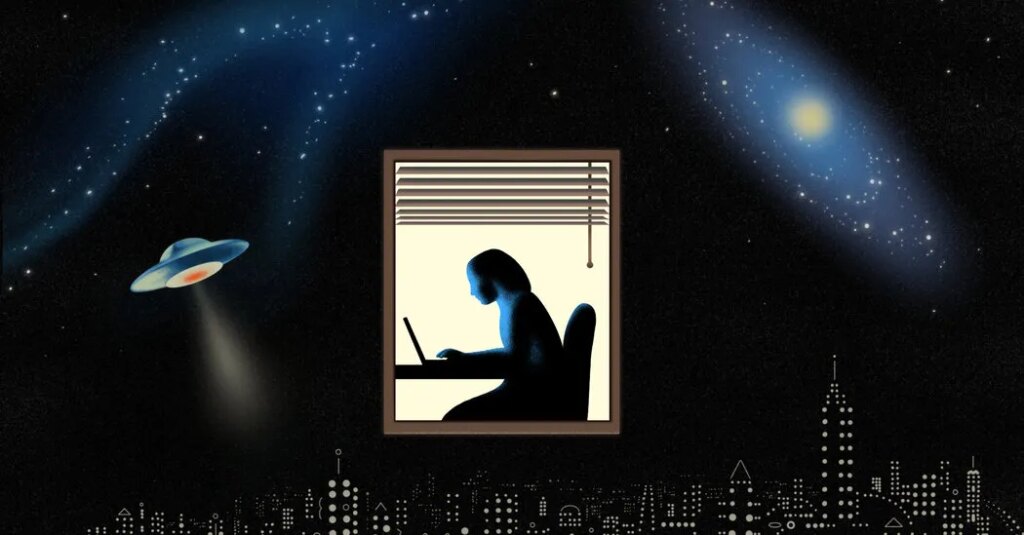
Statistically speaking, I’d like to think there’s got to be something else out there. We’ve seen all kinds of evidence that even worlds within our own solar system have the necessary ingredients for more complex life to not only spring up but thrive. For all we know, there could be something swimming under the ice crust on Jupiter’s moon Europa, and we just can’t see it yet because we don’t know how to probe through 10 kilometers of ice on a radiation-blasted moon. But I want to believe.
The post The Times’s New Space Editor Has Her Eye on the Cosmos appeared first on New York Times.