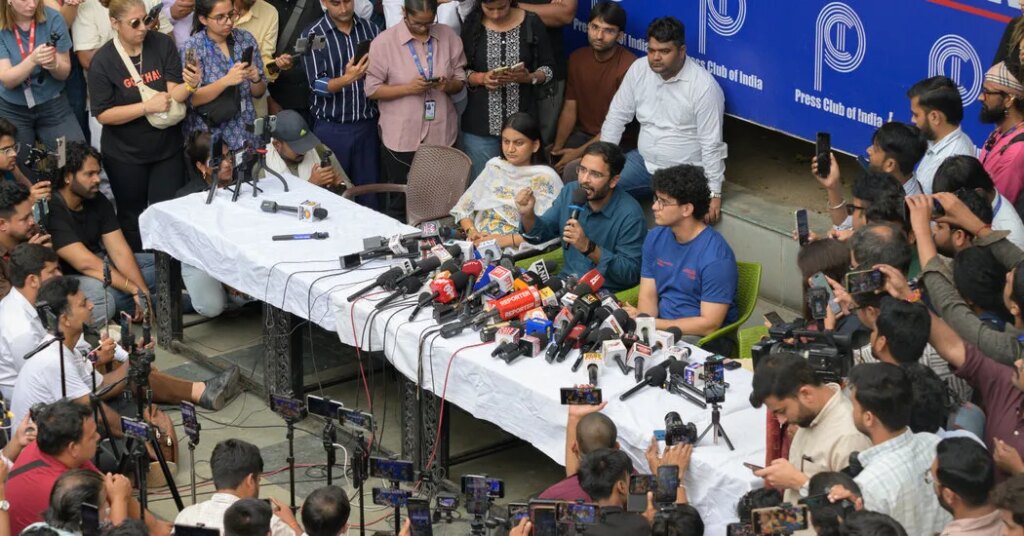
The three leaders of the Cockroach Janta Party, a popular youth movement in India, were released from detention on Sunday, a day after police officers took them into custody as they prepared to lead a protest against sweeping voter roll revisions.
Ratna Singh, who acts as the group’s legal director, said that the three leaders — Abhijeet Dipke, who created the Cockroach movement, along with Saurav Das and Ashutosh Ranka — had been released after they committed to refrain from any breach of the peace for one year.
Immediately after their release, the men promised to continue to protest peacefully. “The CJP will neither back down nor be intimidated,” Mr. Dipke said on social media after his release.
On Sunday, there were scattered, relatively small protests in several parts of central Delhi. The police were out in force. They immediately detained protesters and took them into police vans and buses, as they had on Saturday, when thousands were detained. It was impossible to ascertain how many were detained on either day.
The three men who were released Sunday morning waved to journalists assembled outside the police station as they were swiftly loaded into a black vehicle and driven away. Mr. Dipke was seen wearing the same T-shirt he had on Saturday, with an image of Mohandas K. Gandhi, India’s leader of nonviolent protest.
“Cockroaches never die,” the group’s account on the social media platform X declared, minutes after their release.
Mr. Dipke later said on social media that he was heading back to his home village because of a family death.
In the afternoon, Mr. Ranka told a news conference that the court order would not restrain the men from participating in peaceful protests. “We are law-abiding citizens,” he said. “We have been protesting peacefully from day one.”
“Peaceful protests will go on,” Mr. Das added. “Not just protests in Delhi. All over the country.”
Also on Sunday, in response to petitions from lawyers, India’s Supreme Court ordered that metro stations, rail services and the internet should be allowed to function normally. It also ruled against “illegal detention, particularly in cases of peaceful, unarmed assemblage of people” outside the limited zone in the city center where the police had imposed restrictions.
The scattered protests on Sunday came after an extraordinary show of force on Saturday by Indian security officials, who rounded up thousands of protesters and stuffed them into buses and vans. Trains to the capital were canceled, subway stations were closed and the internet was shut down in much of New Delhi.
Undeterred, thousands of people, mostly in their 20s and 30s, held rallies in several parts of the city, only to face walls of security forces.
The protests are in response to what the Cockroach party and others have called a politically motivated purge of the voter roll. That revision, which began last summer to update the voter roll, has expunged over 130 million names. One of the protesters’ central demands is the resignation of the country’s election chief, Gyanesh Kumar.
For more than a week, anger over the voter roll revision has fueled protests by a range of Indian organizations and opposition politicians.
The three Cockroach leaders were picked up in a dramatic show of force on Saturday morning, when police officers boarded the plane on which they had flown to the capital. The men shared the video of their encounter with the police on social media.
They were detained under a law that allows the police to arrest preventively — without a warrant — those who they believe would commit an offense, in order to maintain public order.
A Delhi magistrate ordered their release 24 hours later.
Mr. Das and Mr. Ranka said at the news conference that the police had not shown them arrest warrants before taking them off the plane on Saturday. The officers detained the three Cockroach leaders in different locations and took their phones without legal seizure orders, the men said.
Those claims could not be independently confirmed. The Delhi police said on social media on Sunday, after the men’s release, that “all due legal procedures were followed.”
“Our law enforcement authorities act strictly in accordance with the law, and our courts remain available to all for the redressal of all grievances,” the Ministry of External Affairs said in a response to a U.N. statement on detentions.
The police station where the men had been held overnight was heavily fortified by law-enforcement officers as New Delhi braced for further demonstrations.
The Cockroach party emerged this summer on the back of Gen Z anger over a dysfunctional system for college entrance exams in India. The group’s name is a tongue-in-cheek response to a comment that India’s top judge made last May, calling young Indians “cockroaches.”
Protests led by the Cockroach party won the rare ouster of a government minister in July, after which the group worked to call attention to the poor conditions in India’s rural schools. In September, it seized on the voter roll revision.
Pragati K.B. contributed reporting.
The post India’s ‘Cockroach’ Leaders Released as Small Protests Go On in Delhi appeared first on New York Times.