Eva Jaber is a student at William & Mary.
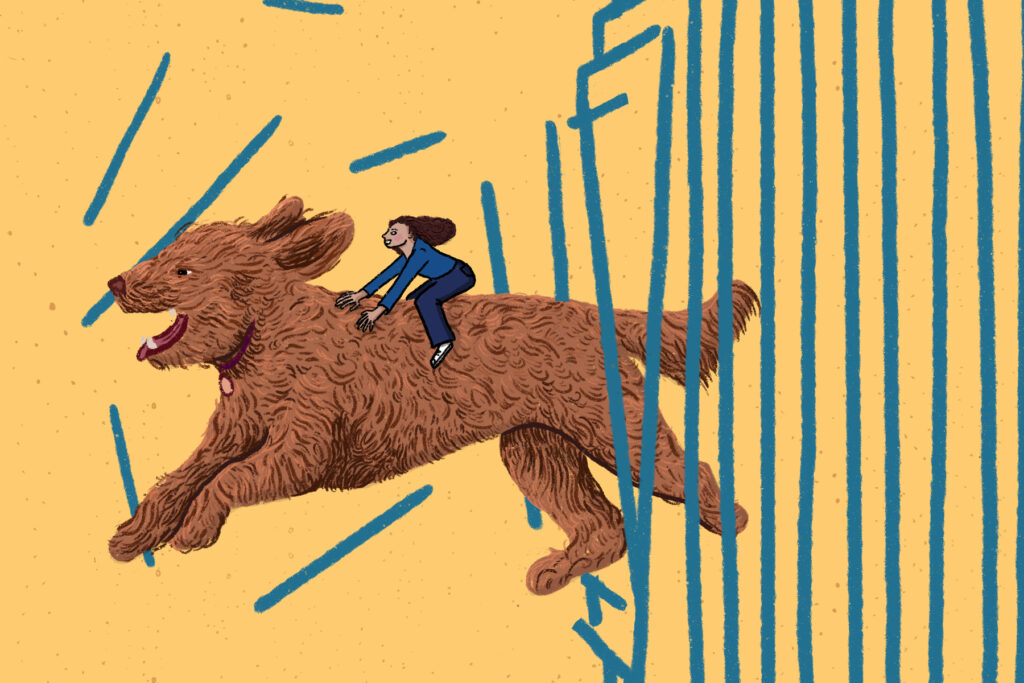
I was 16 when Pretzel, a golden-brown doodle with legs about six inches too short for her stout, hotdog-shaped body, entered my life. I loved her immediately, but she barely tolerated me. She sprinted to the door to greet any soul who arrived, but I was an outlier. Pretzel wouldn’t wag her tail when she saw me and would walk away when I tried to pet her. What could be more disappointing than getting rejected by my own dog?
Everything changed the day I realized that Pretzel wasn’t the oddball. I was.
Pretzel had just learned to give someone a kiss on the cheek in return for a treat. Wanting a treat made her uncharacteristically friendly toward me. I was eating a bowl of popcorn when Pretzel came barreling up and kissed me square on my nose. She licked her lips in anticipation of her reward, but I suddenly wasn’t there.
I had bolted for the kitchen sink. All I could think about were the millions of pathogens that had just made their way from Pretzel’s tongue to my pores. It felt as if I had taken a fire hose of sewage water to the face. As I lathered it with dish soap (the most convenient cleanser), something clicked. This can’t be normal.
And that’s when I figured it out. Pretzel thought I didn’t like her. My behavior confused her dog brain as much as hers did my person brain. I’d been inadvertently rejecting my own dog to avoid contracting some nebulous disease.
A few weeks later, I was diagnosed with obsessive-compulsive disorder. After a decade of insisting that germophobic neuroticism was just a benign component of my personality, I realized it was something more.
OCD is a cycle of obsessions (creating anxiety) and repetitive behaviors (soothing the distress). I feared contamination nearly every time I had contact with the world, but it took my confused puppy to show me that I needed support.
I just turned 20, and I am writing this piece with Pretzel napping by my side. Exposure and response prevention therapy changed my life. ERP consists of confronting anxiety-inducing situations to practice developing healthy, non-compulsive coping mechanisms, and it can be highly effective in treating OCD.
My success with ERP shows that even high-functioning individuals can immeasurably benefit from seeking help. We don’t have to wait until we begin to unravel to address the parts of us that have frayed.
My therapy started small. My instinct was to wash my own utensils and hold them hovering over my place mat before a meal like some suppertime Jedi, because touching the table would make them disgusting. In ERP therapy, I practiced using a fork that had lain on a table. I imagine that someone without my condition would feel the same if they had to do origami with a snotty tissue, but forcing myself to sit with the uncertainty and discomfort of my fears helped disarm my anxiety.
For a tougher exposure therapy exercise, I had to drop my laundry on the floor, fold it and put it away, instead of following my instinct that the clothes on the floor were now dirty and needed to go in the hamper. It felt like I was caking microbes into the crevices of my palms, but I sat during a telehealth appointment with clammy hands folding T-shirts while my therapist played “Fight Song” by Rachel Platten and encouraged me to keep going. It sounds ridiculous. It felt ridiculous.
It was also one of the hardest things I had ever done, which means that I really did need the help. First in therapy sessions and later in real-life scenarios, I challenged myself with exposures and learned new coping strategies. When a friend playfully reached into my bag of chips, I let my contamination discomfort happen without resorting to compulsive behaviors to fight it.
Having OCD sometimes makes me feel less-than, but I couldn’t be prouder of the ways I am triumphing over it. Every time Pretzel tackles me to the ground when I open my front door to pepper me with kisses, I know I’m winning.
My goals for therapy were big and small. I wanted to be happy. And I wanted to eat birthday cake after someone has blown out the candles. This summer, my sister turned 17, and I cheered instead of winced as the flames went out. Pretzel even jumped on the couch and tried to get a lick of the ice cream atop my slice of birthday cake. I’m pretty sure her nose made contact with my dessert. I ate it anyway.
The post My dog seemed to hate me. Here’s how I fixed it. appeared first on Washington Post.