Fabio Pacucci is an astrophysicist at Harvard University.
NASA’s James Webb Space Telescope is a $10 billion machine that unfolded itself like origami as it traveled toward a point four times farther from Earth than our moon is. The complexity of its design is matched by the grandness of its mission: to study the light that encodes the opening chapters of our universe. Since 2021, James Webb has revealed a trove of cosmic marvels, including galaxies whose light had traveled 13.5 billion years to reach its electronic eyes.
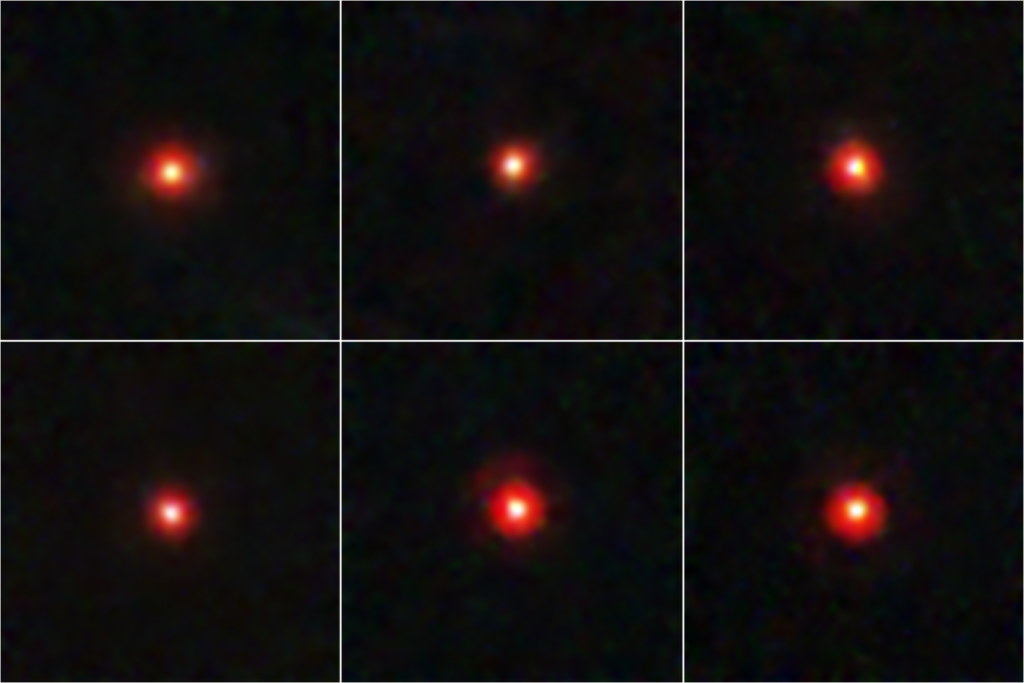
This is what it was meant for. But its most consequential discovery so far was unforeseen: a swarm of crimson specks of light in the distant, young universe, which astronomers have named “little red dots.” James Webb’s data reveal that those dots were everywhere back then: They thrived from 600 million to 1.5 billion years after the Big Bang, and then … mysteriously disappeared. Nothing quite like them exists today.
The dots offer a lesson not only in the mysteries of the universe, but in the peculiar economics of the scientific frontier. A space telescope has a calculable price: mirror, instruments, launch, operation. But what it discovers does not.
That relationship is true for any scientific venture. A discovery — especially an unexpected one — is the highest-value asset that a curious species like ours can acquire. But we never know what the discovery will be, or where it will come from or when. There is nothing to sell before it exists, and once it does, its returns rarely accrue to whoever paid for it. This is one reason pure science today is chiefly (but not exclusively) funded by public money.
Nonetheless, discovery is ultimately a profitable investment. History abounds with examples of what Abraham Flexner in 1939 called the “usefulness of useless knowledge” — curiosities that turn out to be moneymakers years or decades after their discovery. The technology behind your phone’s camera was invented by NASA scientists trying to make tiny detectors for spacecraft. WiFi runs on techniques radio astronomers developed to hunt for exploding black holes. Quantum mechanics, which seemed a mind-bending, esoteric concept a century ago, is now built into every chip, laser and phone. The chips Nvidia spent decades developing for video games turned out to be the missing hardware for artificial intelligence — a side quest that helped make Nvidia the first $5 trillion company.
After James Webb detected those little red dots, the question of what they were consumed the field of astrophysics — including me — for years. Two main answers emerged: Perhaps the dots were unimaginably dense groups of stars, so many that if Earth sat at their center, our sky would shine with billions of suns. Or perhaps they were lit by giant black holes devouring matter, roughly the moon’s mass every few seconds, and heating it until it glowed. Every new observation seemed to support one hypothesis and contradict the other.
I have defended the black hole hypothesis since its inception, though I watched countless observations challenge it. And now, after years of journal articles and conferences around the world, this debate has been partly settled: Most astronomers believe massive black holes power the dots. Yet two main mysteries remain.
First, these black holes are oddly invisible. James Webb, gathering infrared light, detected the fingerprints of matter whirling around a colossal and unseen object — a black hole. But a feeding black hole should also be ablaze in X-rays as superheated matter falls toward its bottomless pit, emitting a final scream of high-energy light before vanishing. Yet, with a couple of exceptions, astronomers have not detected those X-rays from the dots, even using NASA’s most powerful X-ray observatory, Chandra, possibly because these black holes emit too few X-rays for current instruments to catch.
Second, the dots’ black holes are surprisingly massive. In today’s universe, galaxies are monumental structures, outweighing their central black holes a thousand times over, and the standard conception is that a supermassive black hole develops at the center of an existing “host” galaxy. But in the case of the dots, the gigantic black holes seem to rival their host galaxies in mass. And they may have come first: not by-products of galaxies’ evolution, but the seeds from which the first galaxies sprouted. If this turns out to be true, the long-presumed chain that led from a dark, formless universe to galaxies, stars, planets and, eventually, us would be rewritten.
Beneath these mysteries lies the oldest question of all: Where do we come from? The stakes are enormous, and the returns might be supermassive. X-rays are the unmistakable proof of a black hole’s presence — catch those photons, and you are reading a message in a bottle from the dawn of time. To see the beating hearts of the dots, astronomers will need an X-ray telescope far more powerful than Chandra. NASA is starting to explore such a next-generation observatory in an initiative with the fitting acronym ASTRA.
But no line item can capture what a telescope will actually accomplish. Time and again, we build an instrument to answer one question, and the universe presents new ones. We have been rewarded for daring to ask questions, but those rewards have always been as unpredictable as the light beyond the horizon.
James Webb sees the little red dots as they were more than 12 billion years ago — smudges of glowing red in a universe ruled by night. They may help answer one of the most fundamental questions: What lit up the universe? The light that holds the answer has been streaming toward us for billions of years, but our instruments cannot catch it. Could it be that the universe was first illuminated by its darkest objects — black holes? We do not know what a new eye on the sky will reveal. We never do — that is why we must build it. What we do know, from centuries of looking, is that there will be something.
The post Could ‘little red dots’ illuminate the origins of the universe? appeared first on Washington Post.