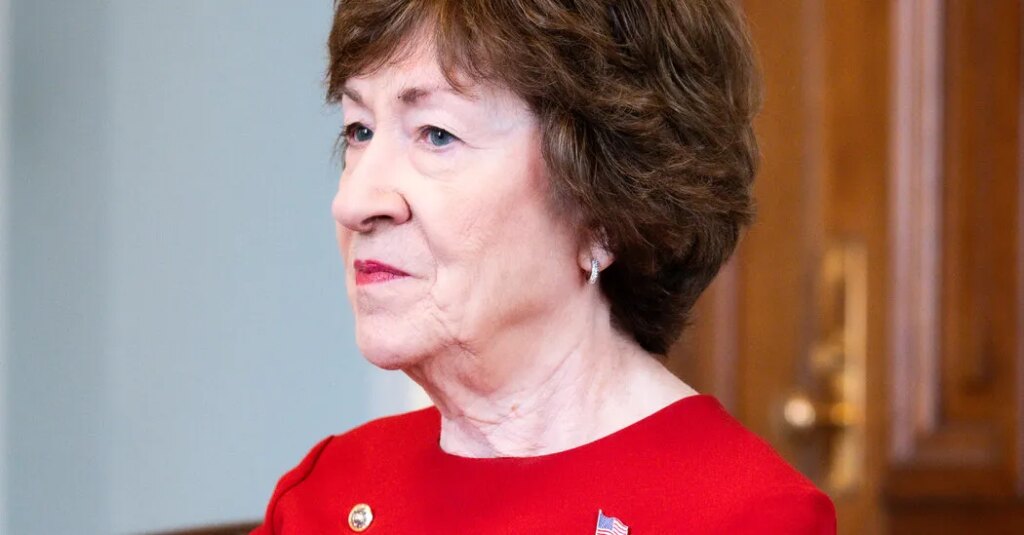
It was approaching midnight on the Senate floor, and a vote that had been meant to last 15 minutes had dragged on for nearly three hours as Senator Susan Collins, Republican of Maine, weighed whether to kill one of President Trump’s top priorities.
It was hardly the first time she had faced such a choice.
Throughout Mr. Trump’s two terms, Ms. Collins had frequently criticized the president and voted against his initiatives more often than anyone else in her party. She cherished her reputation as one of the few remaining independent-minded Republicans in the Senate, which helped explain her enduring popularity in her purple home state. Yet she had more rarely blocked the president’s agenda outright.
On that night last summer, Ms. Collins had the chance to do so. The senator, the chairwoman of the committee that controls federal spending, was deeply opposed to a bill Mr. Trump had demanded to cancel $9 billion in foreign aid and public broadcasting money that Congress had approved.
She had prepared an amendment to shield the Corporation for Public Broadcasting from the cuts, a move that had bipartisan support. But if she succeeded, conservatives loyal to the president would all but certainly refuse to back the spending cuts. Given Republicans’ slim majority, their opposition could have doomed the bill, blocking Mr. Trump’s plan altogether.
After hours of wavering, Ms. Collins decided not to try to make the change. In what amounted to a largely symbolic move, she voted “no,” on the bill, registering her opposition to revoking the spending even though it was clear the measure had enough Republican votes to pass.
That is just what happened. A week later, the cuts were enacted as Mr. Trump wanted.
As Ms. Collins runs for a sixth term this year in a race that has the potential to determine control of the Senate, the episode encapsulates the tension at the heart of her political identity. It has fueled one of the most dominant and long-running lines of attack against her: that she only defies the president when it doesn’t matter.
A New York Times analysis of Ms. Collins’s voting record over the last decade paints a more complicated picture. It shows that she breaks with her party more than any other Republican senator. It also reveals that her defections — which frequently helped Democrats block parts of Mr. Trump’s agenda during his first two years in office — have rarely thwarted the president during his second term.
Ms. Collins, the lone congressional Republican remaining in New England and the chairwoman of the powerful Appropriations Committee, has had her share of major ruptures with Mr. Trump, including when she cast a critical vote in 2017 against repealing the Affordable Care Act and when she voted in 2021 to convict him in his second impeachment trial. It is a record she often cites as proof of her independence from the president as she runs in a state that he lost three times.
The Times’s analysis found that during the current Congress, Ms. Collins has broken with her party 17 percent of the time on votes in which lawmakers mostly divided along partisan lines — more than any other Republican senator.
That is roughly in line with the frequency of her defections during the first Trump administration, though the number has grown as partisan votes have become much more common. But her success rate when she breaks with other Republicans — the times when her vote helps Democrats’ position prevail — has steeply declined.
During the first two years of Mr. Trump’s first term, Ms. Collins’s helped thwart his plans roughly half the time she opposed them. Those instances included stopping Mr. Trump’s attempts to repeal President Barack Obama’s health care law, opposing military assistance to Saudi Arabia and blocking an effort to rescind billions of dollars from the Children’s Health Insurance Program. When Ms. Collins has sided with Democrats over the past two years — such as when she opposed Mr. Trump’s spending cuts, his tariffs and, more recently, switched her vote on the war with Iran — her position has prevailed only 15 percent of the time.
Phoebe Keller, a spokeswoman, said that in a statement that Ms. Collins had long demonstrated a willingness to vote in the best interest of her constituents, regardless of which president was in power, and denied that she limited such breaks to instances where her party could afford to do without her vote.
“She has supported them when she agrees and does not hesitate to vote against the administration when she disagrees,” Ms. Keller said.
But her defections appear to have made less difference in recent years. To some extent, this reflects the increasingly polarized nature of the Senate, in which Ms. Collins has found fewer Republicans willing to join her in defying Mr. Trump. As the president has tightened his hold on the Republican Party, chasing moderates and establishment figures like her out of Congress, they have mostly been replaced by hard-right figures who seldom break ranks.
It also reflects how Senate leaders have adapted to contend with Ms. Collins’s views and the political challenges she faces at home. Top Republicans often factor Ms. Collins’s straying from the party line into their strategy on major bills, changing provisions for her or working to persuade enough other G.O.P. senators to stay in the fold to keep the agenda on track while allowing her to defect.
That was the case with Republicans’ signature domestic policy law — what Mr. Trump refers to as his “big, beautiful bill” — which slashed taxes, significantly increased funding for immigration enforcement and made substantial cuts to social safety net programs.
Ms. Collins voted against the bill, expressing deep reservations about its cuts to Medicaid. But she did not stand in the way of Republicans as they sought to bring it to the floor, siding with her party on a key procedural vote that cleared the way for its eventual passage.
Ms. Collins said that vote was necessary to start debate on the bill so she could seek to reverse or limit the health care cuts she opposed. And she noted that it allowed her the chance to add language securing a fund for rural health care providers meant to blunt the legislation’s effects in Maine.
But in the end, Ms. Collins could not kill or even limit the Medicaid cuts. And Republican leaders turned elsewhere to muster the votes they needed to pass the measure over her objections. They labored overnight to win support from Senator Lisa Murkowski of Alaska, loading the bill with a raft of sweeteners including exempting her state from several of the new work requirements the legislation imposed on recipients of social safety net programs.
Republicans have also been forced to maneuver around Ms. Collins to secure confirmation for some of Mr. Trump’s cabinet nominees. She has for decades followed a longstanding Senate tradition of deferring to the president on such picks, including when Democrats controlled the chamber during President Joseph R. Biden Jr.’s term. Over that period, she sided with Democrats more on more than half the votes that were split among partisan lines — a far higher rate of defection than when her own party had control — backing hundreds of Biden nominees, The Times’s analysis found.
Ms. Collins has argued that such votes have helped her work with presidential nominees on issues of concern to Maine, including recently on tariff exemptions. But in some cases, she has refused to back Mr. Trump’s selections, including Todd Blanche for attorney general and Pete Hegseth for secretary of defense.
Ms. Collins did not bring down either nominee. Mr. Hegseth was confirmed after Senator Thom Tillis, a North Carolina Republican who had been working to kill Mr. Hegseth’s nomination and had signaled to Ms. Collins and Ms. Murkowski that he would join them in opposition, had a sudden change of heart and cast the deciding vote in favor.
And after Mr. Blanche’s nomination advanced to the Senate floor, Ms. Collins was the first in a group of undecided senators to announce she would not support him. Mr. Blanche was confirmed after Senator Bill Cassidy, a Louisiana Republican leaving office this year, apparently swallowed his objections.
Still, Democrats have criticized Ms. Collins for voting to confirm several of Mr. Trump’s other nominees only to later vocally condemn them or actions they have taken.
One such vote in particular has come back to haunt Ms. Collins, a supporter of abortion rights, in her current campaign: her decision in 2018 to cast a critical vote to confirm Brett M. Kavanaugh to the Supreme Court. Justice Kavanaugh would join the conservative majority that overturned Roe v. Wade in 2022. Ms. Collins has said that he “misled” her about his position on Roe, but that she does not regret backing him.
More recently, she voted to confirm Russell T. Vought, the White House budget director, who at the time of his nomination had aggressively challenged Congress’s power to control federal spending, repeatedly arguing that the president could withhold money appropriated by Congress.
Ms. Collins said then that she believed presidents were entitled to “broad discretion when selecting cabinet secretaries” and was focused on “whether the person is qualified for the job.” Ms. Keller, her spokeswoman, said that Ms. Collins continued to work closely with Mr. Vought on spending bills.
But in the time since Mr. Vought’s confirmation, she has angrily objected to a litany of moves he has made to defy congressional intent on spending, including the $9 billion rescissions package she voted against; the move to permanently layoff furloughed workers during last year’s government shutdown; the White House’s rejection of funding for scientific research approved by lawmakers; and the freezing of $600 million Congress appropriated for an international partnership helping developing countries buy and distribute vaccines.
Last month, the White House notified Congress that it was pursuing its second effort to unilaterally cancel spending without the approval of lawmakers using a tactic known as a “pocket rescission.” Ms. Collins called it “a clear violation of the law.”
“This is the most recent attempt by this Office of Management and Budget to undermine Congress’s constitutional power of the purse,” Ms. Collins said. “I will work with my colleagues to address these illegal actions.”
About the data
For its analysis of senators breaking with their parties, The Times focused on votes in which the two major parties diverged. Specifically, The Times selected votes in which at least 60 percent of one party’s participating members voted “yea” and 60 percent of the other party’s participating members voted “nay.” The Times calculated how often, during such votes, each senator voted against his or her party’s majority. The analysis excluded votes in which at least half of a party’s members did not vote.
The Times used data from Voteview covering votes through mid-September 2026. The Times included all types of votes, not only those concerning the passage of bills.
Because the four independent senators active during the time period analyzed all caucused with Democrats, The Times counted their votes toward the Democratic Party totals.
The post In the Senate, Collins Often Defies Trump but Rarely Stops Him appeared first on New York Times.