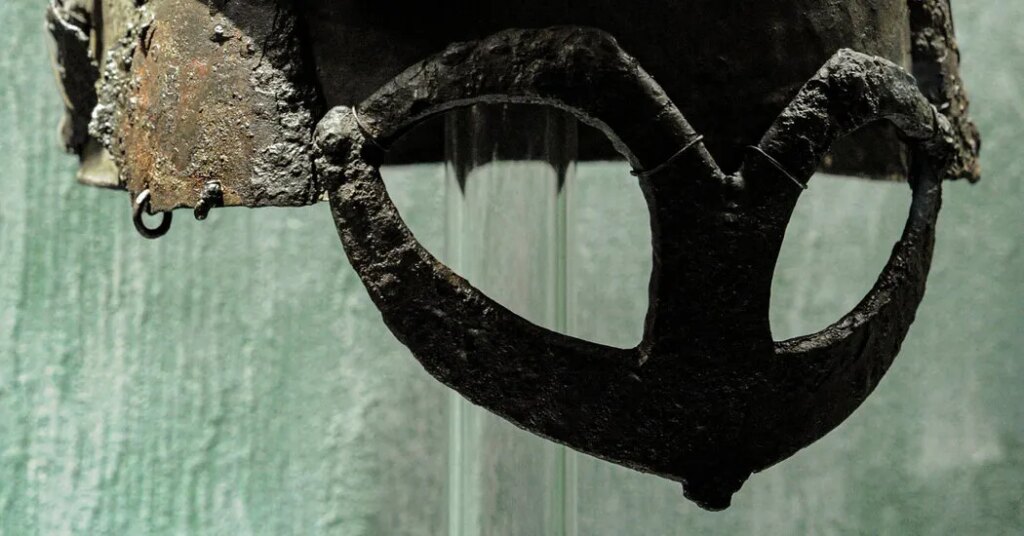
Vikings have long occupied a secure if bloody niche in our collective imagination: pagan maritime marauders, perpetually furious and forever silhouetted against a burning monastery.
If there is a scholar who has emphatically pushed against this cinematic cliché, it is Neil Price.
A London-born archaeology professor at Uppsala University in Sweden, Dr. Price has worked to dismantle the image of the horn-helmeted brute through years of painstaking research. His 2020 book “Children of Ash and Elm: A History of the Vikings” used that research to build a broad historical scaffolding of how the Viking world worked. It suggested that “Viking” was never an ethnicity at all. It was a job description that included overseas raiding and seafaring expeditions.
Dr. Price’s latest book, “The Sea-King and the Sorceress: Life and Death in the Viking Age,” humanizes that world even further by diving into the distinct histories of 21 people from ancient Norse burial sites.
According to Dr. Price, the terrifying armies that descended upon Europe from A.D. 750 to 1050 were not a monolith. They were essentially migrating communities, driven from their homelands by profound social, political and economic upheavals. These communities traveled with women, children and the domestic clutter of a displaced diaspora.
Viking society thus was a fluid melting pot that absorbed Arctic hunters, Persian noblility and Indigenous Sámi nomads into its cultural fabric. The Norse also treated certain animals, specifically bears, not as property or prey, but as individual beings endowed with personhood and distinct societal status. To meet a bear in the woods was to meet another citizen of the cosmos.
Vikings, the book shows, were far more complex — and far more diverse — than the popular narrative makes them out to be.
This conversation has been condensed and edited for clarity.
Most Viking histories fixate on Scandinavian raiders rampaging in England. Your work reveals instead a mobile society stretching from Greenland to Greece. Why does the rest of the world keep getting the Viking map so wrong?
The lingering effects of the Cold War dropped an absolute barrier across European scholarship. Russian and the languages of Asia — the diaspora extended way beyond Greece — also tend not to feature in the skill set of Anglophone medieval historians. The other stories were not being told internationally, quite simply.
Was there a specific moment during your research when a long-held academic consensus cracked right in front of you?
It was a sort of epiphany, shared by many colleagues, I should add, realizing that the diaspora was truly vast. The Rosetta Stone there is a ninth-century report by an intelligence officer from the Caliphate, which relates how the Rus’ — that is, with some caveats, the Norse in the east — journeyed all the way to China. Wait, what? The archaeology is starting to back that up.
You populated this book with diplomats, shape-shifters and nomads. If you threw a dinner party with three of your historical subjects, who gets an invite?
I’d love to talk with al-Ghazāl, the Andalusi ambassador to the Vikings, but you’d need to be careful of his charm. It would also be fun to speak to the Varangian, the warrior who carved on the Piraeus lion. Lastly, I’d invite Ástríðr Sígfastsdóttir, the high-status matriarch, who’d make entertainingly short work of the other two. A definite Maggie Smith vibe there, though like most of the wealthy Norse she was a slave-owner and we should not be disingenuous about any of them.
How does the Norse concept of the natural world differ from our rigid division between human and animal?
The Norse saw sentience all around them in an ensouled world — in animals certainly, but also in trees, plants, rocks and more. When the goddess Frigg tries to ensure that nothing will ever harm her son Baldr, she even extracts promises from metals and diseases. For that matter, the Norse also believed that their weapons were alive, with names, personalities and biographies.
Which Viking trait mirrors our own modern anxieties, and which behaviors remain utterly alien?
Beyond the drama of the sagas, it’s clear that a refusal to give up was something they really valued, and I like that. The violence of their funerals — the killing of both people and animals to accompany the dead — alongside the performative drama that could last for days, still sends a chill through me.
When looking at the sorceresses and the spiritual practices detailed in “Sea-King,” what did the archaeology reveal that the written sagas entirely left out?
That the saga sorceresses were actually real, not medieval fiction. That’s not to say I believe in their magic, but they certainly did. The most important new information, though, was the detail of their equipment and clothes, what they really looked like. One of them was buried with white lead makeup and silver toe rings. Who knew?
What was the core visual aesthetic of the rest of the Viking world?
Definitely “dress to impress.” They blinged out their clothes and themselves to the limit of what they could afford: silver jewelry, bright colors, shimmering silks, body art, makeup, even mirrors sewn into their clothes. Shiny people, and hard to ignore.
What was the most shocking discrepancy between how the Vikings viewed their own lives versus how their victims wrote about them?
I think it has to do with moral value. Norse moral codes were not only utterly different from our own, but also from those of most of their neighbors. Above all, there was little concept that what you did in life affected your fate after death, the complete opposite to Christian belief. One of the biggest shifts we see happening during the Scandinavian conversion to Christianity can be found on runic memorials, where the Norse start claiming that their dead relatives were “good” people. They needed to believe that, thinking of Heaven and salvation, when they’d never had to before. It kind of messed with their minds.
What did you find most disquieting about the way life and death unfolded within the Viking world?
One thing that surprised me was to learn that the average lifespan really was about 42, even assuming you were one of the lucky people who made it past the age of 10, or infancy. The Vikings lived fast and had to make it count; someone in their 60s or 70s was very old indeed.
If someone on the subway spots your book and asks, “So, is this ‘Vikings’ the TV show or actual history?” what is your response?
It’s definitely history. But I’d also say that if you like the TV show, then read the book for the realities behind the story. History is even more entertaining than the drama, and weirder, too.
The post Who Were the Vikings? 21 Graves Weave a Tale of Hunters, Nomads and Sorceresses. appeared first on New York Times.