THE HAVANA SYNDROME: Secret Weapons, a Government Cover-Up, and the Greatest Spy Mystery of Our Time, by Michael Rey and Oriana Zill de Granados
Let’s say you are an official of the American government. One evening, while resting in your living room after a long day of work at the U.S. Embassy in Tbilisi, you are hit by a wave of pulsing energy. Soon your head is aching or ringing. Perhaps blood begins to gush from your ears and nose. What should you do?
Based on the dozens of U.S. soldiers, spies, bureaucrats, spouses and innocent bystanders whose experiences have been cataloged by the CBS journalists Michael Rey and Oriana Zill de Granados in their startling exposé “The Havana Syndrome,” there is some advice you can follow. First, get away from wherever you are — head to another room if you can. Second, secure your children and pets. Third, expect to fight for health care and recognition for the rest of your life.
Rey and Zill first began reporting on Havana syndrome as investigative producers for “60 Minutes,” and they make the strongest case yet that these hits — some officials estimate there have been thousands — are intentional attacks by Russian agents and their proxies, using a futuristic and sinister energy weapon. The U.S. intelligence community, however, and especially the Central Intelligence Agency, the authors convincingly argue, have been desperate to conceal the damage done to Americans as they have served their country abroad, and occasionally at home.
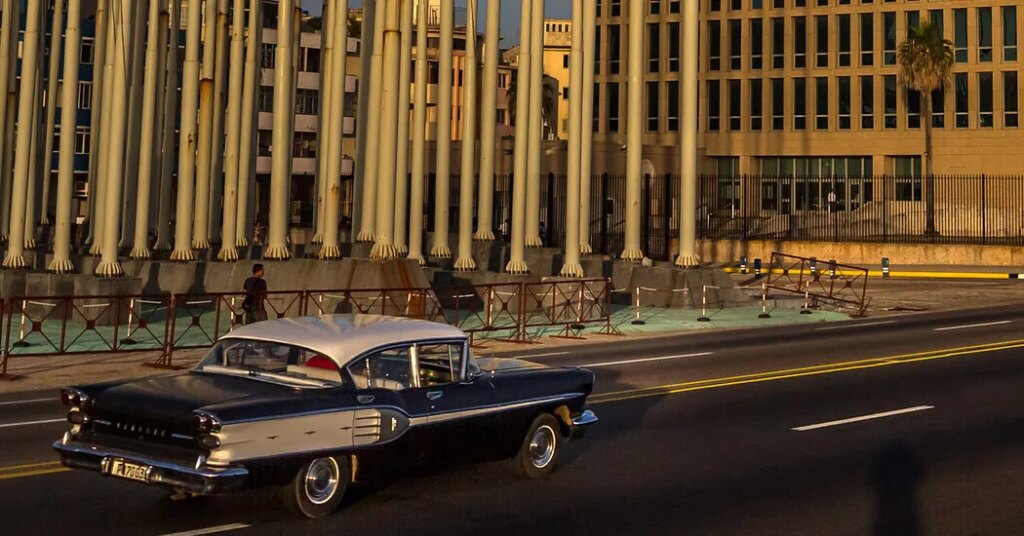
The term “Havana syndrome” was coined in 2017 by a Belgian blogger-cum-nuclear-physicist to describe a set of unusual press reports of traumatic head injuries with no readily evident physical cause. Multiple U.S. intelligence officers and diplomatic officials claimed that they had been hit by some kind of invisible attack. Many of them had been on the job in the Cuban capital when they fell ill, hence “Havana.” In August 2017, journalists raised the issue at a White House news conference.
Soon, more cases began popping up all over the world — China, Georgia, Vietnam. Who was behind the attacks? According to early U.S. intelligence assessments, no one at all. In an internal 2019 report that only came to light in 2024, the F.B.I., working in concert with the Cuban government, called the cases a potential result of “social contagion,” or as Rey and Zill put it, “mass hysteria.”
This characterization seemed to be bolstered by the fact that the weapon left no bullet or chemical behind. “It’s not like a pistol where it leaves traces,” an anonymous government source told the authors. “It’s hard to detect the signal.”
Other services were quick to follow in the F.B.I.’s footsteps: In 2022, the American intelligence community, led by the C.I.A., issued an interim report arguing that, in all likelihood, no dirty deeds had been done. But strangely, as the years wore on, some agencies began to cast doubt on the C.I.A.’s conclusion. Then, in a House Intelligence Committee hearing in March of this year, even the C.I.A. director backed away from his agency’s original statement.
The result is that Havana syndrome is one of the best-known stories in contemporary espionage, but one of the least understood. “Readers may have heard that the Havana syndrome has been fully debunked by the U.S. government,” Rey and Zill write. “It has not.”
The authors have clearly worked closely with the victims of these attacks, some of them C.I.A. officers who have come from the shadows to talk about their experiences, though they have to hide pretty much everything else about their lives. The authors’ descriptions of their pain, in horrific, visceral terms, feel all too real, and medical analyses of the victims, including M.R.I.s, appear to show signs of head trauma. Some have had to go through extensive surgery to relieve their symptoms. “My brain was pushing through the holes into the semicircular canals into my inner ear. Every sound was excruciating,” one says. “I wanted to die.”
Rey and Zill’s book is a maddening read. Every time the U.S. government appears to promise a thorough investigation, there is no follow-through, or worse: The people on the C.I.A. task force set up to investigate the phenomenon refuse to take it seriously. In one instance, the authors report, the C.I.A. officer who ran the task force openly mocked the victims at a work get-together, mimicking “a person having a seizure or getting electrocuted while walking around the office.”
Relying on sources in U.S. intelligence, leaked Russian emails and open source tracking data, Rey and Zill also contend that Havana syndrome was the result of targeted assaults by Moscow’s operatives. As the former Defense Intelligence Agency officer Greg Edgreen tells them, “If my mother had seen what I saw, she would say, ‘It’s the Russians, stupid.’”
To get to the bottom of Russia’s involvement in the attacks, Rey and Zill partner with the Bulgarian investigative reporter Christo Grozev and his team at the news site The Insider. (Grozev gives them a schooling in reporting on Russia — for example, he finds a crucial lead on VKontakte, which is a bit like searching for someone on Facebook.) With Grozev’s help, they are able to track a secret unit of military intelligence assassins and a wild cast of thugs and spies who seem to have been involved in the assaults, including a general’s son with piercing eyes whose youthful appearance earns him the nickname “the murder intern.”
Rey and Zill also give a fascinating history of the Kremlin’s efforts to build a microwave weapon, which was, they write, likely tested on Russian prisoners. They also flesh out a story first broken by CNN earlier this year, reporting that such a device had been bought on the black market by U.S. agents around August 2024 and was now being tested on animals at a military base stateside.
The authors’ work is admirable and compelling, but they don’t follow every thread, even ones that seem obviously relevant. The lack of discussion about the mysterious weapon, for instance, that U.S. troops allegedly used — and that President Trump called “the discombobulator” — in the raid to capture the Venezuelan president Nicolás Maduro in January feels like an omission. Their descriptions of their sources can also run a little cartoonish, such as when we are told of a wounded C.I.A. officer named Marc Polymeropoulos whose “red-hot Greek blood still pulsed through his veins.”
More significant, they don’t really delve into one of the biggest questions at the heart of their story: Why, as the authors allege, were U.S. officials so keen to cover up the attacks? Rey and Zill float a suggestion that the government hasn’t looked deeply into the reports because acknowledging the existence of a direct Russian assault on U.S. service members, even as Vladimir Putin’s people boast about knocking off their adversaries, could trigger a dangerous confrontation between the two nuclear powers.
But there are other possibilities, too. The hits appear to have effectively targeted some of the top-performing officers in U.S. intelligence. Could a highly placed enemy agent or agents be sowing confusion and stymying the investigation?
Such speculation does not seem to animate Rey and Zill. At its core, “The Havana Syndrome” is about the failures of the United States government to take care of its own. The challenges that some of the victims have faced to get affordable treatment sadly won’t be unfamiliar to the many Americans who have been frustrated by the U.S. health care system.
Polymeropoulos retired in 2019, less than two years after he reported his symptoms. He calls the agency’s response “a leadership fail for the ages.” It’s a sharp indictment of a government that spends about a trillion dollars a year on defense, but would rather avoid spending money figuring out how to keep its officers safe on an increasingly uncertain global battlefield.
THE HAVANA SYNDROME: Secret Weapons, a Government Cover-Up, and the Greatest Spy Mystery of Our Time | By Michael Rey and Oriana Zill de Granados | Crown | 306 pp. | $33
The post Havana Syndrome Seems to Be Real. Why Did the C.I.A. Deny It? appeared first on New York Times.