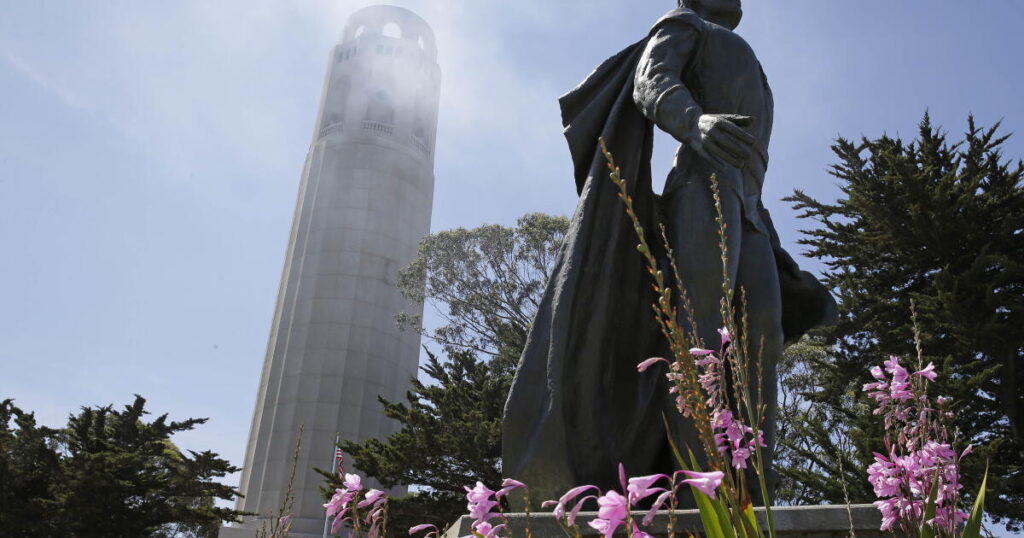
Every October, the same argument resurfaces, and every October it ends the same way: nowhere. Rename it Indigenous Peoples’ Day, say some cities and other organizations. Many have. Keep it Columbus Day, say Italian American organizations, and some cities quietly leave the holiday unchanged. Both sides call upon historians to back their arguments. Both sides produce statistics. Neither side moves the other an inch, and by November everyone has simply agreed to disagree until next October, when the whole thing starts over.
This argument never resolves because it was never really about Christopher Columbus. It’s a theological dispute that both sides insist on conducting as a historical one, and history is the wrong tool for the job.
Start with why the holiday exists at all. Columbus Day — this year being observed on Monday, Oct. 12 — was established in 1892, and not because America suddenly discovered new facts about a 15th century Genoese navigator. It was established, in significant part, in the wake of the 1891 lynching of 11 Italian immigrants in New Orleans — a moment when Italian Americans were widely regarded, legally and socially, as something less than fully white, fully American, fully safe. Columbus became the answer to a specific and urgent question: Is there an Italian who belongs at the center of the American story, rather than at its margins? The holiday was never primarily a monument to Columbus’ lifetime achievements. It was a claim staked on American belonging, using the earliest Italian-ish face from North American history that Italian Americans could plausibly assert.
Indigenous communities, meanwhile, experience Columbus as the opening chapter of a genocide — the man who inaugurated a process of disease, displacement and violence that eliminated the overwhelming majority of the pre-contact population of the Americas. From that perspective, the holiday isn’t a heritage celebration that happens to have some rough edges. It’s a national holiday honoring the start of their catastrophe.
Here is the uncomfortable part: Both descriptions are accurate, and neither community is wrong about what the symbol means to them. The dispute isn’t a disagreement about facts that better research could settle. It’s two communities who have invested the same object with two incompatible sacred meanings, and neither community can give up its meaning without giving up part of how it understands its own belonging and its own suffering. You cannot out-argue a sacred attachment with a footnote.
This is not unique to Columbus. It’s the pattern behind nearly every intractable American symbol fight. Confederate monuments were mostly erected decades after the Civil War, during Jim Crow, as assertions of a particular racial and regional order. Defenders now describe them as heritage, which they are — heritage of the political statement they were built to make, while the people those monuments were built to intimidate experience them as exactly as intended. The flag and the anthem carry a similar split: for some, an object of unconditional reverence; for others, a symbol inseparable from the specific country that has treated them specifically badly. Even the Statue of Liberty holds two readings at once — golden door and, for some, a promise the country has never fully honored. In each case, the fight isn’t over what happened. It’s over which sacred story the object is now required to tell.
The clearest illustration I’ve seen of what’s actually being defended came, unexpectedly, from a subway platform. On the internet talk show “SubwayTakes,” host Kareem Rahma and a guest arguing to keep Columbus Day conceded, without much resistance, that Columbus himself was — their word — a scumbag. Then they proposed a fix: Keep the holiday, just rename it after someone better. Frank Sinatra. Joe DiMaggio. Anyone Italian American and considered decent would do.
If the holiday were really about celebrating Italian American heritage in the abstract, Sinatra’s name would satisfy the need as well as Columbus’ — arguably better, given the scumbag problem. But the swap doesn’t feel like a solution to those who cherish Columbus Day, because the attachment was never to the general function of “a day that celebrates us.” It was to that specific day, that specific name, the specific vessel that has carried the claim to belonging since 1892. Idols aren’t interchangeable. That’s what makes them idols instead of tools.
The artist Sonya Clark spent several years unraveling a Confederate battle flag, thread by thread, with the help of roughly 250 participants working in museums across the country — pulling it apart until what was left was simply three piles of thread: red, white and blue, no longer arranged into anything. The Branch Museum of Design, where the project showed, put it plainly in the wall text: Those three colors can be woven into a symbol of oppression or a symbol of freedom. What story they tell is up to us.
That work of art doesn’t pretend the fabric is neutral, and it doesn’t pretend the fabric is fixed. It says the material is real, the history is real, and the meaning is still, actually, a live question — one that gets answered by what we choose to weave, not by what we insist the old weave secretly meant all along.
That’s why the argument over Columbus Day never lands on an answer. There is not one under the current terms of debate. The disagreement about the holiday isn’t going to go away anytime soon. What counts is how you hold it while it doesn’t: not as two sides who refuse to listen to reason, but as two communities each protecting something sacred. That doesn’t make the fight easier. It makes it, at least, comprehensible — which is more than most renaming debates manage to offer.
Jason Schlosberg is an attorney in Washington, D.C., at work on a book about the sacred and civic symbols that structure American public life.
The post Why we’ll keep arguing about the meaning of Columbus Day appeared first on Los Angeles Times.