He does not claim to be Russia’s brightest spy.
Alexsander had really wanted the job, though. He was born in Ukraine but believed in Russia. And it was hard getting by on his shifts at McDonald’s. So when two Russian operatives approached him with the offer of a piecework spying gig, he jumped.
He was in France at the time, he said. The Russians wanted compromising material on a Western government official. Some of what Alexsander did was real field espionage, like seeing where the official lived. A lot was Google searches. Alexsander didn’t have much need for disguises.
“I had a pair of black sunglasses, but I rarely wore them. Only when the sun was shining,” he said wryly.
Alexsander’s work changed when Russia invaded Ukraine in 2022. He joined a Facebook group for foreigners enlisting in the Ukrainian Army. He gained other members’ trust. On trips to Ukraine, he reported to Russia the location of Ukrainian forces, their planned assault operations and their personal information. His actions, he said, led to soldiers’ deaths.
Then it all caught up with him.
Driving through northern Ukraine, Alexsander was stopped at a checkpoint. A guard asked to see his phone. He had forgotten to delete a message to his Russian boss.
“I am not saying I am a good spy,” Alexsander told me. “I got caught.”
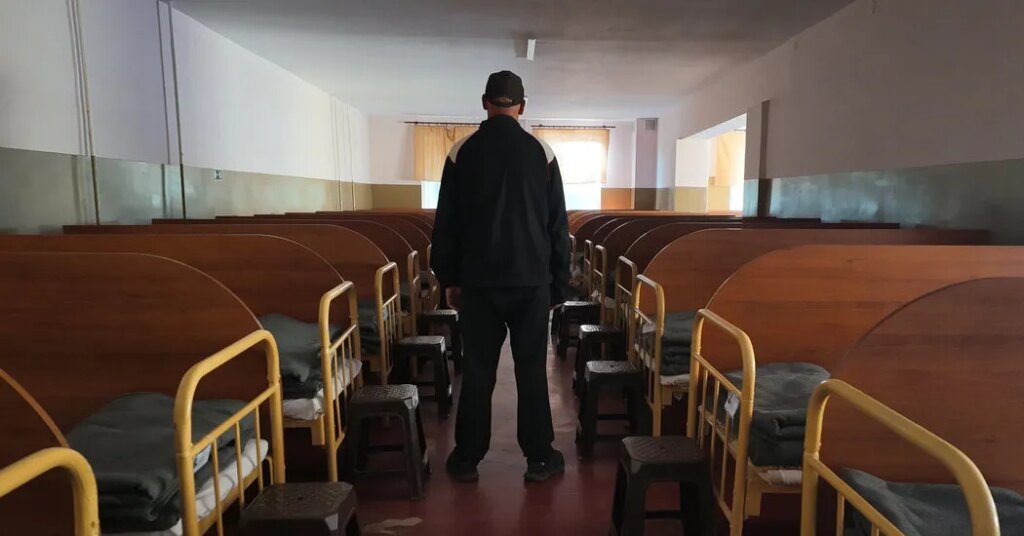
I met Alexsander on a bright summer day in a meeting room of Prison Colony No. 122 in central Ukraine, where he will remain for the foreseeable future after pleading guilty in a Ukrainian court to the charges against him, including high treason.
It is impossible to corroborate everything he told me, though parts of his story could be confirmed through Ukrainian court documents and interviews with Ukrainian officials.
I had received a call from a shadowy contact saying that Alexsander was open to talking. The Ukrainian government has arranged throughout the war for journalists to talk to Russian prisoners. This, however, would be my first time knowingly meeting a Russian spy.
Alexsander, 42, wore a worn-out gray baseball cap, sweatpants and a tracksuit jacket with white stripes along the sleeves. He looked straight into my eyes with a playful yet penetrating stare. He leaned back leisurely in his chair, oozing self-confidence. Now and again, he smiled at a military officer who was in the room for security reasons.
I wanted to make sure that Alexsander knew what he was doing in deciding to sit down with me. “Do you realize,” I asked, “that what you tell me will be published in an article and that it will not necessarily be a positive portrait of you?”
The last part seemed to surprise him. “Why is that?” he answered.
Alexsander is proud of being a Russian spy. As far as I could tell, he just wanted the world to know his story, though he said he did not want his last name published to protect his family. He kept asking me if I was really from The New York Times. Maybe Russia would remember him, he said, and ask that he be included in a prisoner exchange.
There are 2,570 spies for Russia in Ukrainian prisons, according to Yevhen Pikalov, the deputy justice minister in Ukraine. Ninety-nine percent are Ukrainian citizens. Alexsander, who moved to Israel as a young child, is both Ukrainian and Israeli. He is the only such spy imprisoned in Ukraine, Mr. Pikalov said.
Spies still play an important role even as the war becomes defined by robotic eyes in the sky. Both sides have more weapons than ever. Old-fashioned human spying helps them find targets.
There are a few categories of spies, said Viktor Yahun, a former deputy chairman of Ukraine’s main domestic security agency.
Top-level ones are carefully controlled and rarely uncovered, he said. Catching one every six months counts as success.
Then there are lower-level spies recruited for money. Ukraine captures about 120 of those a year, according to Mr. Yahun.
These spies are a bit like the drones that both countries deploy — inexpensive to develop and produced in bulk. They are often juvenile delinquents, drunks or disgruntled soldiers recruited online for small sums, said Sean Wiswesser, a former C.I.A. station chief who spent much of his career working in the former Soviet Union.
Alexsander appeared to belong to a middle category. He seemed motivated by ideology, a supporter of Russia’s effort to control Ukraine and restore Moscow’s power and influence in Eastern Europe. No more than a dozen such agents are caught each year.
But ultimately, like all but the most valuable spies, they, too, are expendable, Mr. Wiswesser said.
Alexsander said he had served in the Israeli Army and left in 2011. He refused to describe the work he did before the two Russians approached him in France.
The Israeli Embassy in Ukraine and the Israeli defense and foreign affairs ministries in Jerusalem did not answer requests for comment on Alexsander.
The Russians, he said, proceeded slowly with him. The first time they interviewed him, they asked only simple questions, observing his behavior and trying to determine his motivation.
“I told them my ideology,” he said. “First of all, to work on the side of truth. Russia is the truth for me. So, yeah, I count myself, so to say, part of the Russian world.”
Though he was born in Ukraine, most of his family live in Russia. He said he felt alienated while living in Israel and in Western Europe, and wanted to return to his roots. Russian intelligence agencies recruit extensively in the Russian exile community, experts say.
In his early work in Europe, Alexsander was assigned to dig up dirt on a business leader. The man turned out to be squeaky clean. He declared every penny he earned to the tax authorities, never cheated on his wife and was always home for dinner, Alexsander found.
“I’ll tell you, honestly, these people are annoying,” Alexsander said.
Still, the pay was good, he said: about 5,000 euros a month, roughly $5,700.
When Russia started its full-scale war against Ukraine, Alexsander wrote in online chat groups for foreign fighters that he wanted to join the Ukrainian military. He never did, but after befriending the foreigners, he traveled to Ukraine to meet with them. He said he gave them advice, including on how to handle problems with their commanders.
Alexsander sent to Russia whatever he could glean from the soldiers and tried to thwart their efforts. Some of his work could be rather elaborate.
In France, he said, he had baited a couple of French would-be fighters into causing a car accident that got them arrested and foiled their plans to join the Ukrainian Army.
He kept at his assigned tasks for more than two years, until Sept. 10, 2024. On that day, Alexsander loaded his gray Citroën with a box of pistol ammunition and set off toward the Russian border in the northern Ukrainian region of Kharkiv. His goal was to trick foreign fighters into taking part in a sabotage operation that was actually a trap.
Instead he stumbled into a trap himself.
Alexsander never thought that a military guard at a checkpoint would ask him to open his phone. This very thorough guard found a photograph that had been sent to Russia. It showed a passport for a soldier fighting for Ukraine.
“He stuck his nose into something he shouldn’t have,” Alexsander said angrily about the checkpoint officer, breathing out cigarette smoke into an already very smoky room, stripes of sunlight hanging in the haze.
The military officer keeping watch during our interview shrugged as the conversation grew tense. He allowed the guards to bring in more cigarettes.
Alexsander took another puff and peeled off his jacket. On his right arm was a tattoo: “Amat Victoria Curam,” Latin for “Victory loves preparation.”
He said he had just one regret in life.
“If I could go back,” he said, “the only thing I’d change would be to delete that photo.”
Natalia Yermak, Michael Schwirtz and Nataliia Novosolova contributed reporting.
The post A Russian Spy’s Lone Regret: ‘I Got Caught’ appeared first on New York Times.