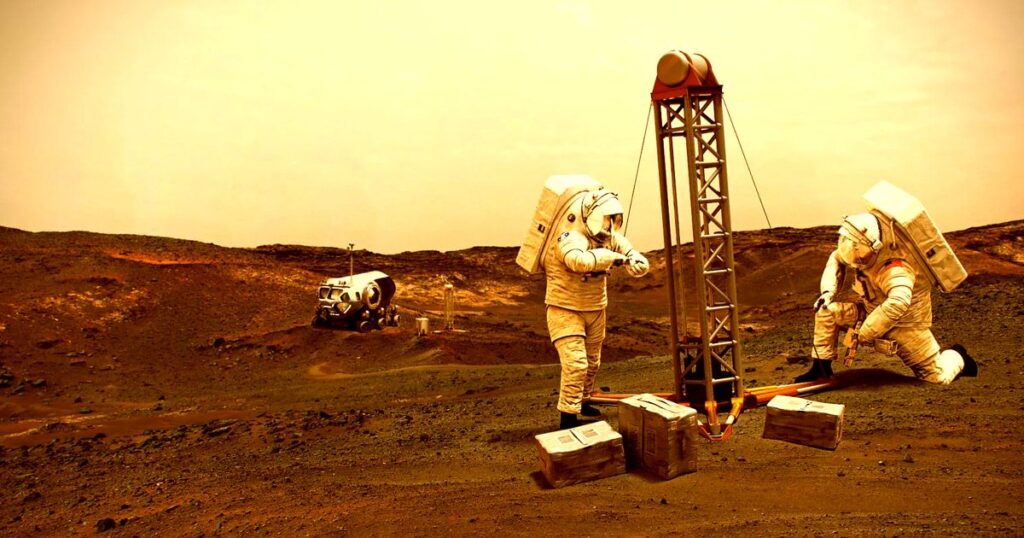
The goal of sending astronauts to the surface of Mars has been a major point of contention, with the likes of SpaceX CEO Elon Musk arguing that we should skip the Moon entirely in favor of the Red Planet — despite NASA already being deeply invested in returning astronauts to the lunar surface for the first time in over half a century.
It’s an enormously more complex journey that will require major leaps in technology, from keeping astronauts safe from the harshness of outer space for months at a time to ensuring they have shelter and enough air to breathe once there.
Unperturbed, a consortium of American scientists and engineers filed a report on Tuesday that stridently makes the case for putting boots down on the surface of Mars. Why? To finally figure out whether we’re alone in the universe, they say.
“We’re searching for life on Mars,” MIT aeronautics professor Dava Newman, who cochaired the committee that drafted the report, told Ars Technica. “The answer to the question ‘are we alone’ is always going to be ‘maybe,’ unless it becomes ‘yes.’”
While NASA has successfully sent five remotely-controlled rovers to the planet’s surface, sending a crew there remains a distant prospect.
But at least there’s a sense of growing momentum. SpaceX space tourist and billionaire jet fighter pilot Jared Isaacman, who has previously argued we can simultaneously send humans to both the Moon and Mars, is widely expected to be confirmed by the US Senate sometime next week as NASA administrator.
The 200-page document pulled together by Newman and her collaborators, which was in development long before Trump took office in January, was designed to identify the top priority science objectives during future crewed missions to Mars. Among the top eleven objectives are the search for life, the Red Planet’s geology, how well humans can survive on its surface, and where future space travelers could find resources.
They concluded that sending a crew to Mars for 30 Earth days — and delivering the necessary cargo during a subsequent mission to allow future astronauts to stay there for up to 300 Earth days at a time — made the most sense for an inaugural campaign.
Yet plenty of major challenges remain. For one, astronauts face the threat of being exposed to copious amounts of deep-space radiation. Then there’s the potential of biologically contaminating the surface, which could threaten life there if it indeed exists.
“NASA should continue to collaborate on the evolution of planetary protection guidelines, with the goal of enabling human explorers to perform research in regions that could possibly support, or even harbor, life,” the report reads.
When humanity might finally send the first humans to Mars remains a big question. If we were to take Musk by his word, the first SpaceX Starship could head to Mars by the end of 2026, sending the first crew as early as 2029, though he sees 2031 as more likely. However, given the company’s progress so far, and Musk’s extensive track record of being overly optimistic in his predictions, it could take a lot longer until we set foot on the Red Planet.
Nonetheless, as we continue to search for extraterrestrial life, scientists are adamant that sending humans there could be a watershed moment for humanity.
“The first human landing on Mars will be the most significant moment for human space exploration since we first set foot on the moon over 50 years ago,” said NASA scientist and Berkeley Space Sciences Laboratory director Linda Elkins-Tanton, who cochairs the committee that drafted the report, in a statement.
“Our report puts science at the center of what will be a remarkable achievement, and outlines the incredible knowledge we’ll have the opportunity to glean about our place in the universe, the potential habitability of Mars, and so much more,” she added.
More on Mars: Scientists Find Evidence of Ancient Tropical Oasis on Mars
The post Scientists Say the Time Has Arrived to Land Astronauts on Mars appeared first on Futurism.