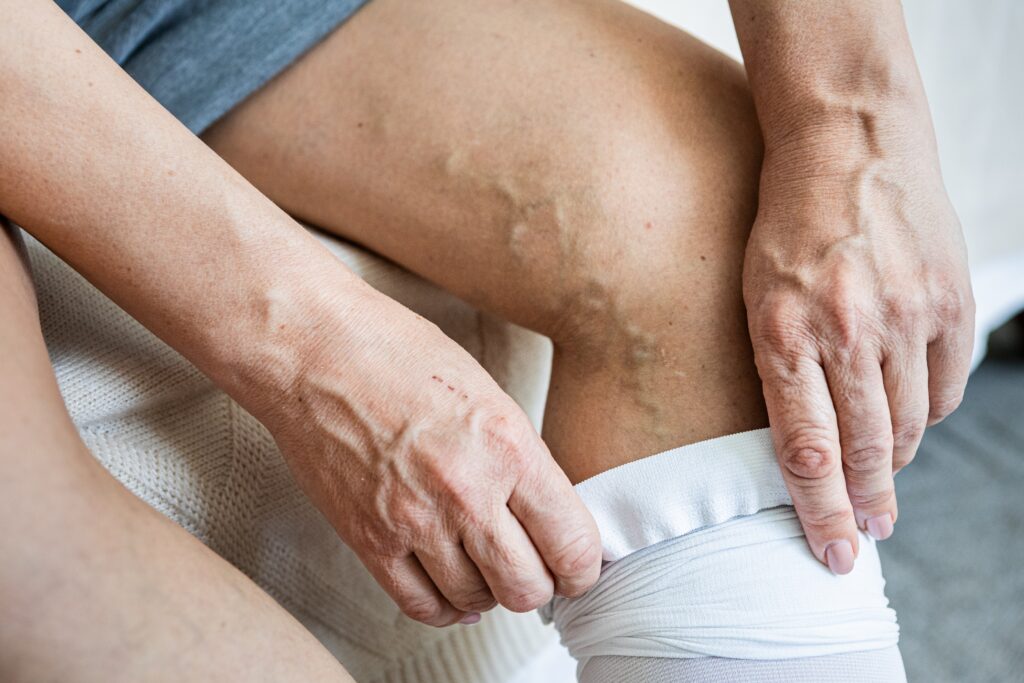
Varicose veins can have a way of suddenly making themselves known: a bulging, twisted or ropelike blood vessel in the leg that catches your eye and seems to come out of nowhere. But the changes that lead to varicose veins unfold over decades — and it might be possible to delay or halt them.
“Veins in the legs have to work against gravity to return blood to the heart,” said Juan Carlos Jimenez, professor of surgery in the Division of Vascular Surgery at the David Geffen School of Medicine at the University of California Los Angeles. Over time, valves inside the veins that prevent backflow can malfunction, allowing blood to seep down and pool in the legs, he explained.
Varicose veins may be unsightly without triggering symptoms, but they can also be uncomfortable, said Julianne Stoughton, vascular surgeon in the Mass General Brigham Heart & Vascular Institute and assistant professor of surgery at Harvard Medical School. In some people, they’re a visible sign of chronic venous insufficiency (CVI), in which the vein valves progressively weaken and fail, leading to high pressure in the veins. Symptoms can include leg heaviness, aching, swelling, throbbing and itching, Stoughton said.
About a quarter of adults in the United States have varicose veins, which are more prevalent in women and become increasingly common with age. You’re also more likely to develop varicose veins if a family member has them. “Some people inherit genes that produce proteins that can weaken the walls of the veins,” Stoughton said. More rarely, people might inherit a propensity for clotting, which can cause scarring in the veins and damage to the valves, she added.
But genetics aren’t everything. Lifestyle can play a big role in your risk for varicose veins. Moving your body, eating a nutritious diet and maintaining a healthy weight can improve blood flow and ease pressure on leg veins.
There are also several specific behaviors that experts said can help support the return of blood from the legs to the heart and ward off the development of varicose veins.
Elevate your legs
This zero-cost prevention tactic simply counteracts the force of gravity. It’s especially helpful to do at night if you stand on your feet all day — Jimenez recommends it to the nurses, doctors, teachers, hairdressers, chefs and set designers who make up the bulk of his patients. You can lie on the floor and prop your feet up on a wall, but even just lifting your legs to hip height can be beneficial, he said. For example, you could put a pillow on your coffee table and rest your feet on top of it while watching television.
Another key time for leg elevation is after a workout, Stoughton said. Exercise shunts extra blood to the leg muscles — which places a bigger burden on the leg veins to send it all back to the heart once you stop. Lifting your legs up “makes that venous return less daunting,” she said.
Wear compression socks or stockings
All the experts we spoke to emphasized the benefits of wearing compression socks throughout the day, particularly if you’re sitting or standing in one place for long stretches. “They push on the weaker superficial veins to give them a little bit of a boost to fight against gravity,” said Justin Ha, a vein specialist at Metro Vein Centers in New York.
Look for graduated compression socks or stockings that cover the feet, which have a pressure gradient — highest at the bottom and lowest at the top, Stoughton said. They’re designed this way to push blood in and upward. Jimenez suggests choosing ones with a minimum pressure around 20 to 30 millimeters of mercury. But as for the height and style, it’s up to personal preference, he said. They don’t have to reach your thighs or take the form of hosiery that you pull up to your waist; even knee-high compression socks can be a major help. Think about squeezing just the very end of a full tube of toothpaste, Jimenez said. Toothpaste will still flow out of the top — and the same principle applies in the veins.
It’s ideal to put compression socks or stockings on in the morning and leave them on all day, Jimenez said. (You can remove them before exercising or elevating your legs, both scenarios in which your veins need less outside support to combat gravity.)
Flex your calves often
Weight-bearing physical activity of any sort supports blood flow in the legs because of how muscular contractions help the veins push blood toward the heart, Jimenez said. But if your work requires you to spend much of your time sitting or standing relatively still, it’s worth incorporating bursts of calf movement into your day whenever possible.
A good practice is to pace around for a few minutes every 30 or so minutes throughout the day, Ha said. Simple heel-to-toe walking activates the calves, Stoughton said. But even while you’re seated, it’s possible to get the calves going. You can pump your heels up and down (while leaving your toes planted on the floor), Jimenez said, or do simple ankle circles or toe taps to help keep the blood circulating.
Choose the right shoes
Blood has to move from the veins in the feet to the ankles before traveling back up through the legs, Stoughton explained. Having weak feet or collapsed or flat arches can lead to pooling of blood in the foot veins, making it tougher for the lower leg veins to do their job.
Shoes with good arch support can help facilitate proper alignment and circulation, as can doing exercises to strengthen the intrinsic muscles of the feet, such as toe-ups (lifting just your toes while keeping the rest of your foot flat on the floor) or towel curls (placing your feet on a towel and using your toes to scrunch it toward you).
Stoughton also suggested avoiding high heels, which prevent the calf muscle from flexing properly with each step.
To tell if you have flat feet, look to see whether the inner portion of each foot fully touches the ground while you’re standing. If yours do, it might be worth seeing a podiatrist who can evaluate your foot mechanics, Stoughton said.
Do water aerobics or water walking
The resistance you feel when wading through waist- or chest-deep water or exercising while standing in water can act as a form of pressure on the legs and might boost venous blood flow, Stoughton said.
At the same time, the buoyant force of water can oppose the tug of gravity, which could make it easier for veins to shuttle blood upward. Stoughton broadly recommends any kind of standing water activity for anyone looking to avoid vein issues or even counteract early-stage venous insufficiency.
When to seek care
The above strategies aren’t guarantees — you can engage in a healthy lifestyle and vein-supportive behaviors and still wind up with varicose veins.
The good news: Varicose veins are generally not dangerous, Jimenez said. If they’re asymptomatic, you might not need any treatment, Ha said. Though if the appearance bothers you and especially if you’re having symptoms such as leg heaviness or swelling, too, then it’s worth seeing your primary care provider. They will likely first suggest several of the behaviors above — compression, elevation and exercise — to help alleviate discomfort, Ha said.
If those lifestyle tactics are not sufficient, they might refer you to a vein specialist, who can suggest additional options. People with varicose veins who have skin discoloration around their ankles should also seek treatment from a vein specialist, Stoughton said. The staining is caused by blood pooling under the skin and leaking out of tiny vessels, and it signals an area at high risk for a skin ulcer, she said.
Treatment for varicose veins typically involves a minimally invasive procedure to shut or seal off the problem veins, using either heat (thermal ablation), a foam or liquid injection (chemical ablation) or a specialized type of glue. These superficial veins are not critical to circulation — they’re considered accessory veins, which the body uses mainly for volume storage and temperature regulation, Stoughton said. After they’re closed, the blood that used to traverse them is able to find its way forward through other veins, Jimenez explained.
But again, whether or when you might need this kind of treatment hinges at least partially on your everyday habits. “We inherit a warranty on our veins,” Stoughton said, “but [our lifestyle] determines if we’re going to lengthen or shorten it.”
The post Here’s how to prevent varicose veins as you age appeared first on Washington Post.