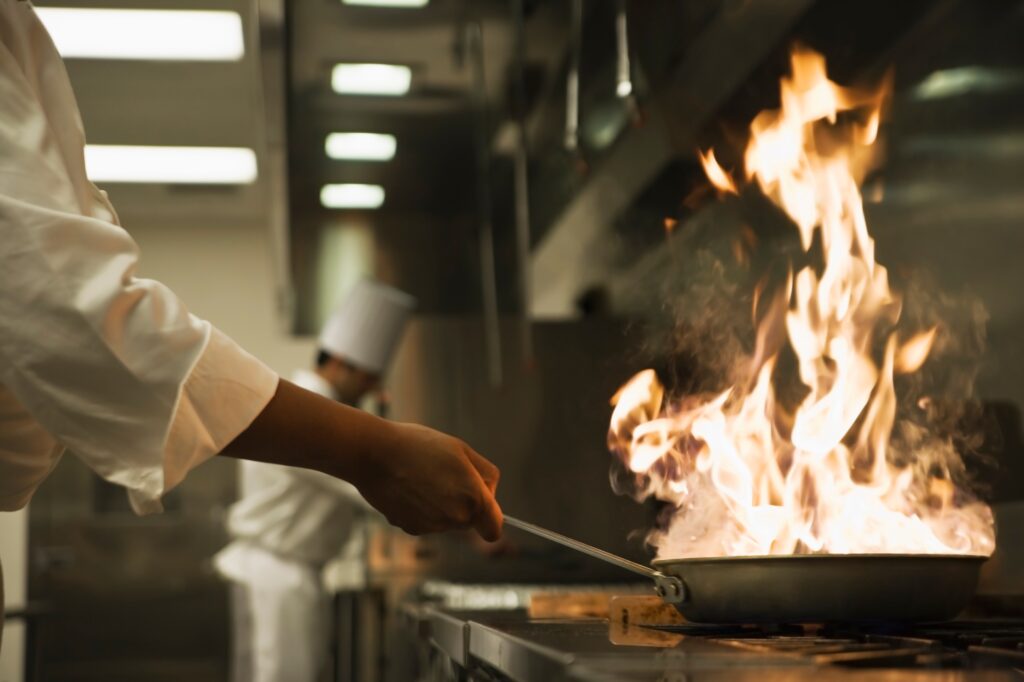
In restaurants across the country that use gas-powered appliances, kitchen workers are being unknowingly exposed to high temperatures and unhealthy levels of pollution from nitrogen dioxide and other chemicals, according to a new study.
New research published this week in Environmental Research Letters set out to examine effects on the more than 15 million individuals working in restaurants and commercial kitchens in the United States, the majority of which use gas stoves.
Yannai Kashtan, an air quality scientist at PSE Healthy Energy and the paper’s lead author, said the team wanted to build on existing research about residential kitchen pollution, which has made up most of the research on cooking-related pollution. The work was a collaboration among PSE, an independent research institution; the Stanford Doerr School of Sustainability; and New York University’s Grossman School of Medicine.
They found extremely high temperatures and unsafe levels of pollution in kitchens with gas appliances, while fully electric kitchens were cooler and had cleaner air. Previous research has found that exposure to gas stove emissions can lead to higher rates of asthma and respiratory sensitivity, especially in children.
“What is like a Thanksgiving-day scenario for just a person living in a house is every single day for so many people working in kitchens,” Kashtan said.
The study looked at a sample of 27 commercial kitchens across three states, varying in size, layout, cuisine, appliances, ventilation hood type and service intensity. The research team tested for nitrogen dioxide, methane, carbon dioxide, carbon monoxide, benzene and temperature across multiple zones in each kitchen.
While kitchen ventilation hoods are intended to catch heat and cooking emissions, workers such as chefs who directly face gas cooking surfaces see high levels of exposure.
The researchers found that about 70 percent of gas or propane kitchens had nitrogen dioxide levels above the Environmental Protection Agency’s one-hour outdoor air quality standard — which sets maximum exposure limits for harmful pollutants — during working hours. Over half of the gas kitchens in the study reached temperatures above 90 degrees Fahrenheit, with some reaching more than 122 degrees.
George Thurston, a New York University researcher who has studied the human health effects of air pollution for decades, said that standards like this should be updated more frequently and to be more specific to workplace environments (such as using eight-hour indoor standards). He also suggested that future studies could look for other emissions, like ultrafine particles and volatile organic compounds.
“They really should be looking at, based on knowledge like they’re getting from studies like this, whether those are really sufficiently protective of health — those standards need to be reassessed, and they haven’t been updated in many years,” said Thurston, who was not involved in the study.
Chef Christopher Galarza, founder and CEO of Forward Dining Solutions, worked with the scientists to connect them with chefs for the study. While collecting data in his friend’s kitchen, he recalled, one of the scientists alerted him to the benzene analyzer spiking above 100 parts per billion — equivalent to the daily intake of heavy secondhand cigarette smoke.
“Knowing that my friend, in 15 minutes, was exposed to something most of those aren’t exposed to an entire month,” he said, “it was pretty crazy.”
The study also found high emissions from the appliances even outside of work hours, indicating that gas stove pilot lights increase pollution levels overnight while ventilation systems are turned off. The pollution levels peak at night and early in the morning before the workday starts.
“I think that’s just important for people to know because if you’re a cleaning crew coming in at night or you’re first into the kitchen, prepping some food cold without meaning to cook, you might not even think about ventilation because everything’s off,” Kashtan said. “In fact, there are dozens of these flames that are on all the time.”
The quick fix for this, according to Kashtan, is turning on ventilation first thing in the morning, even if no one is cooking.
But “the best way to get rid of pollution is to get rid of the source,” he said.
Thurston is a proponent of induction stoves, a type of electric stove, and said he has them in his own home to protect his children’s health.
“I think that this study is important in that it raises the issue of workplace exposures that are avoidable by immediately improving ventilation,” Thurston said. “And then in the longer run, switching over to induction stoves.”
Although the alternatives can be more expensive, the study points to electric appliances as a viable replacement for gas stoves, because they don’t produce combustion pollutants. The study looked at three fully electric kitchens and found they had significantly lower pollution levels and temperatures, and none of the electric kitchens exceeded pollution guidelines.
One of the electric kitchens belonged to Claude Le Tohic, a chef who owns ONE65 in San Francisco, which houses four distinct dining concepts. It runs mostly on electric appliances, with two charcoal ovens and two gas burners used for longer cooking needs that could damage the induction. Le Tohic said that since he first went electric at his previous restaurant in Las Vegas, he hasn’t looked back, and the study’s findings validated his choice.
“We just realized that we were doing things right, and the emissions were very, very, very low,” he said. “It was a very good result.”
Le Tohic encouraged other chefs to consider making the switch, saying the kitchen is a more comfortable environment because of the cooler temperature, easier to clean and better for the planet. He agreed with Kashtan and Galarza that regulations on gas appliances are necessary.
“Food is one of the few common languages we all speak, which brings people together,” Galarza said. “And it’s probably one of our last places that we can come together that isn’t a divisive place. And I don’t want it to be a place that we’re poisoning each other.”
The post Why restaurant kitchens pose hidden dangers for chefs and other workers appeared first on Washington Post.