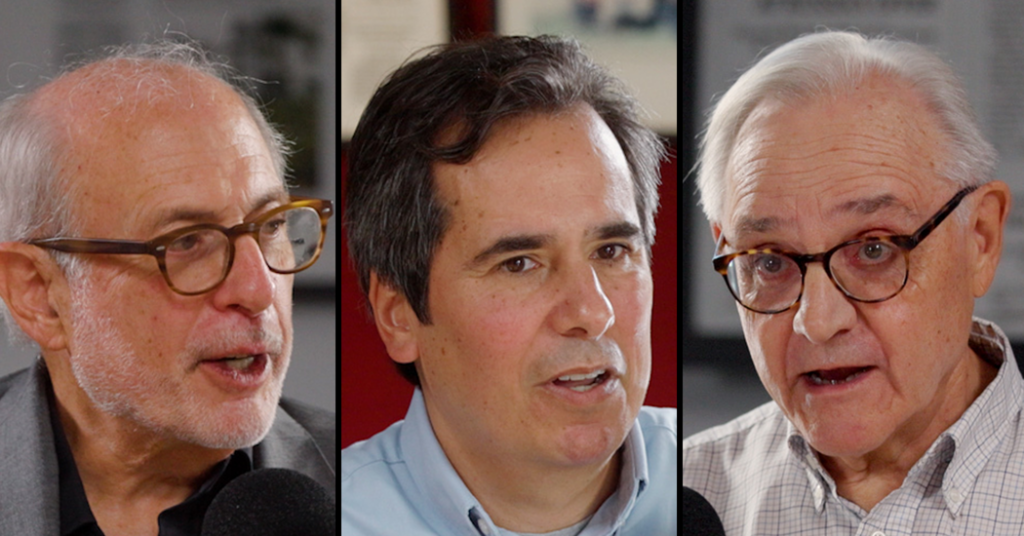
From the midterm elections to advances in artificial intelligence, there’s no dearth of political news this week. The Opinion contributor Robert Siegel joins the contributing writer E.J. Dionne Jr. and the columnist Carlos Lozada to discuss the role money plays in political campaigns, how the Democrats should proceed in November and whether A.I. has the ability to feel emotions.
Below is a transcript of an episode of “The Opinions.” We recommend listening to it in its original form for the full effect. You can do so using the player above or on the NYTimes app, Apple, Spotify, Amazon Music, YouTube, iHeartRadio or wherever you get your podcasts.
The transcript has been lightly edited for length and clarity.
Robert Siegel: This week on our plate: Democrats appear to be doing very well in the midterm elections. What are they selling, and why are people buying? And it’s hard for A.I. developers to figure out how to deal with their models morally. And now comes the question: Are the models capable of making moral decisions on their own? Can they learn morals? Can they feel hurt?
But first, the midterms, and one stunning measure of what’s happening this year.
Records for campaign funding and spending are being shattered. In August, The Times published a list of megadonors — just 20 of them — although some of them are pairs of people, whose combined contributions to various federal races is $1.2 billion. Most of them are Republican donors. Democrats are bracing for a big G.O.P. spending blitz in the last month. Considering all this, the Democrats are doing pretty well in the polls, and that raises the question: How important is money in politics? Do we overestimate that importance? Carlos?
Carlos Lozada: I have conflicting views on money in politics. First of all, it is extremely important. Money buys you name recognition. It may preclude you from running at all if you are someone who lacks the ability to raise sufficient funds. And money buys access to politicians, right? The views of donors inevitably get more attention in Washington. If either of you are “Star Trek” fans, it’s like Spock’s line, “The needs of the many outweigh the needs of the few.” It’s the other way around in Washington, when it comes to money, you know? The preferences of the few outweigh the needs of the many. So money can tilt the playing field, but it doesn’t guarantee that you win the game, right? If it did, Jeb Bush would have been the 2016 Republican nominee, not Donald Trump. Michael Bloomberg would have been the 2020 Democratic nominee.
Siegel: Hillary Clinton would have been the winner of the presidential election.
Lozada: And we’d be somewhere, reaching the halfway point of the Kamala Harris-Tim Walz administration right now. So money can help you amplify a message. It doesn’t substitute for a message. If you don’t have one that resonates with voters, money doesn’t fix the problem. It might even expose that problem even more. The last thing I’ll say on it is, there can be diminishing returns to, say, ad spending. There comes a point of just saturation, where I think voters have had enough and kind of tune it out. I was in Ohio a couple of weeks ago, and my God, was it hard to watch television when I’m just trying to watch a college football game, guys. And every commercial is an attack ad; and after a while, you just sort of start tuning out.
Siegel: Yeah. E.J.?
E.J. Dionne Jr.: I’m glad you started with the few, not the many, buying interest. I think that we should take a step back and say that the Supreme Court, beginning with Citizens United, really destroyed all the guardrails that we had on big money in politics. My friend and mentor in many ways Robert G. Kaiser, famous editor of The Washington Post, wrote a book back in 2009, called “So Damn Much Money,” about the influence of money in politics. And if he did a sequel, it would be “So Damn Much More Money.”
An analysis released just this past Wednesday, by Americans for Tax Fairness, found that 170 billionaire families had spent over $1.7 billion to influence the election. There’s just something wrong here. Among pure democracies, they don’t do it like this, and that influence matters. But as Carlos says, does it always matter?
I think historically what people said is you can be outspent two to three to one. As long as you’re in the game, you can compete. These elections are going to test that further, but I think we’re reminded that no matter how much advertising you put up, the product has to be something people want to buy. And what Republicans so far seem to be up against is a lot of people just resisting the product. Sabrina Tavernise had a great piece in The Times this week, where she quoted a former Republican state representative who gave, I think, the simplest answer to what’s going on. He said, “People are tired. The whole divider-in-chief thing, it’s gotten to the point where it’s just exhausting.” And that exhaustion may yet overcome all this money, but I think it is going to tighten some of these races. We shouldn’t deny that it has some impact.
Siegel: But Carlos, with all respect to Mr. Spock and his formulation, have we simply become desensitized to a massively corrupt relationship between money and politics?
Lozada: I think that money in politics can be especially dangerous when you have a set of politicians, or an administration that has shown itself to be especially susceptible to the desire to enrich itself while in office. There’s also this amazing story that, I believe, ran just this week in The Wall Street Journal, about Kimberly Guilfoyle, the U.S. ambassador to Greece, former fiancée of Donald Trump Jr.
Siegel: Wasn’t she also with the governor of California before that?
Lozada: Prior. Yeah. You know, politics is a family business. And The Journal got hold of all these text messages between Guilfoyle and a Trump donor, where she’s essentially begging him to pay off her American Express bill.
Siegel: $100,000.
Lozada: And the line is: “Honey please I need you to get this done for me today.” They really have all the receipts. And what you see is — aside from her messages where she’s telling him, “Do not say we have any arrangement. What a nightmare you’ll literally cost me my ambassadorship stop writing” — there’s one moment when the donor responds and he says: “I have paid you $300,000 over the years. As of this memo, I have not received one favor. I am not naïve or a sucker. I need results.” And that captures so clearly, so blatantly, the quid pro quo expectations — why people donate money. “I need results.”
Siegel: Moving on. E.J., we talked the other week about how the midterms are likely to affect the Republicans in 2028. Let’s talk about the Democrats right now. Going by the polls, which admittedly can be very hazardous, Democrats are leading in states where they didn’t seem to have a chance. They’re competitive in places where they had been an endangered species. What are the Democrats selling so well, exactly?
Dionne: Well, as I mentioned, I think that the thing they’re selling most is a backlash against Trump, prices, and a war in Iran that is deeply unpopular, because it’s still not clear why we fought it.
Siegel: They’re selling who they are not.
Dionne: Well, right. And so, they are selling the thing you sell first in a midterm election, which is: You don’t like that guy in the White House; buy us. But I think, underlying here, there are a couple of big lessons. You’re seeing a lot of more moderate Democrats challenging in states, Kansas notably, where they haven’t elected someone in a long time. And so you’d say that’s an argument for moderation. But you’re also seeing an awful lot of Democrats, including moderate Democrats, running against concentrated economic power, big corporations, the power of billionaires and what and how that affects people’s lives.
And so, I’ve been thinking a lot about: The lesson of this election is what we need to move beyond. And our conversation partner for a long time, David Brooks, once made fun of me for being a beyond-ist, saying we need to move beyond this or that. Well, I’m a double beyond-ist in this election. I’m doubling down, I guess. Because I think, on the one hand, the Democrats need to move beyond the left-right fight in the party and say: Look, in order to win in a lot of places, you cannot be a left-wing Democrat. The word “socialist” doesn’t sell everywhere. And that a certain amount of care and moderation and understanding of who your constituents are is really important.
However, the left is right when it says that there is a lot of disaffection with the economy and about this inequality. The party has to find someone who can pull these messages together. But the other beyond is, I think the country so wants to get beyond this division, wants to get beyond where we are now, where we’re not solving any problems. And I think somebody who can move the country past this, who can plausibly make that argument. You’re seeing that in the campaign of James Talarico in Texas, Adam Hamilton in Kansas — both talk about trying to bring people together. And so, I think this double message comes out of this election and gives Democrats a potential road to not only a victorious message, but actually a substantively decent message.
Siegel: What do you think, Carlos?
Lozada: When I hear questions about the Democrats — Will the Democrats win back the Senate? How will the Democrats do? My question is always: Which Democrats are we talking about? Like, what version of the party? If there is a resounding Democratic victory next month, what version of the party will claim that victory?
What version will be able to use it as a governing mandate? Will it be the progressive wing, the D.S.A.-inflected wing, or will it be, as you mentioned, the Hamiltons in Kansas and Talaricos in Texas? That’s the key question leading into 2028, but also into your question of, what is it that they’re selling, because different people are selling different things. I think, regardless of how it turns out, and of which part of the party claims that mantle, there’s such a thing as overreading your victory. I think we’re seeing that with Trump right now. Donald Trump took his victory in 2024 to mean he could do whatever he wanted on immigration, on tariffs, foreign policy — and that has backfired massively.
Would a Democratic victory really mean an endorsement of Democratic priorities, or is it — as E.J. mentioned at the beginning — a repudiation of Donald Trump? Midterms are always a repudiation, or often a repudiation, of the party in power. Of course, people who win like to say elections have consequences, right? That was the famous Barack Obama line. But my corollary to that would be: Elections often have bizarre, unexpected consequences, even when you win. Just go back to 2022. People were thinking there might be a red wave. The opposite of today. And when there wasn’t — when the Democrats performed better than expected — that was read as some kind of victory for Joe Biden, for his agenda. It may have encouraged him to run again, despite worries over his age. And we all know how that turned out. So in some ways, I think you never really know exactly what an election means and what it’s going to lead to.
Dionne: You know, I think this is really important, and elections can be like Scripture. They can be read in many different ways, and people, partisans in various arguments, always read them as confirming whatever it was they thought going in. You saw that a lot in 2024: Why did Trump prevail? But Carlos’s comment on the nature of Democratic Party requires the obligatory reference to Will Rogers: “I’m not a member of an organized political party; I’m a Democrat.”
And the fact is that the Democratic Party is a very big coalition that is very hard to hold together — which is something each faction of the party has to remember. And so I think it’s a difficult line they have to walk, because the country really does seem to want substantial change from where we are. But that does not mean that the country has gone all ideological in one direction. Now, how do you square that circle?
Siegel: I do think what you said earlier is actually quite important; that there are people whom we call moderates, who are running in a way that during the Reagan and Bush presidencies, I think, was branded by Republicans as class warfare. If you keep on complaining about what the billionaires have got and how much rich people are getting away with, that’s divisive. It isn’t good for the country. And it seems that the line, the definition of moderation the way I hear it, has changed a bit to include some complaint about inequality in American life.
Dionne: One hundred percent. Although I think there was always class warfare on both sides, the Republicans wage class warfare against the educated class, and the Democrats did it against the moneyed class — and it was a clash of those two forms of class warfare. But absolutely right: You could argue that reality has moved to the left to some degree. And even some conservative economists I know acknowledge that rising inequality over the last 30 years is a fact and an important problem in the country. And so you have a lot of, yes, moderate Democrats speaking in class terms. Why? And I think, by the way, tech has brought that into relief because the tech folks are so wealthy, and have accumulated so much wealth, that this is an issue that sort of transcends ideology now. But you’re right. Class warfare, or at least an awareness of class inequality, is much more embedded in the conversation than it used to be.
Lozada: Yeah. Two thoughts on that: First, one of the things that has happened since that Reagan-Bush era attacks on class warfare by the Democrats is that you’ve had reality intervene in the form of the Great Recession. And that really, I think, crystallized for a lot of people what had been going on for a long time, which was the increase in inequality in both wealth and income in the United States. And so I think that, in a sense, has become a more mainstream concern that once would have been classified as a more extreme concern. The other thing I’ll say about that is that, in some ways, this is also a more palatable rebranding of the Democratic Party, away from what, say, Alexandria Ocasio-Cortez would refer to as “Woke 1.” The culture war issues, on gender, on identity, on race. A.O.C. generated some headlines recently, when she said, “Woke 1 was crazy,” right? And this, I think, is Woke 2.
This is the far more focused attention on issues of economics, of class, of inequality, affordability that, in a sense, is a remaking of the party on issues that, because of that reality that has changed, seem much more palatable to the broad swath of voters.
Dionne: Of course, for the people who would recognize this, I don’t think it’s woke. I think it’s something that old Franklin Roosevelt and Harry Truman would recognize. And ——
Lozada: They were super woke, E.J.
Siegel: Long dormant.
Lozada: Reawakened.
Dionne: What all wings of the party actually agree on is that if Democrats don’t do better among working-class voters, they’re going to have a long-term problem. And so they argue about how to do it, but they all agree that they need bigger margins among the working class, not only to win, but to be able to govern.
Siegel: And just very briefly, a short-answer question: Is there some Democrat who stands out to you right now as looking like the person most likely to benefit from the results next month and become the party’s standard-bearer in 2028?
Dionne: My short answer is no. I don’t think it’s clear, at least to me. And I ask almost every Democrat I run into, “Who do you think is the person?” And more than at any time since I’ve been doing this, which is a long time, I don’t think I’ve ever heard so much uncertainty about who that person is. But if you ask the question: Who did himself the most good in this cycle so far? It’s probably Jon Ossoff. I think Ossoff has gotten attention and energy with his very focused attacks on corruption, and how he’s linked corruption to economic discontent. Assuming he wins by the margins people expect, I think he will emerge, certainly, as one of the big winners out of this election.
Siegel: From the very genuine intelligence of the two of you, onto artificial intelligence. And we are indebted to Times reporter Elizabeth Dias for a very thought-provoking piece on the interactions between the A.I. company Anthropic, in particular one of its founders, Christopher Olah, with religious thinkers representing many religious and philosophical traditions.
The questions they addressed are posed by what Anthropic technologists have come to see in the models that they have created. And just to give one example: Dias describes Olah as saying — and this isn’t a direct quotation of him, but her writing — But Mr. Olah believes that “if there is a chance the models experience suffering, the responsible thing is to avoid causing them harm.”
Carlos, you were especially struck by this story of people trying to implant morality into A.I. models, and first trying to figure out what morality is, exactly.
Lozada: This gets to the heart of the debate over what makes us human, what makes us distinct. It’s an extraordinary story, and it really does get into this question: Does this technology possess a consciousness of its own?
When people debate these issues, the term of art that is often used is “alignment,” right? Which, like every euphemism, is just terrific. It sounds kind of benign and neutral. If we just instill core human values into artificial intelligence, then things will be fine. We’ll be aligned. And whenever A.I. does something that looks dangerous or worrisome, it’s a misalignment incident. That’s how it’s described. The results from imperfect training. My question is: Aligned with what? Who has decided what the agreed-upon consensus is on human values and human behavior, and therefore what should be instilled in these programs? I don’t think we can leave that to agreements between the White House and tech companies — like the agreement that they signed just a few days ago. Anthropic is the company at the heart of the story, and Anthropic published a constitution for Claude, for its main A.I. program.
Siegel: Written by the in-house philosopher.
The company’s chief philosopher.
Lozada: Yes. And it embeds all these principles of safety and ethics and helpfulness for Claude. And if you read it, it treats Claude as this near-sentient being. It offers Claude advice on how to behave. It talks about its character and its nature. It expresses hope that Claude will genuinely care — that’s a quote about behaving in a way that is safe. I mean, I hope so too, right? I share this hope, but I think treating A.I. this way, hoping that it’ll care about our safety, is not a reassuring strategy. It’s an abdication of responsibility, and I think it’s kind of a corporate dodge.
Siegel: You mean, the more we acknowledge some separateness, that there’s a discrete entity that happens to be an A.I. model, the more we distance ourselves, its inventors, from responsibility for what it does.
Lozada: One me. That’s the answer.
Dionne: Everyone should read that story. It is a magnificent piece of work, and it drove me back to Genesis, where God says to Adam, “You are free to eat from any tree in the garden; but you must not eat from the tree of the knowledge of good and evil, for when you eat from it you will surely die.”
And I thought, oh my goodness, is A.I. the tree of the knowledge of good and evil? Now, for scientific rationalists out there: I am not saying that Genesis predicted A.I., but it does remind you, and this story did — this very scary thing about whether human beings are creating a technology with almost godlike qualities. Because what’s really striking about A.I. is it’s unlike other machines. Machines could replace aspects of human action, human labor. But this technology is gobbling up all human knowledge, all the work done by human beings over a long period of time. Philosophy, theology, novels — it’s all going into these models with the idea that they literally are superhuman. And that’s very scary. And the notion that these beings, these agents have consciousness — first of all, playing to type, maybe they should form a union. But this terrible error of thinking that an algorithm can have consciousness, that an algorithm can be a human being.
Both Carlos and I were talking about Pope Leo XIV’s encyclical. There were so many great lines in there about what it means to be human. Perhaps because I make many errors, I particularly like this line. He said, “For an algorithm, an error is a flaw to be corrected; for a person, however, an error can be a catalyst for profound change.” Insisting on a line between human beings and this technology, I think, is so important going forward.
Siegel: I’m glad that you raised the papal encyclical, in which Pope Leo XIV, who has a mathematics degree, is unusually well-suited for this debate. And he was much more concerned about the workers who would lose their jobs because of this technology, and with it, their dignity. Speaking up for the dignity of work doesn’t seem to be fitting, jibing easily, with Anthropic and the others.
Lozada: It’s interesting. Pope Leo XIV came of age in his formation, in kind of the post-Second Vatican Council, Catholic Church. He learned about liberation theology. And if you read his encyclical, which is called “Magnifica Humanitas” — magnificent humanity, right?
It is imbued in that kind of culture of the social doctrine of the church. And part of that is why he comes out swinging against this whole idea of alignment.
He worries that what he calls “technocratic thinking” is going to dominate, because technology takes on the characteristics of those who devise it, who finance it, who regulate it. He also really, really dislikes the idea of anthropomorphizing technology. He says that the A.I. do not undergo experiences, do not possess a body, do not feel joy or pain, nor do they have a moral conscience.
And yet, the Claude Constitution attributes almost all those things to Claude. It says we can’t ignore the potential moral status of the A.I. models. They may have some functional version of emotions. So if you take personality and self-perception, emotion and agency, I wouldn’t be surprised if legal personhood is what follows. That seems to be the logic at play here.
Siegel: And again, the legal personality for the model is, once again, insulation for the designer of the model.
Dionne: The Supreme Court created a precedent when it declared “corporations are people,” so why not a bot? I think everything you said, Carlos — which is really profound — is why there is so much uneasiness that is beginning to seep into the election conversation that we had earlier, about this technology. And whenever someone is critical of a technology, they’re accused of being a Luddite. You know, progress is inevitable. You’ve got to embrace it. And I don’t think any of us wants to be a Luddite in that sense. And Pope Leo XIV, by the way, is not. In that encyclical, he talks about potential gains from this technology. But people are genuinely petrified about the social impact of this, because they know, as these companies are kind of admitting now, that they themselves don’t fully understand what they are creating; that they may lose control of what they are creating.
And so, the desire to slow down and maybe think a little about what we’re doing, I think permeates the public reaction to this. And maybe this is one good thing. I think some of this backlash — or even better said, just quiet concern — does transcend the ideological categories in the country right now. And I’m reluctant to predict this because such predictions never turn out. This may be an occasion for us to sit down and forget our labels for a little bit and say, “What are we doing here?”
Lozada: I think part of the backlash to data centers — that is, a bipartisan backlash — is a tangible way to oppose something that, in some ways, feels so intangible and so difficult to understand. The debate over consciousness reminds me of this terrific novel from the ’50s, “A Canticle for Leibowitz.” Have you read it?
Dionne: Oh, what a wonderful book.
Lozada: Walter Miller Jr., I believe, is the writer. And it’s all about this tension between technology and politics and faith. But there’s a great moment when a skeptic and an abbot are talking, and the skeptic talks about his uncertainty over whether he even has a soul. And the abbot says: No, no, no — wait a second, doctor. You don’t have a soul. You are a soul. You have a body temporarily.
And the skeptic is like: Oh, that’s just semantic confusion. And the abbot is like: Yes, it probably is, but which one of us is confused here?
I think we’re in that moment right now, where we’re trying to discern body, soul, faith, reason.
Dionne: You are the soul of thoughtfulness, and I am so glad you raised that book because I had not thought of it until you said it — how relevant that is to this conversation.
Siegel: I just wanted to note, I was especially struck by the remark of a rabbi — Navon, an Orthodox rabbi or scholar who was part of this discussion that Anthropic organized — and he didn’t believe that the models had consciousness. But he told Anthropic: If you do believe that, then you’re advocating slavery. You want to create beings whom you regard as having soul or consciousness and human attributes and abuse them, abuse their labor.
It’s been a wonderful discussion. And as we end every discussion, I’d like to ask both of you — E.J., starting with you — some source of joy in your life recently.
Dionne: You know, Robert, when we started doing this 13 months ago, my joy was the fact that our daughter Julia had married a wonderful person, named Devin Stein, and they are still happily married. And I am now going full circle because my joy this week is that, at the beginning of the month, our son James got married to Kate Applegate, an absolutely wonderful woman we love, at a great ceremony where her parents, her brother Gray, joined our family, and it was really spectacular. And at the risk of being mushy for the tough-minded, smart readers, I want to say that what you can’t replicate is seeing your own three kids love each other so much, and to have your family grow in this way, really in such a spirit of love. And it was just a great event.
Siegel: Carlos?
Lozada: Congratulations. That sounds wonderful. I love that that’s where you went, E.J., because I’m also going to share something that is about family and about these big transition moments. It’s joy tinged with a little bit of sadness because our oldest son has gone off to college. And this is the first of our kids to do that. And he is so happy to be there, jumping into dorm life and his classes. And we’re the ones left with his empty room. So I’m sad at his absence, but I’m so happy for him. And at the same time, it’s a reminder that, really, parenting from the first moment you hold your child is about preparing them to leave you. And also, even with the tinge of sadness, I feel joyful at the new stage that our own relationship is going to embark upon, because as he really comes into his own as an adult, our relationship will evolve as well.
Dionne: These are perfect because my story says the joy doesn’t stop when these big transitions happen.
Siegel: Well, for me, this time I just wanted to add, in addition to some very nice time with family, also a very interesting play that my wife and I went to see called “The Score,” which the Shakespeare Theater Company in Washington, D.C., has brought over from London. And it’s an imagining of what went on when Johann Sebastian Bach met with Frederick the Great. Frederick the Great, who ruled with an iron fist, but presumably had at least some hand made of something more pliant, because he played the flute, and extremely well. And it’s a play about the authority of art and musical genius versus the authority of political strength and political power. And I found it a very fascinating and joyful day at the theater, and look forward to more.
Lozada: I went to see that as well last Friday. And of course, the lead is the great Brian Cox. Best known to many of this generation for playing Logan Roy in “Succession.” I found it a similarly captivating experience.
Dionne: I know what I have to do soon. Thank you.
Siegel: Carlos Lozada and E.J. Dionne, thanks again so much. Great to see you guys.
Dionne: Thank you.
Lozada: Thanks, Robert.
Thoughts? Email us at [email protected].
This episode of “The Opinions” was produced by Vishakha Darbha. It was edited by Kaari Pitkin. Mixing by Carole Sabouraud. Video editing by Steph Khoury and Mahdokht Mahmoudabadi. The postproduction manager is Mike Puretz. Original music by Pat McCusker and Carole Sabouraud. Fact-checking by Mary Marge Locker. Audience strategy by Shannon Busta, Kristina Samulewski and Ali Baluch. The director of Opinion Video is Jonah M. Kessel. The director of audio engineering is Isaac Jones. The deputy director of Opinion Shows is Alison Bruzek. The director of Opinion Shows is Annie-Rose Strasser.
The Times is committed to publishing a diversity of letters to the editor. We’d like to hear what you think about this or any of our articles. Here are some tips. And here’s our email: [email protected].
Follow the New York Times Opinion section on Facebook, Instagram, TikTok, Bluesky, WhatsApp and Threads.
The post Republicans Have the Money. Democrats Have the Momentum. appeared first on New York Times.