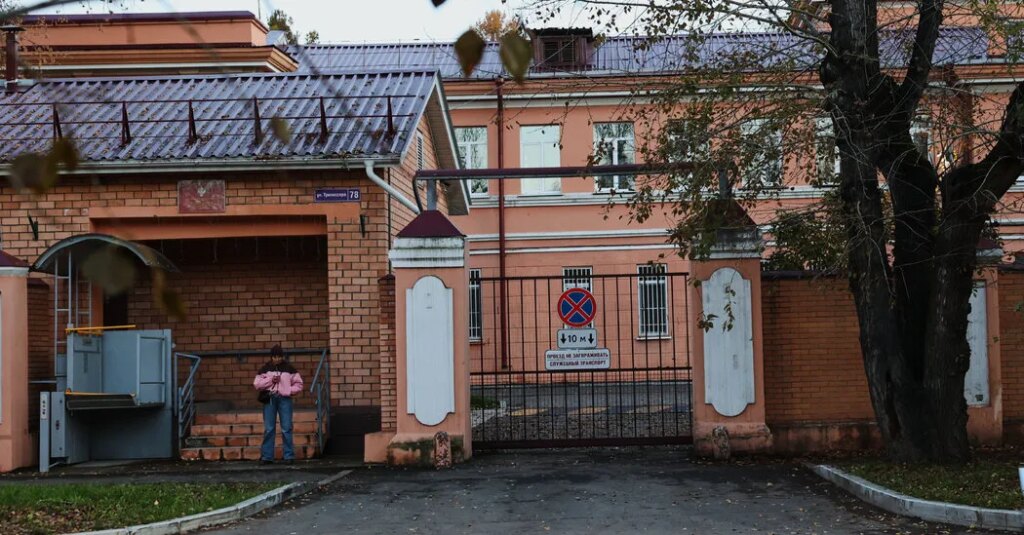
More than a week after a young plague researcher’s mysterious death from pneumonia, Russia has still not publicly identified the pathogen that killed her.
The possibility that the researcher contracted pneumonic plague in her lab led to global fears of an outbreak. Those worries have begun to recede as no other known cases have surfaced in the Irkutsk region, where Darya Shipilova, a 28-year-old researcher at the Anti-Plague Institute of Siberia and the Far East, died on Oct. 2.
But the absence of an official explanation for Ms. Shipilova’s death, despite thousands of tests conducted on others in the community and on her own remains, has stoked concerns about what, if anything, Russia’s authoritarian government might be hiding.
According to Rospotrebnadzor, the Russian public health regulator, Ms. Shipilova’s remains did not test positive for any of the dangerous pathogens she was working on at the institute, which included the bacterium that causes the plague. The regulator has said she died of pneumonia of an unknown origin. Pneumonia can be caused by numerous viruses, bacteria and fungi.
The World Health Organization is still seeking to understand the “causative agent” of the fatal pneumonia, whether or not it was the plague, Maria Van Kerkhove, the W.H.O.’s director of epidemic and pandemic management, said at a news conference on Wednesday.
“If that is ruled out — they say that is ruled out — what did she actually die from?” Ms. Van Kherhove asked.
Experts said they believed that with modern testing technology, the Russian authorities should know the answer by now.
“Presumably, they have the capability within days to do a simple genome sequence,” said Raj Panjabi, who served as a White House public health official during the Biden administration. “Presumably, they’ve done that, but they’ve not shared the results, and that’s concerning.”
The lingering questions reflect a broader lack of global public trust that stems in part from unanswered questions about the origins of the Covid-19 pandemic.
More than six years after Covid upended the world, questions remain about whether the lab that was studying bat coronaviruses in the Chinese city where the pandemic started played a role in the outbreak. China swiftly rejected the possibility and impeded a global investigation into the matter.
In Russia, any possible case of a pathogen escaping a lab attracts outsize attention globally in part because the country is one of the few in the world that continues to work on biological weapons, according to the U.S. intelligence community’s annual threat assessment.
That has led to greater concern among officials and experts in the United States, who point to the nation’s vulnerabilities.
“The United States does not have a licensed plague vaccine,” said Andrew Weber, a senior fellow at the Council on Strategic Risks and a former Pentagon official in charge of biodefense. “Given that Russia has an illegal bioweapons program, it is very concerning.”
Ms. Shipilova was involved in testing which antibiotics and doses worked against Y. pestis, the bacterium that causes the plague, according to the summary of a study presented this year at a Moscow infectious disease conference.
The plague, which is endemic to Siberia and some other regions of the world, caused the “Black Death” that ravaged Eurasia in the 14th century, but it is treatable with antibiotics if caught quickly. Pneumonic plague is considered the most dangerous of the three main forms of infection, because it spreads from person to person and causes deadly, rapid-onset pneumonia.
Referring to Ms. Shipilova as “the patient,” the Russian authorities have said that she was vaccinated against the dangerous microorganisms she was working with, and that two reviews of the institute ruled out any “emergency situations” at the lab. The quarantine measures that the Russian authorities took in the Irkutsk region were put in place out of caution, owing to the nature of the patient’s work, they said.
Plague vaccines have long existed, but experts have raised serious doubts about their effectiveness and safety.
Beyond what pathogen led to Ms. Shipilova’s pneumonia, many other questions remain unanswered, including where she was in the days leading up to her death, what she was working on at the institute at the time, and how and when her illness first showed itself and then progressed.
Labs around the world working with deadly germs take extensive precautions to keep workers from being infected, but accidents have occurred.
Though Russia took swift action to quarantine and test individuals who had come into contact with the researcher, Rospotrebnadzor has not held any news briefings and has provided information only in periodic public statements. The Kremlin has declined to field specific questions, urging the public to listen only to public health officials.
Russia has been slow to reveal the details of other incidents with possible public health implications.
In 2019, Moscow concealed critical information about the failed underwater recovery of a nuclear-powered missile in the White Sea, which caused an explosion and left seven people dead. The authorities did not initially say that a nuclear device was involved, acknowledge a spike in radiation or warn doctors that they were treating irradiated patients.
Nondisclosure has long been the modus operandi of the Soviet and now Russian bureaucracy, said Alexander Kelle, a senior researcher at the Institute for Peace Research and Security Policy at the University of Hamburg in Germany. He cautioned against reading too much into the paucity of details.
“Just because there is a lack of information, we have to be careful not to equate that with something nefarious,” Mr. Kelle said, noting that there were many legitimate public health reasons for researchers to work on dangerous pathogens.
To posit any link to Russian biowarfare, he said, would “be stretching the very limited evidence that has been presented too far.”
In a video message on Thursday, the governor of the Irkutsk region, Igor Kobzev, sought to close the book on the episode. He said that the medical monitoring of people in the region had concluded and thanked his fellow Russian officials for taking swift action under intense scrutiny.
Mr. Kobzev said the W.H.O. had publicly confirmed that there were no risks to public health, though the organization has said it has not received enough information from Russia to make a risk assessment.
Some people commenting on Mr. Kobzev’s video in his Telegram channel weren’t having it.
“What caused the pneumonia that killed the healthy young woman?” one asked.
“Are there really still naïve, gullible people in our city who would believe this?” another commenter said.
A third wrote: “X-Files, nothing to see here.”
K. R. Callaway contributed to this report.
The post A Week Later, Russia Hasn’t Said What Pathogen Killed Plague Researcher appeared first on New York Times.