WEIMAR GERMANY: The Death of a Democracy, by Victor Sebestyen
Imagine a vibrant Western democracy with a deeply polarized electorate. This country is known across the globe for its film industry, its brash style and its tech innovation, yet is mired in culture wars and conspiracy theories. In this same place, the plotters of a failed coup are overwhelmingly let off the hook, while influencers make the intellectual case for dictatorship. And then there is the country’s aged leader — recently elected with less than 50 percent of the vote — who prefers to rule by executive decree.
All this describes the world that appears in the journalist Victor Sebestyen’s perceptive “Weimar Germany: The Death of a Democracy,” about the autocratic turn in German society in the first half of the 20th century.
Sebestyen is hardly the first to see parallels between the short-lived German experiment with representative government after World War I and what he calls the “wave of nationalist populism” afflicting the United States and other countries today. Usually, as in Volker Ullrich’s political history, “Fateful Hours,” the analogy centers on Weimar’s disastrous end: the collapse of multiparty rule and the handing over of power to Adolf Hitler in early 1933. Sebestyen, by contrast, shapes his account around the early years, when the state’s flawed foundations were laid. In this telling, art is as important as politics: Cultural conflict, he argues, was “one of the significant reasons for the fall of the republic.”
Weimar’s radical chic was more than Broadway legend. With the lifting of censorship laws just after the war, publishers and performers were given extraordinary license. Horror films pushed the boundaries of cinema; convention-busting art movements erupted in quick succession. Decades before Robert Rauschenberg began using found objects in his famous combines, the German collagist Kurt Schwitters was doing much the same thing with Berlin’s trash.
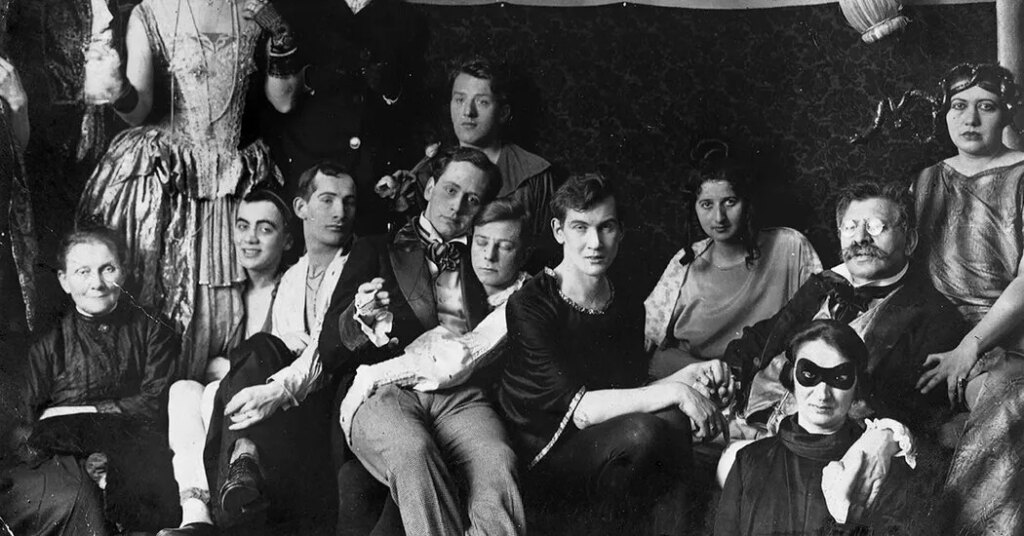
Social mores were similarly jolted. Women and workers suddenly enjoyed expansive rights, while a surge of nightclubs, magazines and books openly catered to a burgeoning gay and cross-dressing community. In a well-to-do Berlin neighborhood, the doctor Magnus Hirschfeld opened the world’s first sex institute. Dancing and drugs were everywhere. “In some cafes,” Ernest Hemingway observed during a 1923 visit, “cocaine is served at the tables by the waiters.”
Yet from the outset, Sebestyen writes, social ferment provoked nationalist outrage. As early as the spring of 1919, city officials in Weimar were calling Walter Gropius’s visionary new art and design school, the Bauhaus, “a hotbed of Spartacus agitation and Jewry.” While church leaders and conservatives railed against state-fueled “smut and rubbish,” right-wing paramilitary groups warned of the “danger” posed by liberated women. Posters kept appearing in Berlin demanding “a Germany for Germans.”
Much of the middle class was far less concerned about rights than about the collapse of the old order. Ernst Jünger’s “Storm of Steel,” a literary glorification of combat first published in 1920, became a best seller, and some of the most popular movies were costume dramas about German history. Around the country, Sebestyen notes, a new generation of youth — far more than the embittered war veterans of conventional Weimar historiography — flocked to fringe militias.
Even the liberal intelligentsia fretted about too much freedom. Before he became an anti-Nazi, the novelist Thomas Mann published a 500-page book defending authoritarian rule and high German kultur. The sociologist Max Weber, wary of political fragmentation, urged that the Weimar Constitution give the president sweeping emergency powers — a provision fatally abused by Field Marshal Paul von Hindenburg after he became president in 1925.
Then there was the judiciary. Regardless of the law, the country’s conservative judges dealt harshly with leftist agitation, or even, as the artist Georg Grosz discovered, mere satire of the military. Yet they continually made excuses for the insurrectionists — including a young Hitler — who tried to overthrow the democratic order. As Sebestyen makes clear, the Weimar Republic did not collapse because of a broken political system; it was deliberately killed by politicians, generals and judges who wanted it gone.
To its credit, “Weimar Germany” does not overdetermine a story of doom. The republic endured economic chaos and even a French invasion. On occasion, opposing factions came together, as when Alfred Hugenberg, a Rupert Murdoch-like newspaper magnate, agreed to bankroll Fritz Lang’s anticapitalist masterpiece, “Metropolis.”
Nonetheless, Sebestyen leaves surprisingly underexplored the nationalist right’s own obsession with cultural renewal, including the attraction of some leading Nazis to “Germanic” modernists, such as the painter Emil Nolde and the architect Ludwig Mies van der Rohe. If the arts were, as he maintains, “connected, in a direct way, to what happened politically,” it was significant that avant-garde ideas had supporters in both camps.
“Weimar Germany” makes a provocative case for culture as an accelerant in the rise and fall of the republic. But its greater insight may be that democracy failed not because of cultural warfare but because too few Germans — regardless of whose side they were on — really believed in it.
WEIMAR GERMANY: The Death of a Democracy | By Victor Sebestyen | Pantheon | 469 pp. | $38
The post What Happened When the Volk Turned Against the Woke appeared first on New York Times.