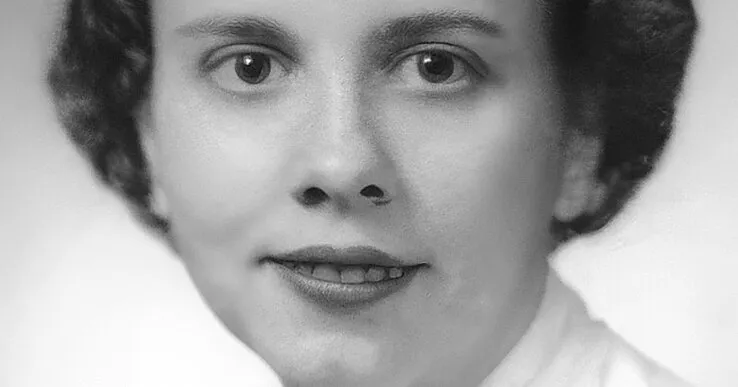
Mary Tsingou arrived at Los Alamos Scientific Laboratory in 1952, seven years after the testing facility in New Mexico helped propel the world into an age of nuclear proliferation. She was a recent college graduate with a mathematics degree and joined the cohort — almost all women — of “human computers.”
As Los Alamos continued to serve as a leader in Cold War scientific research, Ms. Tsingou was disappointed that her first task was to input simple math equations on a calculator. “It was pretty boring sitting there doing addition and subtraction,” she recalled in 2020 to a publication of the federal research lab.
But Ms. Tsingou was soon given the opportunity to work as an early programmer of MANIAC I, the lab’s first fully electronic computer. Her coding work — translating equations into the MANIAC-approved language of holes punched on tape — led to the creation in 1955 of the Fermi-Pasta-Ulam (FPU) problem, named after the men who worked on the numerical experiment.
When the report was published, Ms. Tsingou was not listed as an author. Instead, her name was placed in a footnote: “We thank Miss Mary Tsingou for efficient coding of the problems and for running the computations on the Los Alamos MANIAC machine.”
“They didn’t know anything about programming,” she told The Los Alamos publication. “They set up the equations, and I did all the programming.”
The groundbreaking computational physics experiment observed surprising physical behaviors that propelled the development of nonlinear science, one of whose branches is chaos theory — an influential way of thinking about how subtle changes to the initial state of a complex system can eventually lead to wildly unpredictable outcomes. It offered scientists a new way of exploring the physical world, by showing, for the first time, the power of the computer to investigate phenomena too complex to visualize by hand or with traditional experiments.
Ms. Tsingou (later Menzel), who spent her nearly 40-year career as a programmer at what became Los Alamos National Laboratory, died on Aug. 27 at her home in Los Alamos. She was 97. Her death was confirmed by her daughter Ann Menzel.
The original MANIAC — an acronym for “Mathematical Analyzer, Numerical Integrator and Computer” — was seven feet high, nine feet wide, weighed 1,000 pounds and was fitted with about 3,000 vacuum tubes. It could make upward of 10,000 calculations per second, dramatically superior to computing by hand.
Through a series of trials, Ms. Tsingou and her fellow operators became so familiar with the computer that they could identify and address issues with code by ear. But the technology was so new that they were forced to “invent their way out of problems,” said Nicholas Lewis, a lab historian at Los Alamos.
“You had to use what the machine recognized, which was only ones and zeros,” Ms. Tsingou said of the laborious task of programming the MANIAC. “We typed the directions on a tape and put it in the machine.”
Her first exercise while learning to work with the hums and blinks of the primitive computer was to find the sine of an angle. After poring over her work for some time — computing, coding, checking and rechecking — she finally punched the tape.
“It worked immediately!” she said in a 2002 oral history interview with the Institute of Electrical and Electronics Engineers.
She was invited to program an experiment for the mathematician Stanislaw Ulam and the physicists John Pasta and Enrico Fermi as they brainstormed ways to use the MANIAC to explore theories they couldn’t easily compute by hand.
They decided to observe the computationally simulated motion of a line of particles connected by springs, similar to a vibrating string. Their expectation was simple: When prompted, springs would cause energy to be shared throughout the entire system, resulting in random movement patterns.
But when Ms. Tsingou plotted the data she pulled from the MANIAC on to charts and graphs, the system appeared to vibrate in structured ways, periodically returning to its initial configuration. This revealed, numerically, that there can be hidden patterns in the motion of dynamically rich, or “nonlinear,” systems.
The revelation from the FPU problem strongly influenced how scientists and mathematicians study the multitude of nonlinear systems in our world, including how our heart beats, how the economy sometimes functions and how complex weather patterns behave.
Her programming work, physicists say, would make her a co-author today, because programmers are charged with writing the computable code that scientists need to run simulations they design. But fuller credit was not provided until Thierry Dauxois, a French physicist, championed her contributions in a 2008 article in Physics Today titled “Fermi, Pasta, Ulam, and a Mysterious Lady.”
“Her programming of a 1950s computer was not a trivial task,” he wrote. “Why has her contribution received only a two-line acknowledgment?”
Soon afterward, the problem became more widely known as Fermi–Pasta–Ulam–Tsingou. And despite the intriguing headline in the Physics Today story, she told The Los Alamos Monitor, a local newspaper, that she was far from “mysterious.”
Mary Tsingou, the younger of two daughters, was born to Greek immigrant parents in Milwaukee on Oct. 14, 1928. The Tsingous moved during the Depression to Bulgaria, where they had property, before returning to Milwaukee in 1940, soon after the start of World War II.
Her father, Thomas Tsingou, was a factory worker, and her mother, Anastasia Koutsouyianni, had only a second-grade education. Her parents spoke Greek at home, and it was well into their childhoods before Mary and her sister, Sally, had fluency in English.
Back in Milwaukee public schools, the daughters were so behind in English that they were initially held back several grades — yet both were so strong in math that they were soon able to resume education at grade level.
In 1951, Mary Tsingou received a bachelor’s degree from the University of Wisconsin with the intent of becoming a high-school math teacher.
In her oral history, she said school jobs were sparse for women, because male veterans returning from the Korean War were given priority. She learned that Los Alamos was hiring women to do hand computing, which was considered a clerical job mostly reserved for women. She and the others in her cohort were informed that they would be paid less than the men doing the same work.
She temporarily left Los Alamos to work on a master’s degree in mathematics and received her diploma from the University of Michigan in 1955. Over the years, her mathematical and code-writing skills were used in thermonuclear research and for the Strategic Defense Initiative, the Reagan-era antimissile system popularly known as Star Wars.
In 1958, she married Joseph Menzel, who worked in security at Los Alamos. He died in 2022. In addition to Ann, she is survived by another daughter, Carol Menzel; eight grandchildren; and three great-grandchildren.
Reflecting on her career, Ms. Menzel said in the Los Alamos lab publication that she was not bothered by being left out of the 1955 experiment’s original name, Fermi-Pasta-Ulam.
“I was just doing the job,” she said. “I was glad to get paid.”
The post Mathematician Who Waited 50 Years for Proper Credit for Her Work Has Died appeared first on New York Times.