Last May, contractors were upgrading the security fences and driveway at the governor’s residence in North Dakota when they made a discovery that brought the work to a standstill. In the southwest corner of the grounds, where a cemetery had once been, they unearthed what appeared to be human remains and coffin fragments.
Over the next four months, what started as a landscaping and construction job in the state capital, Bismarck, turned into an examination of the state’s history. This week, officials in Gov. Kelly Armstrong’s administration announced the results of an analysis of the remains: They were two women, two men, two teenage boys and a toddler.
The seven sets of remains appear to have been overlooked when bodies at the former cemetery were exhumed after 1877 and moved to new cemeteries during Bismarck’s early settlement period, the state Office of Management and Budget said in a statement.
“Many were already reinterred to somewhere else,” Jen Raab, a spokeswoman for the office, said in an interview. “We didn’t know there were still some there.”
The discovery on May 19 set in motion a wide-ranging project that has played out at the nexus of science, history and spirituality in Bismarck, a onetime frontier town that is now a city of about 78,000.
The state Legislature last year approved $2.35 million in security upgrades at the governor’s residence, which sits on the grounds of the Capitol. After the remains were discovered, archaeologists were dispatched to the site to conduct surveys with ground-penetrating radar. They detected more than 80 anomalies in the earth, leading to the recovery of seven sets of remains and an empty wood box, the Office of Management and Budget said.
A chaplain will organize a ceremonial handling of the remains, which will be reburied next year, Ms. Raab said.
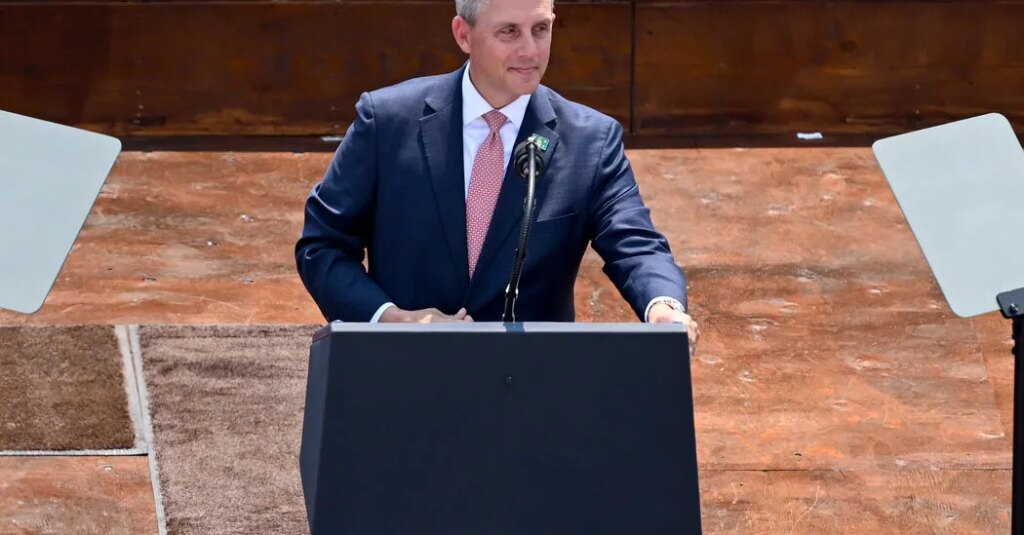
In a statement on Friday, Mike Nowatzki, a spokesman for the governor’s office, said Governor Armstrong “wants to ensure the remains are treated with appropriate care and respect.”
The discovery of the remains generated interest in the former cemetery and how its long-buried dead ended up intersecting with modern city life.
Historians scoured archival newspaper clippings for death notices to help tell the story of the burials, which were held on the grassy knoll from 1872 through 1877 — a period that coincides with the renaming of the town, formerly known as Edwinton, to Bismarck in 1873.
The cemetery did not have an official name. Townspeople generally called it “the graveyard on the hill,” according to the state archives.
“It was far out of town,” said Lindsay K. Meidinger, the deputy archivist at the North Dakota State Archives.
One person known to have been buried there was a woman named Sophie deMarsh. The Bismarck Weekly Tribune reported in January 1877 that she “suffered through three days labor, but will probably recover.”
She did not. She died in the next month, the newspaper reported, according to archival clippings provided by Ms. Meidinger.
By the end of 1877, the old newspaper clippings reported that a section of the burial ground was going to be sold to make way for a railroad. The cemetery, and those at rest there, had to find a new home. So bodies were moved to other cemeteries.
But not all of them, as the newspaper reported over the decades that followed. As the city developed, more of the buried dead were found, their resting places inadvertently intertwined with newly laid streets and railroad tracks.
In 1903, at least 13 bodies were unearthed during excavations for a trolley line at the site of the old graveyard, including that of a man named Dave Mullen, who was “shot and killed in a row with some soldiers from old Fort Lincoln,” according to the newspaper.
In 1959, a shallow grave was discovered at the southwest section of the plot, where a new governor’s house was to be constructed. Two workers using a “power shovel” found the bones, the newspaper reported that year.
That same year, workers using a dirt loader found an “ancient pine box” holding the remains of a man who was believed to have died at 45. In total, at least five bodies were found that summer.
Archaeologists are now reviewing and cataloging the remains that were found in May. They expect to be done early in 2027.
A funeral home has been contracted to help with the reburials, and a nonprofit group was called to the site when the remains were found.
“We had a word of prayer over that site for the deceased,” Greg Carr, a chaplain with Crisis Care Chaplaincy, said in an interview this week.
He said the reburials will take place in the spring.
“We’ll handle the spiritual aspect of the events,” Mr. Carr said. “There’s no way to know who these people are or what their religious backgrounds were, if they even had one in the 1800s in North Dakota.”
Jennifer Sinco Kelleher contributed reporting.
The post 7 Coffins Are Found Near North Dakota Governor’s Residence appeared first on New York Times.