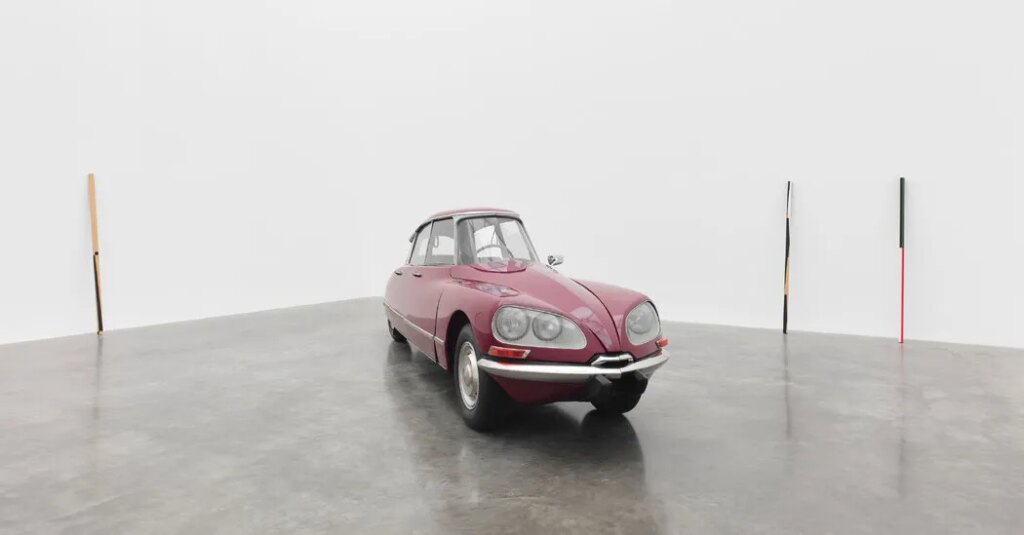
As a little boy growing up in Mexico in the 1960s, the artist Gabriel Orozco had two posters on his bedroom walls: a reproduction of Picasso’s “Guernica,” and a photograph of the Formula 1 champion Jackie Stewart at the wheel of a blue racecar.
Those twin passions — art and cars — were to come together three decades later in the work that Orozco is perhaps best known for: a Citroën DS model that he cut lengthwise into three separate sections, removing the middle section, and seamlessly put back together.
The original DS is in the French national collection, but a second version (from 2013) is on view through Nov. 8 in a sprawling exhibition titled “Chronotopic” (curated by the British art historian Briony Fer) at the White Cube Gallery in London, coinciding with this year’s Frieze London.
While the surgery on the DS took a month of hard labor, other Orozco works have taken no time to make — like the open shoe box he showed at the 1993 Venice Art Biennale, or the four plastic yogurt lids he pinned to four walls of the Marian Goodman Gallery in 1994 for his first gallery exhibition in the U.S.
A conceptual artist, he could be seen as an heir to the French artist Marcel Duchamp (who submitted a porcelain urinal for exhibition back in 1917).
Hanging in the giant main gallery space at White Cube, for instance, are four ceiling fans fitted with rolls of toilet paper that flap away as they twirl. There’s also “The Weight of the Sun,” (a new version of a site-specific work) a constellation of 12 suspended objects: a straw broom at the center (symbolizing the sun), surrounded by items including a discarded paint lid, a broken bucket handle and a drum of electric cable from a brand called TIME.
Nowadays, Orozco, who has no permanent studio and spends time across three continents, can often be found in Japan. A room of more recent works in the show includes scrolls, elliptical drawings on musical score paper and old wooden beams and columns that were once used in Japanese temple architecture and that Orozco has adorned with toy racecars and pegs from the board game Go.
In an interview at the exhibition, Orozco talked about what made him slice up a car all those years ago, why his art involves objects from everyday life and what he thinks of artificial intelligence. The conversation has been lightly edited and condensed for clarity.
Where did you get the idea for your Citroën work, “La DS,” in 1993?
When I was a kid, I had a collection of toy cars and dreamed of being a Formula 1 driver. I was looking at regular cars and wondering how I could turn them into Formula 1 racecars. I thought that maybe if you cut them and put them back together, they would become much faster cars. Of course, I wasn’t thinking about the motor, because you’re taking it out! It’s a kind of illusion or dream from childhood. A lot of my work is coming from my childhood.
Why is this carved Citroën a work of art?
What is sculpture? The activity of sculpting is to cut, carve, polish, glue, put together, join. All of these actions, in terms of gestural labor, physical labor, are in that car. There is a parallel vertical axis of cutting, very carefully done, so you don’t see the drama of the labor. You then reassemble the car in a symmetrical line, and you have the same object, but it’s invariably different. It’s the same object, but it has imploded on its own.
From your early 30s, you exhibited ready-made objects such as a shoe box, or yogurt lids. How would you describe your relationship to the ready-made?
I was performing with all kinds of real objects, and considering that no object is pure — even if it’s pure stone, or a piece of wood, or a classical material used to make art. They are all ready-made in a way. They all involve human labor.
Then I reflected on my relationship with time and space. The shoe box came about in a specific space for the Venice Biennial. The yogurt lids were in the context of a specific room at the Marian Goodman Gallery in New York. It’s not the shoe box per se, it’s not the yogurt lid per se: It’s the context around that really signifies the object.
Why you are so interested in everyday objects, in what others might describe as banal?
Small gestures can change the world more dramatically than big buildings, long-term projects or very expensive projects. Finding a moment of poetry is accidental. Even if you’re a writer, to achieve the moment in which the poetic happens is something quite mysterious. As the Argentine author Jorge Luis Borges said, poetry is everywhere. It can happen in any moment, at any corner. We are the ones who don’t know how to see it. You have to train yourself to see the possibilities of the poetic happening in the universe, in your life. Sometimes, it’s with things that are very banal.
My work tries to be nonspectacular. You can achieve connections with people that are not about entertainment and not about spectacularity, but where you are trying to get a bit deeper than that.
You need a participant in the work, somebody who, with their brains and with their attitude, is motivated to be active, not just to expect to be entertained or pleased by something beautiful.
The circle is very important in your work. It is a representation of time and eternity because the circle eternally comes back to where it started, and human life is repetition. Now, artificial intelligence threatens humanity, and the circle of human life seems endangered by technology. How do you feel about A.I.?
I use the circle as an instrument that is helpful for me to produce, make, and understand things: understand the way we move, how things circulate. The way we move our arms, fingers, is in circular movements. Bodies in movement and performance generate ellipses. Planets are circular forms.
What I have found until now is that artificial intelligence is very stupid, because it’s just reproducing the knowledge that is circulating on the internet. It’s very biased, and doesn’t answer anything that you request of it. It’s just a kind of compressed and very fast Encyclopaedia Britannica. But Encyclopaedia Britannica is not going to give you poetry. It’s not going to teach you how to invent something.
The post A Car, a Broom, a Paint Lid: How Is That Art? appeared first on New York Times.