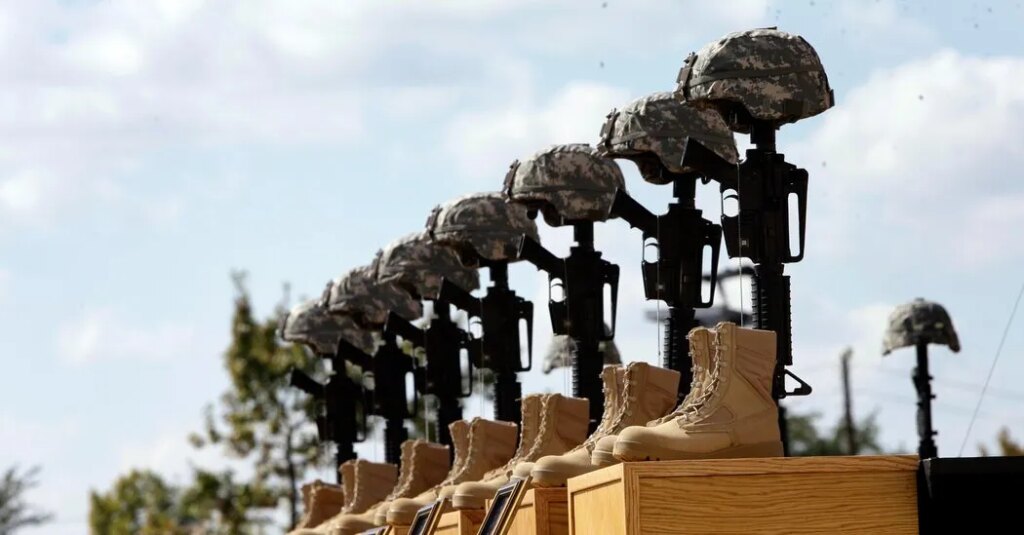
The former Army officer convicted of a 2009 mass shooting at Fort Hood has exhausted his appeals in the military courts. But he may have options in the civilian justice system to contest his planned public execution by firing squad.
Legal experts say that Nidal Malik Hasan could potentially ask federal courts to step in and stop his execution. That path for the courts to intervene, though, would likely be narrow and rushed, and could involve novel and untested legal claims.
The Supreme Court last year rejected an appeal from Mr. Hasan, who was convicted in 2013 by a military jury of fatally shooting 13 people and wounding 32 more after opening fire at a military processing center in Central Texas. The justices at that time declined to take up his legal team’s argument that a judge’s decision to close part of the proceeding violated his right to a public trial.
But legal experts said the former Army psychiatrist’s lawyers could now file a new appeal to ask the federal courts to block the administration’s plan to kill him on Dec. 3 in a live-streamed execution at the base where he attacked fellow service members. It remains unclear whether he will do so.
Jonathan F. Potter, a lawyer from the U.S. Army Defense Appellate Division who represents Mr. Hasan, did not respond to a request for comment.
Defense Secretary Pete Hegseth announced the plan on Thursday in an interview with Real America’s Voice, a conservative outlet, saying that the execution would be available to watch “because people need to understand that there’s serious consequences for these types of things.”
At the 2013 trial, Mr. Hasan, who was a major at the time of the shooting, represented himself and confessed in his opening statement to being the shooter.
If the federal courts were to weigh in, legal experts said that the case would likely begin in Kansas, since he is incarcerated at the U.S. Disciplinary Barracks in Fort Leavenworth. An appeal could then wind through the U.S. Court of Appeals for the Tenth Circuit and arrive quickly at the Supreme Court, likely as an emergency petition.
Legal experts say that Mr. Hasan could challenge the government’s decision to livestream his execution, perhaps by asserting that a public broadcast would violate prohibitions on cruel and unusual punishment in the Uniform Code of Military Justice and the Eighth Amendment of the Constitution.
Courts have rejected requests from private companies that sought to broadcast executions to the public.
In 2001, a federal judge refused to allow an internet company to carry a live feed of the execution of the Oklahoma City bomber Timothy McVeigh, citing Federal Bureau of Prisons rules that forbid recording or broadcasting executions.
In that case, the broadcaster for adults-only subscription websites argued that the execution of Mr. McVeigh presented a compelling public interest that warranted widespread dissemination of the killing.
But the Supreme Court has not weighed in directly on the question of whether public executions are legal, particularly when requested by the government, experts said.
Public executions have been seen, including by United Nations officials, as a violation of international human rights protections under the International Covenant on Civil and Political Rights, said Eugene R. Fidell, who teaches military justice at Yale Law School.
“This is terrible company for our country to be in,” Mr. Fidell said, citing the authoritarian regimes that have engaged in the practice. But he cautioned that there was “no current legal document that you point to that says this is clearly unlawful as a matter of the U.S. Constitution or any federal statute.”
How the Supreme Court may approach the issue is unpredictable, some observers said.
Less than a decade ago, a majority of the court appeared “deeply attuned” to changes in society’s norms and moral values, including waning support for capital punishment, said Stephen I. Vladeck, a law professor at Georgetown University Law Center, where he specializes in constitutional law, national security and military justice.
Professor Vladeck said he believed that the court would likely have found it “exceedingly difficult to reconcile” changing mores with a live-streamed, public execution, particularly given how long it has been since the last public execution in the United States.
The country’s last state-sanctioned public execution happened nearly a century ago, when about 20,000 people gathered in August 1936 to witness the hanging of Rainey Bethea, a young Black man convicted of raping an elderly white woman.
But the makeup of the court has changed considerably since 2018, when Justice Anthony M. Kennedy, often the key swing vote, retired. Now, the court has a conservative supermajority, with six conservatives and three liberals.
Professor Vladeck described the current court’s approach as “far less sympathetic to those kinds of arguments.” A majority of the justices consider themselves “originalists” who examine legal issues with an eye to how the law was interpreted at the time it was adopted.
With Mr. Hasan, Mr. Vladeck said a majority of the justices may look to whether a particular punishment would have been seen as cruel and unusual in 1791, when the Eighth Amendment, which barred such punishments, was ratified.
“If that’s the test, I think it’ll be quite an uphill battle,” he said, noting that conducting executions publicly was common at that time.
Mr. Hasan could also raise issues related to the planned protocol: death by firing squad. He was shot during his attack on Fort Hood and paralyzed from the waist down. He uses a wheelchair, and it is not clear how the military would execute him.
The Army’s 2023 regulation on executions provides a list of people who can witness one, including “a minimum” of two media representatives. It specifies that no one younger than 18 can be a witness. The regulation, however, can be changed by the Army at any time.
The regulation is far less detailed than the service’s 1944 manual for executions that guided the last firing squad to take the life of an active-duty service member: Pvt. Edward Donald Slovik, who was convicted of twice deserting his unit in combat and was put to death in France on Jan. 31, 1945.
The World War II-era manual, which referred to the firing squad as “execution by musketry,” required an Army band to play a song called “Dead March” as the condemned prisoner was led to a post and strapped to it in “an upright position,” accompanied by a chaplain.
A medical officer was then to place a four-inch, round target over the prisoner’s heart, on a uniform stripped of all rank and insignia, including buttons. An “execution party” of 12 soldiers armed with rifles would form two firing squads. “Not more than four nor less than one” of the rifles would be loaded with blank ammunition, the manual states, and placed randomly on a rack for the dozen soldiers to draw from.
Should an initial volley of six bullets fail to immediately kill the condemned soldier, a second group of six soldiers could be ordered to shoot the prisoner at the medical officer’s direction. A sergeant armed with a handgun could also “administer the ‘coup de grace’” shot by holding the weapon’s muzzle “just above” the prisoner’s ear and “one foot from the skull.”
Following confirmation of the prisoner’s death, the Army band would play “a lively air” as the assembled soldiers and firing party departed the scene.
The manual also instructed: “No photographs nor motion pictures of the actual execution will be permitted except for official purposes.”
Julie Tate contributed research.
The post Fort Hood Shooter’s Execution Could Face Challenge in Federal Courts appeared first on New York Times.