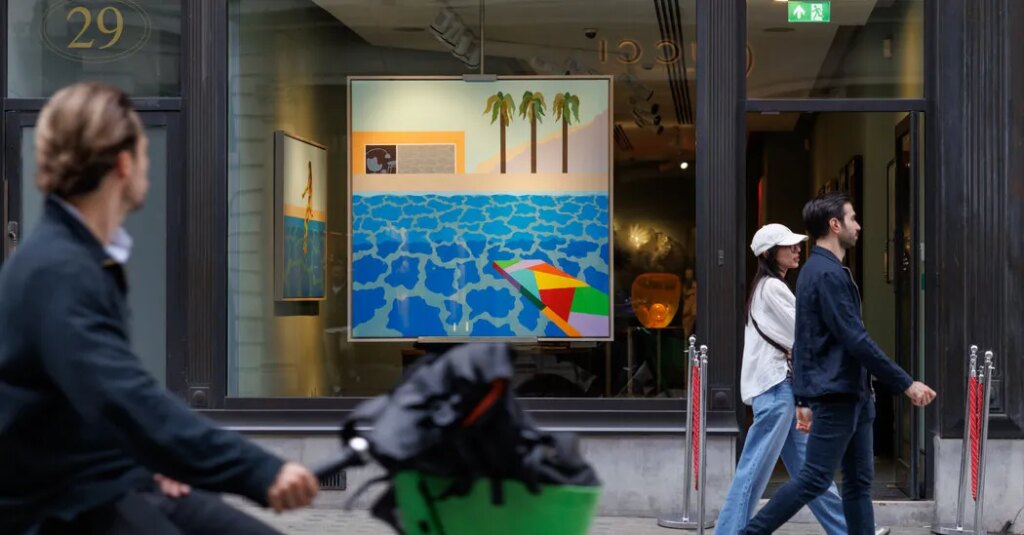
Never before in London had an auction from a single owner’s collection fetched such sums as it did on June 24 at Sotheby’s London.
The sale of 25 masterworks owned by Joe Lewis, a British currency trader, raised roughly $400 million that evening. The top lot: Modigliani’s 1917 “Seated Nude With Necklace,” which sold for about $63 million.
Later that night, another roughly $130 million in art changed hands at Sotheby’s, bringing the total to well over $500 million. The result signaled a possible rebound in London’s auction sales, which dropped around 50 percent between 2015 and 2025, according to the analytics firm Pi-eX.
But the city’s galleries are less buoyant.
Stephen Friedman Gallery — which represented Yinka Shonibare, Kehinde Wiley and David Shrigley — announced in February that it was liquidating its business. Three months later, its neighbor, Tiwani Contemporary, followed suit, citing rising costs and “wider market uncertainties.”
London’s art scene is a tale of two contrasting cities: one that can host the sale of over half a billion dollars of artworks in an evening, and another where high-profile galleries go bust. Things were cheerier 23 years ago, when the Frieze Art Fair began: The city’s contemporary-art scene was booming, spurred by the birth of Tate Modern in 2000 and the success of a new generation of talents known as the Young British Artists.
When assessing the current outlook, “you can’t say it’s fantastic,” Iwan Wirth, president and co-founder of Hauser & Wirth, one of the world’s largest art dealerships, said in a phone interview. “But it’s also wrong to say it’s not good.”
Wirth said stock market gains worldwide meant that “there’s certainly a lot of money around to buy great works,” so he was “optimistic that the upswing in the market globally will also be felt in London.”
Britain, the world’s second-largest art market behind the United States, generated $10.5 billion in sales in 2025, or about 18 percent of the global total, according to the Art Basel and UBS Art Market Report 2026.
In 2019, it had a 20 percent share and had total sales of $12.7 billion.
There are global reasons for the shrinkage: the coronavirus pandemic, which shut everything down in 2020; the Russian invasion of Ukraine in 2022, which inflated energy, shipping and travel costs; and the U.S.-Iran war, which began in February, and has curbed oil shipments.
Yet there are also Britain-specific reasons. The 2016 vote to leave the European Union — known as Brexit — limited E.U. nationals’ travel to Britain and placed new levies and bureaucratic hurdles on art transactions with the continent.
Wealthy residents of Britain have been driven away by the 2024 decision to scrap the “non-dom” (non-domiciled) tax status, under which individuals whose permanent home for tax purposes was in another country could live in Britain without paying tax on income earned elsewhere.
So auctioneers were heartened by Joe Lewis’s decision to sell off his collection in London.
It is “based on a confidence in the market, which we’ve seen coming back over recent seasons,” Helena Newman, chairman of Sotheby’s Europe, said in a video interview. She said she expected more such auctions as the “big generational wealth transfer” leads to the sale of collections assembled in the 1960s, ’70s and ’80s.
There will be more evidence of that wealth transfer later this month, as Christie’s London holds its biggest single-owner auction: nearly 200 works from the collection of Peter Simon, founder of the British fashion brand Monsoon, which are estimated to fetch as much as $170 million.
Why sell in London? Katharine Arnold, vice chairman of 20th and 21st century art at Christie’s Europe, explained in a video interview that before major auctions, Christie’s displays important works on offer in exhibitions held in the United States, Europe and Asia, where its buyers are evenly situated. “Our expectation is that an international audience will buy them, regardless of where they’re being sold,” she said.
But there will likely be fewer bidders based in Britain than before.
“The U.K. has lost a lot of its collector base,” Wirth said. “A lot of European collectors have left, and every week you hear of people still leaving.”
London is still “the center of gravity for so many people from all over the world,” he said, adding that his gallery is investing in a new flagship location in the Thomas Goode Building in Mayfair.
While London was a hot spot at the turn of the millennium, today Tate (a network of four museums) and other British institutions are facing funding struggles. Government grants to arts and cultural organizations fell 18 percent between 2010 and 2023. The pandemic slashed visitor numbers and energy costs squeezed budgets.
Tate cut 7 percent of its work force last year because of “profound challenges for Tate and the cultural sector as a whole,” according to its board. The National Gallery (which reopened its Sainsbury Wing last year after a $113 million redevelopment) announced a voluntary staff exit scheme in February to help plug a nearly $11 million deficit. The Victoria & Albert Museum preemptively closed two of its London sites (though not its main site) on Sept. 4 and 5 in response to a workers’ strike.
Tate is getting a new director in January: Jessica Morgan — the current director of the Dia Art Foundation and previously a longtime Tate curator. It is a “great appointment,” Wirth said. He described Morgan as “a rare combination of a great curator and manager, and a fantastic fund-raiser.”
London may no longer be at the top of its game, but that is not necessarily a bad thing, said Daniel Birnbaum, a prominent European curator and academic and the former director of the Moderna Museet in Stockholm.
Birnbaum remembered the October 2003 opening of one of Tate Modern’s landmark exhibitions: “The Weather Project” by Olafur Eliasson, a giant sun that visitors basked in for months. The evening was filled with major cultural, business and political figures, and was followed by a dinner at the home of a prominent architect.
“I had the feeling that I was visiting the masters of the universe,” he said. “London was at the peak of power.”
“Sometimes, things can suffer from their own success, and a city can be almost too full of itself,” he added. “I think dysfunctional, slightly vulnerable situations can be very attractive artistically.”
He said London’s young and emerging artists and gallerists are now so vibrant that his art students at Frankfurt’s Städelschule all want to go to London on school trips.
Hannah Barry helped put London’s Peckham area on the art map by establishing a gallery there, and also created the Bold Tendencies summer arts festival, which has been held in a former parking garage since 2007. Hannah Barry Gallery’s pristine two-level exhibition space recently hosted the paintings of George Rouy, a rising star who is now also represented by Hauser & Wirth. Barry has weathered art world fluctuations for two decades.
How has she managed? Despite “overwhelming feelings of impossibility rather than possibility,” at times, she said in a video interview, her gallery — which employs five people and represents 14 artists — stayed “very vigilant about costs,” seldom showed at art fairs and focused on the program.
The gallery is set to show in three art fairs in the next several months.
“Yes, we’ve been in times of perma-crisis, arguably, for the last 20 years,” she said. “But one cannot abandon the hope and possibility of what doing this kind of job brings.”
The post London’s Art Scene Manages the Ebb and Flow of an Uncertain Business appeared first on New York Times.