For its debut at Frieze London, Hafez Gallery, with two locations in Saudi Arabia, will present two Arab artists in what many see as an example of how the Middle East continues to emerge as a major art center.
The Egyptian artist Ahmed Nawar and the Bahraini-Saudi artist Faisal Samra will be featured in “Dialogue of Forms” at Hafez’s booth at Frieze London, open to the public from Thursday through Oct. 18 in Regent’s Park.
The show will feature works from “The Will,” Nawar’s solo exhibition in April 2025, and “Other Body,” Samra’s solo exhibition in January, both at Hafez Gallery in Riyadh’s artsy Jax neighborhood. “The Will” will soon move to Hafez’s gallery in the upscale Ar Rawdah neighborhood in Jeddah, opening Oct. 26.
“When we decided on our first presentation at Frieze London, I wanted to show that Saudi Arabia’s art scene is in dialogue with the wider Arab world, not separate from it,” Qaswra Hafez, the founder and owner of the gallery, said by email. “Nawar is a towering figure in Egyptian and Arab visual art, and Samra is one of the most important artists to emerge from Saudi Arabia.”
For Samra, 71, his works are a homage to some of the earliest works of art in the Arab world.
“These artworks belong to my first research project, Al‑Mu’allaqat, which flourished in the heart of the Arabian Peninsula before and during Islam,” Samra explained in a video interview. “Poetry expressed and documented all aspects of these people’s culture and lives. Al‑Mu’allaqat, or hanging poems, were thin pieces of animal skin on which poems were written to be displayed and hung on the walls of holy places at certain times of the year.”
Samra, whose mixed-media works are part of several museums’ permanent collections, including the British Museum and Mathaf: Arab Museum of Modern Art in Qatar, will take four works to Frieze London, including two from his “Parachute” series, which was created in 2003 in reaction to the American invasion of Iraq that year, and one painting from his “Head” series in 2000.
“The heads are in a state of shock from the unknown horror coming in the new century,” he said.
In keeping with the origins of the poetry on animal skin, with “Suspended Metamorphoses 2,” also to be featured in the booth, he works with basic materials.
“My range of materials are mostly organic, such as natural fabrics, goat skin, old papers and wire mesh, because they represent a perfect memory to me,” he explained. “The colors are from natural bases such as pigments, charcoal and henna, and I apply them to get washed, dirty used textures.”
All of these works were seen at his Hafez Gallery show in Riyadh in January, which coincided with the opening of this year’s Diriyah Biennale in Riyadh, where Samra had a separate series of artworks featured.
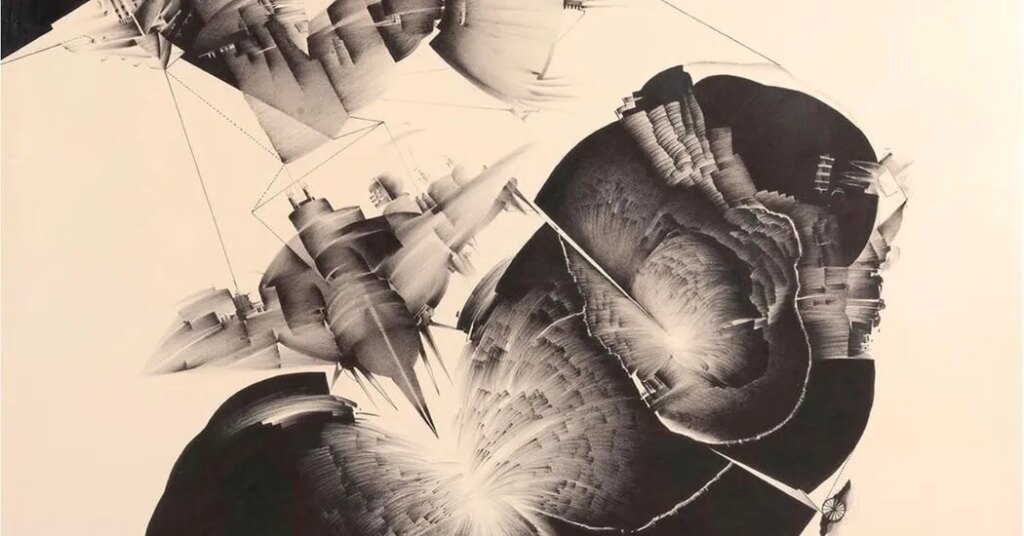
For Nawar, his nine pieces traveling to the fair, all in felt-tip pen on paper, reflect his commitment to depicting the world he sees, for better or for worse. Six pieces from his 2021 “Sniping” series will travel to Frieze London.
“In ‘Sniping,’ the pictorial space is dominated by an expanse of black, charged with ambiguity and uncertainty,” Nawar, 81, said by email. “Through this darkness passes a searching beam of light, seeking a target and attempting to penetrate the brutality deeply rooted within the forces of evil.”
And that threat has only grown in recent years, making his artwork even more prescient, he said. An artist who has exhibited in dozens of galleries and museums in his 60-year career, Nawar will also take three works from his “Will of Nation” series from 2020.
“Advanced technology, with all its extraordinary and terrifying potential, has become a means of producing weapons capable of destroying human life itself,” he said. “In my work, this reality is transformed into a call for peace and human justice, expressed through points of light emerging from the heart of a dense black mass.”
For Qaswra Hafez, who founded the Jeddah gallery in 2014 and opened the Riyadh space in January 2025, these works by the two artists complement each other.
“I’ve always been drawn to artists who treat their materials as an entire language rather than a means to an end,” he said. “Placing these two artists side by side, an Egyptian master and a Saudi pioneer, in London for the first time felt like the right way to introduce Hafez Gallery to this stage, not as a regional gallery but as part of a much larger conversation.”
And dialogue is a sentiment echoed by Eva Langret, director of Europe, Middle East and Africa for Frieze, who said the presence of Middle Eastern and Northern African galleries at the London fair has been growing.
“We’ve worked with several galleries from West Asia for quite a long time, such as several Beirut galleries, Gypsum from Cairo and Focus from Dubai, for example, but in the last few years we have added more galleries from that region,” Langret said by phone.
“There are many reasons for this growing presence,” she added. “London has had good ties with collectors from the region, and many of them spend their summers here. Frieze London has always benefited from that connection.”
She pointed to a growing number of galleries in the Middle East, but also to high-profile museums, including the new Guggenheim Abu Dhabi scheduled to open in December, three weeks after the debut of Frieze Abu Dhabi, formerly Art Abu Dhabi (which began in 2009).
“There is more activity in the region, and it makes sense that this would be represented at Frieze London,” Langret added.
As the region emerges as an art center, the works of Middle Eastern artists seem to be more on the radar. For Nawar, it’s never felt more urgent to be creating art.
“At the core of my works is a dialogue, and a struggle, between black and white,” he said. “This contrast embodies humanity’s determination to resist darkness and destruction, and to pursue the hope of a new beginning and a brighter future.”
The post Bringing Attention to Art From the Middle East appeared first on New York Times.