Mike Ditka, a tenacious tight end for the Chicago Bears who relished each collision and fought for every yard, then a Super Bowl-winning Bears coach so well-known for his sideline rants that he became a symbol of competitive fire, died on Friday. “Da Coach,” as he was commonly known, was 86.
The death was announced by his family through Jarrett Payton, the son of the former Bears running back Walter Payton. No further details were provided.
Ditka, who at times could be a bully, more often exuded a kind of crusty charm that fans found endearing. He was glib and amusing and opinionated. After leaving football, he became one of the sport’s most visible and enduring talking heads, working as an analyst for NBC, CBS and finally ESPN.
Nowhere was he more esteemed than in Chicago, his adopted home, where he was exalted as someone who epitomized the city’s grit. He was viewed as tough and authentic, a man who spoke his mind no matter the consequences.
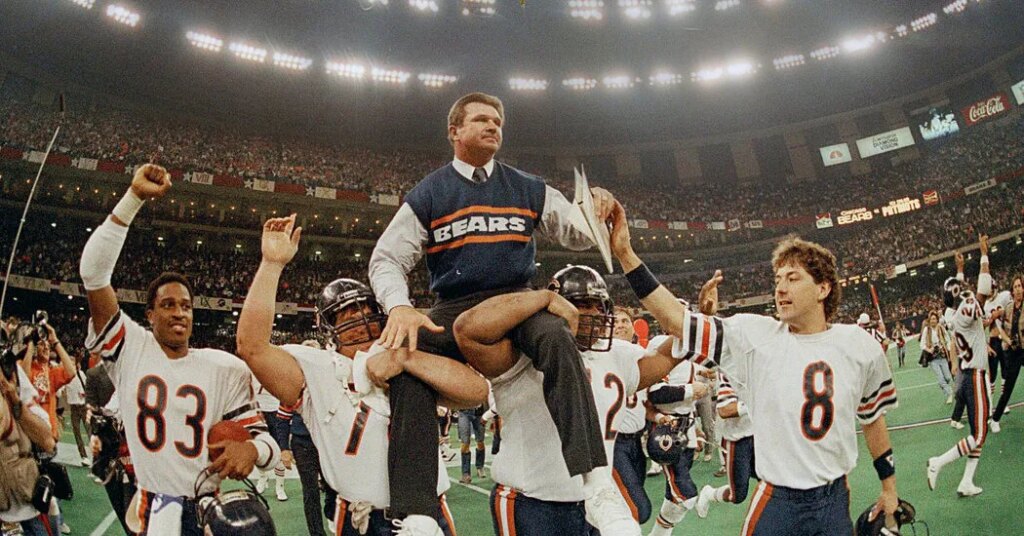
To a large degree, the Windy City felt in his debt. He starred on the 1963 Chicago Bears, a team that won the N.F.L. title, and coached the 1985 Bears to the franchise’s only Super Bowl victory, a 46-10 win over the New England Patriots.
Ditka favored a basic style of play that he called “Bears football,” taking the game back to its primal roots: Hit the other guy harder than he hits you. With a protruding chin, combed-back hair and bushy mustache, he even resembled the fierce bear on the team’s emblem. He certainly could growl.
Chicago’s affection for its coach was the subject of several memorable sketches on “Saturday Night Live.” Devoted Bears fans, always shown seated in a restaurant and gorging themselves with meat and beer, extolled their hero, claiming “Da Coach” could win a game even without his players. They prayed, “We thank God and Ditka for all they have provided.”
Ditka portrayed himself and his team as the “Grabowskis,” blue-collar guys who carried a lunch pail to work and weren’t afraid of getting dirty. “We were the hard-hat guys,” he wrote in a 2005 memoir called “In Life, First You Kick Ass.” “The other guys ride in limos. We ride in trucks.”
But Ditka himself enjoyed vintage cars and exclusive golf club memberships. He opened a chain of pricey restaurants that featured 38-ounce pork chops. For three decades, he was one of America’s most prominent pitchmen, doing ads for Hanes underwear, Campbell’s chunky soups, American Express and, as he aged, Levitra, a medication for erectile dysfunction. He sold everything from antifreeze to frozen yogurt and started his own line of fine wines and cigars. He opened Mike Ditka Resorts in Florida. Despite being a “Grabowski,” he had his own limousine service.
As a coach, Ditka displayed wild mood swings, in a rage one day and penitent the next. He was notorious for screaming at his players and berating sportswriters. He chewed gum as if he was angry at it. His intensity could be both admirable and intimidating.
After a loss in 1983, his second year as a head coach, he punched a locker in front of the team and broke his hand. And yet he could also laugh at himself. A week later, he held up his cast and told his players, “Win one for Lefty.”
Ditka made profitable use of this gruff persona, playing a parody of himself on TV commercials and in the 2005 film comedy “Kicking & Screaming,” where he coached a kids’ soccer team with Will Ferrell. “I eat quitters for breakfast and spit out their bones,” he bellowed at the young players.
Armen Keteyian, who wrote the 1992 biography “Ditka: Monster of the Midway,” portrayed the coach as “a complex and contradictory man,” a hard drinker who “played more cards than Amarillo Slim and as much golf as Arnold Palmer.” Keteyian added, “His self-esteem and temperament are forever tied to that one constant in his life, the one elixir that cured any ill — winning.”
Keteyian quoted Megan Ditka, the coach’s only daughter: “I asked my mom once. I said, ‘Mom, was he the same person when you married him?’ She said honest to God, he was a very shy and unassuming person before he got into the Pro Bowl. Then it was women. Fame. This and that. She said the priorities in his head got a little crowded.”
Michael Keller Ditka was born on Oct. 18, 1939, in Carnegie, Pa., outside of Pittsburgh, and grew up in nearby Aliquippa. The family name had been Dyzcko in Ukraine, and the surname was changed by Ditka’s father, also named Mike. His mother was Charlotte (Keller) Ditka.
The elder Ditka, himself a forceful man, worked at a steel mill, coming home with burn marks on his arms and scorched clothing. He became president of the local union and held the job for 34 years. He was a strict father, “not afraid of taking the belt out to whip you,” his son said.
Young Mike, the eldest of four children, was a fierce competitor even as a boy. He’d chew out his teammates for making errors in Little League. He once chased his younger brother over a fence after he dropped a fly ball.
In high school, he was captain of the football, basketball and baseball teams. He had a chance to sign a professional baseball contract but decided instead to attend college. He was recruited heavily to play football by Pitt and Penn State. At the time, he thought he might one day become a dentist, and Pitt alumni convinced him that their dental school would be easier to get into.
Reflecting later on his career choices, Ditka said: “The dentistry thing wouldn’t have happened. I mean, think of Dr. Ditka. Me looking into people’s mouths? I think I’d rather knock teeth out than put them in.”
At Pitt, Ditka played tight end and split end on offense and on the defensive line. He also punted. The Bears drafted him with the fifth pick of the first round in 1961, signing him for a $12,000 salary (about $130,000 today) and a $6,000 bonus. That same year, he wed Margery Dougherty, whom he had known since high school. The marriage produced four children and lasted 12 years until their divorce.
Though just a rookie, Ditka redefined the notion of what a tight end could add to an offense. At 6-foot-3, 230 pounds, he was not just a blocker, but also a prolific pass catcher who bulled his way over tacklers downfield. He became rookie of the year and made the first of five Pro Bowl appearances.
The take-no-guff tight end inevitably feuded with his domineering coach, George Halas, who was also the team’s owner. Their biggest dispute was about money. Halas was a skinflint who, Ditka said, “tosses around nickels like manhole covers.” In 1966, in a secret deal, Ditka accepted $50,000 to sign with the Houston Oilers of the rival American Football League. The deal fell through when the N.F.L. and the A.F.L. merged.
Halas traded Ditka the following year to the then-lowly Philadelphia Eagles, where, slowed by injuries, he played two miserable seasons. Though he was never again an All-Pro, he enjoyed three better years after that with the Dallas Cowboys before retiring in 1972.
Tom Landry, the Cowboys’ coach, thought enough of Ditka to hire him as an assistant. The two were an odd couple, one a stone-faced man who taught Bible classes and the other a hot-tempered carouser. In a forward to Ditka’s autobiography “Ditka,” Landry cautiously wrote, “Although I cannot condone the use of four-letter words in this book or elsewhere, I can endorse the book’s Christian intent.”
In 1977, Ditka married Diana Trantham. In addition to his wife, his survivors include his four children.
Ditka remained a Cowboys assistant for nine years. In late 1981, eager to become a head coach, he took a long shot, writing to the 86-year-old George Halas and asking to be considered if the Bears were ever looking to replace their coach.
Halas had given up the on-field reins in 1967; the Bears glory days were in mothballs. He was in the market for a new coach, someone as tough as himself, and by hiring Ditka he got what he wanted. The team’s new coach cursed and threatened. He said he told his players that “they were cowards for not hitting anybody. Then I threw chalk at the chalkboard.”
The Bears were coming off a 6-10 season and, in Ditka’s first year, a strike-shortened season, they went 3-6. But the new coach had inherited a strong core with running back Payton, middle linebacker Mike Singletary and defensive lineman Dan Hampton, all future Hall of Famers.
The team drafted well. In 1983, the Bears went 8-8; in 1984, they were 10-6.
In 1985, they finished 15-1 and won Super Bowl XX. The Bears were not only one of the most dominant teams ever, they were also a fun house of outlandish characters, including a player so massive he was called the Refrigerator and a defense that woofed like hounds before each play.
Ditka’s subsequent Bears teams, though abundant with talent, never again made it to football’s biggest game. Indeed, the fun house was only great fun the first time around. The Bears suffered from key injuries, salary disputes and internal bickering about endorsements. Ditka’s tirades no longer seemed master strokes of motivation, just displays of an uncontrollable temper. He was fired after the Bears went 5-11 in the 1992 season.
Five years later, Ditka, a man with such bad hips that he waddled more than walked, returned to the game as head coach of the New Orleans Saints. His teams were awful. In Ditka’s third and final year, he said, “God puts people in places for reasons, and he probably put me here to be humbled.”
This general was not one to fade away. His TV appearances continued. He maintained a business empire. In his later years, he became a leading advocate for former N.F.L. players suffering from injuries incurred during their careers. The hard-hitting Ditka criticized the sport for failing to effectively deal with the problem of concussions.
In 2004, Republican leaders asked him to run for the U.S. Senate from Illinois against a state senator named Barack Obama, a greenhorn candidate with far less name recognition than a Hall of Fame football legend. Ditka, a staunch conservative, decided he already had too many other commitments. He came to regret the decision.
“Biggest mistake I ever made,” he told a reporter in 2013. “Not that I would have won, but I probably would have and he wouldn’t be in the White House.”
The post Mike Ditka Has Died. Bears Coach Was Beloved for Winning and Shouting. appeared first on New York Times.