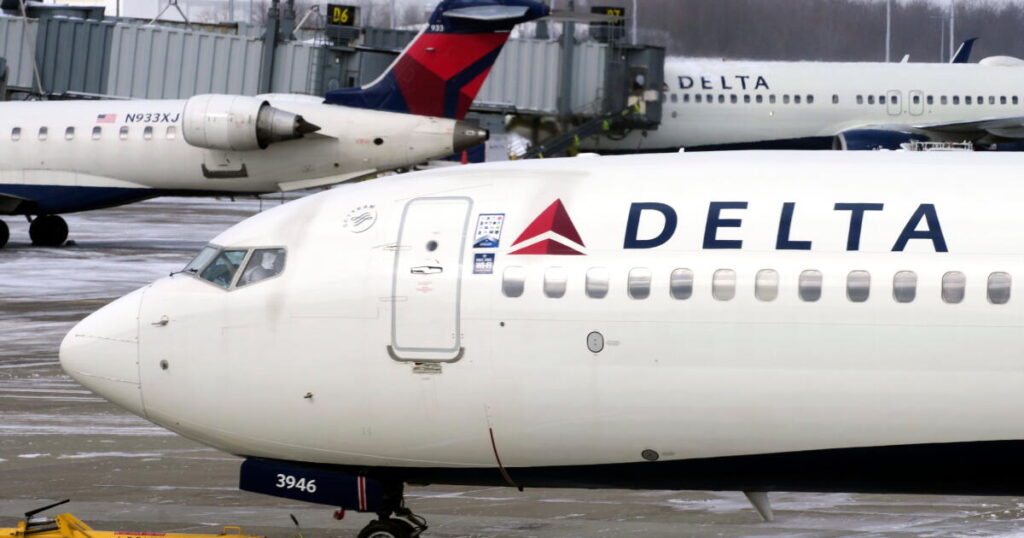
Delta Air Lines Inc. reduced its full-year earnings outlook as high jet fuel prices stemming from the war in the Middle East continue roiling US airlines, even as strong travel demand helps the carrier offset some of the added costs.
The Atlanta-based airline said Friday it expects adjusted earnings of $5.10 to $5.60 per share in 2026, well below the $6.50 to $7.50 range it reaffirmed in July. The new forecast is in line with analyst estimates compiled by Bloomberg of $5.44 per share for the year.
Delta said it expects to absorb approximately $6 billion in additional fuel costs this year compared with 2025.
“I wouldn’t call that a surprise to anyone, it’s all because of higher fuel prices,” Chief Executive Officer Ed Bastian said of the new range. “If this continues to go higher for longer — which I think it will — as the premium airline in the industry we have the best ability to be able to price for that.”
Shares fell in premarket trading in New York. As the first major US carrier to report quarterly results, investors see Delta as a bellwether for the industry at a time of rising costs and questions about how long demand will remain strong in the face of rising ticket prices entering the crucial holiday travel season.
Delta reported adjusted third-quarter earnings of $1.72 per share, lower than the $1.82 expected on average among analysts surveyed by Bloomberg. Adjusted revenue rose about 16% from a year earlier to $17.6 billion, roughly in line with expectations.
The carrier said adjusted fuel expenses jumped 62% to $4.1 billion year-over-year, including more than $500 million in additional costs compared with its July forecast.
“We continue to see very strong demand, and we see that being sustained in the fourth quarter and the start of next year,” said Bastian in an interview with Bloomberg.
He also didn’t see travel demand tapering off even as airfares are expected to climb.
“Air travel, even with a higher price point, is still a relative bargain in the consumer economy,” he said. “Airfares are still 10 points lower than inflation.”
The carrier reported adjusted pretax income of $1.5 billion, basically flat from a year earlier, as higher ticket prices and growing premium revenue helped cushion the impact of fuel costs.
Premium revenue increased 18%, while revenue from its long-standing partnership with American Express Co., the exclusive issuer of Delta’s co-branded credit card, rose 15%.
For the fourth quarter, Delta forecast adjusted earnings of $1.15 to $1.65 per share and revenue growth of about 20% from a year earlier.
The carrier expects an operating margin of 7% to 9% and an all-in fuel price of approximately $4.25 per gallon, signaling that elevated energy costs will remain a drag on earnings through year’s end.
Delta has increasingly leaned on higher-paying customers and its lucrative loyalty program to drive revenue. It recently expanded its network of exclusive Delta One lounges, further segmented its business-class cabins and deepened partnerships tied to its SkyMiles program.
Revenue outside of traditional main cabin ticket sales, including premium seating, loyalty and other businesses, accounted for 61% of adjusted revenue in the quarter.
Faster in-flight Wi-Fi is one of the ways Delta and rival carriers are trying to lure premium travelers.
Delta recently found itself in the middle of a public spat with Elon Musk after the carrier selected Amazon.com Inc.’s Leo satellite internet service instead of SpaceX’s Starlink. Bastian told Bloomberg in May that Amazon’s product offered better bandwidth at a significantly lower price than Starlink.
Musk repeatedly criticized Bastian over the choice, saying last week the Delta executive “will lose his job over this” after an account on X circulated unverified comments attributed to Bastian.
“I’m very confident that we’re doing just fine here on Wi-Fi, and I’m not going to take any bait there, as much I’d like to,” Bastian said when asked about the recent comments. “Starlink is a great product, we know it well. We were involved in the early days of Starlink, and we couldn’t align on an agreement so we went our own separate paths.”
Delta’s main competitors — United Airlines Holdings Inc., American Airlines Group Inc. and Southwest Airlines Co. — are embracing Starlink, with American announcing plans to expand the service to its entire mainline fleet of more than 1,000 aircraft.
Taylor writes for Bloomberg.
The post Delta cuts profit outlook as soaring fuel costs hit airlines appeared first on Los Angeles Times.