As of 2022, more than half of the seafood eaten worldwide was farm-raised rather than caught at sea, a fact that has been praised as evidence that fish farming can meet a growing demand for seafood while slowing the collapse of the oceans.
But the unbridled embrace of aquaculture as a sustainable answer to feeding the planet ignores some very real costs.
The most popular types of farmed seafood — salmon, shrimp, trout, seabass, seabream — are fed “fishmeal,” a protein-rich powder or pellet made from the very kinds of wild fish that aquaculture is thought to save.
In fact, fishmeal is fed to two-thirds of global farmed fish. Before they reach market, some farm-raised salmon eat more than six times their weight in wild-caught fish.
With thousands of fish farms worldwide, aquaculture provides millions of people with year-round access to affordable protein. Fish farming is also a crucial source of jobs, especially for women in India.
But a wide-reaching investigation by The Outlaw Ocean Project, a nonprofit news organization based in Washington, D.C., has found that the aquaculture industry’s answer to worries about the world’s oceans — “grow more fish so we can catch less” — is often making the very problem it hoped to solve worse and harming the people it was meant to help.
The investigation
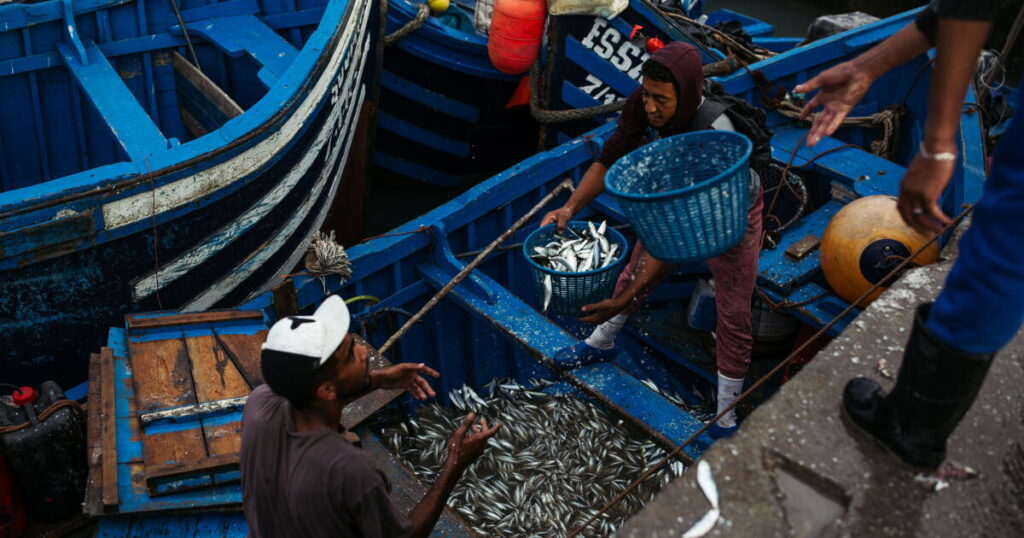
The business of fishmeal — often out of public view — can involve using forced labor, poisoning communities, and eradicating the livelihoods of local fishermen.
Fishmeal production has led to chronic chemical exposure, violent protests — typically spurred by the stench from fishmeal factories — and escalating transnational tensions as countries compete for catch. That price is paid primarily by the poorer countries where the main ingredient of fishmeal is harvested and processed.
The Outlaw Ocean Project mapped roughly the entire global fishmeal industry, including more than 1,400 fishmeal factories across 64 countries. The effort involved dozens of journalists from over 15 countries who visited factories and farms and boarded fishmeal ships at sea.
Using certification documents, ownership records, trade data, audits and government lists of licensed fishing ships, the reporting team was able to connect ships to the plants they supplied and pin down which species were being targeted for fishmeal. This allowed them to determine which fishmeal plants were connected to ships engaged in illegal or unsustainable fishing. Then, they traced the fishmeal to the fish farm and to where the seafood was sold by retailers.
The investigation found that more than 2,400 ships tied to fishmeal production, operating in the waters of at least 30 countries. It found that most of those ships do not fully comply with the Global Charter for Fisheries Transparency, a guide created by leading ocean-focused civil society groups detailing accountability standards for industrial fishing fleets.
For example, less than 30% of the fleets had publicly available location information, and less than 25% had a unique vessel identification number. Such opacity makes the ships difficult to police.
At least half of the species landed by the assessed fishmeal vessels are classified by scientific studies as “overexploited” or worse. Most of these vessels are purse seiners or trawlers, which deploy vast nets to capture dense schools of fish. Both gear types are associated with high levels of waste, routinely hauling in large volumes of non-target species.
At least 165 of the ships were bottom trawlers, a particularly destructive form of fishing that uses weighted nets that scrape the ocean floor, destroying virtually everything in their path.
Concerns about aquaculture extend far beyond the fate of the oceans. In Gambia and Mauritania in western Africa, the industry drives food insecurity as fish that once sustained local communities are diverted into fishmeal factories.
In remote islands in Russia’s far east and in China’s Xinjiang region, the reporting detailed the use of forced labor on ships, farms and in factories. In other countries, including India and Peru, this industry was tied to at least 80 incidents of civil unrest, some violent, usually in the form of labor strikes and protests sparked by the water pollution or the stink from factories cooking tons of decomposing fish.
In Chile in 2024, several hundred demonstrators burned tires and blocked coastal highways and railway tracks to protest the early closure of the fishing season, a move partly driven by overfishing tied to fishmeal.
In Senegal, fishmeal has put local fishers out of work, so they increasingly are selling — or repurposing — their boats to ferry migrants to Spain’s Canary Islands, a stepping stone to Europe. This perilous journey of roughly 930 miles claimed more than 3,000 lives in 2025.
“We’re fishermen, but there’s no fish left here, so we left,” said Cheikhou Omar, a 21-year-old fisherman in 2024 as he sat on a beach in Senegal, rescued after the fishing boat he tried to sail to Spain capsized, killing 30.
The fishmeal industry also contributes to transnational tensions. For example, in 2021, a dozen Turkish bottom trawlers fishing illegally in the Aegean Sea tried to ram a Greek research vessel when the scientists began filming their activity.
In 2018, riots broke out in Saint-Louis, Senegal, after a fisher was shot and killed by Mauritanian coast guards, during what the Mauritanians said was a cross-border raid by a fishmeal boat.
The politics of protein
In her 2021 book “The Fishmeal Revolution,” Kristin A. Wintersteen traces how the Humboldt Current — a cold, nutrient-rich upwelling system along the Pacific coast of South America — was reimagined as a protein mine. That shift, she argues, turned Peru into a fishmeal superpower, responsible for roughly a quarter of worldwide production.
Fishmeal helped fuel the post-World War II expansion of industrial chicken and hog farming, particularly in Europe and the United States. Since then, this model has spread worldwide.
The feed industry has emphasized that it is decreasing its reliance on fishmeal and fish oil — and especially the use of whole fish or fish parts that can be eaten by people. However, as aquaculture grows, global fishmeal production is predicted to rise by nearly 10% by 2032, according to the Food and Agriculture Organization, a United Nations agency.
For example, five of the world’s largest salmon companies increased their use of fishmeal and fish oil made from whole wild fish by as much as 39% between 2020 and 2024, according to a report from the Farm Animal Investment Risk and Return Initiative.
Asked about sustainability concerns tied to her industry, Véronique Jamin, a spokesperson for IFFO, the international fishmeal association, said that fish farming is “the most efficient animal protein system.” She added that her organization’s “role is not to advise which markets should use fishmeal and fish oil.” Attempts to make the industry more sustainable must consider market forces, she said, and seafood companies have to respond to “what people actually want to buy and eat.”
Efforts to move away from fishmeal and fish oil have struggled. Researchers have identified potential alternatives — including seaweed, cassava waste, single-cell proteins produced by fungi and even sewage.
But none are being produced affordably at scale, and the alternatives often lack the nutrients that support the growth of farmed fish.
The role of forced labor
For those toiling at fishmeal plants and fish farms, the work and conditions can be brutal, the investigation found.
In Russia, fish processing workers were held captive in secluded company towns or stuck on ships far from shore. “People have nowhere to go, no money,” one worker told President Vladimir Putin, who participated in a call-in television show about the fishmeal plant in 2016. A second worker pleaded: “Please, help us.”
In China, the aquaculture industry is expanding rapidly in the country’s mountainous and desert areas inland, particularly in Tibet and Xinjiang, two areas known for political repression, with criminal penalties for speaking native languages or practicing religious or cultural traditions.
Because the U.S. government found human rights abuses to be pervasive there, Congress enacted a law in 2021 that banned all goods produced “wholly or in part” by workers in Xinjiang or by ethnic minorities from the region on the presumption that they were made with state-sponsored forced labor. No such law exists for Tibet.
The investigation mapped more than 1,000 fish farms in Xinjiang and Tibet that produce an estimated half-billion dollars’ worth of seafood annually, much of it exported to more than a dozen countries, including the United States. Despite the 2021 law banning goods from Xinjiang, the investigation found that farm-raised fish from that region have reached the United States.
For example, the Xinjiang Tiayun fish farm, which produces 40% of China’s domestically produced salmon, is tied through supply agreements to a brand of seafood called Aqua Star sold by Walmart and the world’s largest food service company, Sysco, which in the U.S. distributes to public schools, military bases and congressional cafeterias.
Sysco said it was unaware of the link to Xinjiang. “We hold all suppliers across our global supply chain accountable” to uphold U.S., international and local laws, and Sysco suspends contracts when they do not, said Ramit Plushnick-Masti, a company spokesperson. Aqua Star and Walmart did not respond to a request for comment.
Xinjiang Tianyun said in a statement that claims of forced labor “are completely factually unfounded.” The Chinese government did not respond to a request for comment.
More than 80% of seafood eaten in the U.S. is imported, and 9% of that comes from China.
Another major supplier of seafood to the U.S. is India, which produces roughly a third of the shrimp that Americans consume, almost all of it grown with fishmeal. The investigation found at least 18 instances of civil unrest and at least 20 cases of water or air pollution tied to Indian fishmeal plants.
In November 2020, Indian government investigators found hidden bore holes where the operator of the United Marine Products fishmeal plant in Goa had been covertly disposing of toxic waste, thereby contaminating groundwater. The plant owner denied wrongdoing.
Shrimp sold by Sysco and at Kroger and Safeway is fed fishmeal from United Marine, according to Bait to Plate, an online tool that maps seafood supply chains. Kroger and Safeway’s parent company, Albertsons, did not respond to a request for comment.
Sustainable practices
Though problems with fish farming have arisen worldwide, for some countries, it aquaculture has been a boon.
In Bangladesh, aquaculture has driven down the price of fish. Even accounting for fishmeal and transportation to the U.S., the production of certain farmed fish, including tilapia and Atlantic salmon, emits less greenhouse gas per pound than beef or pork.
Harvesting bivalves, like clams, oysters, scallops and mussels, is especially sustainable because these species do not require feed. This type of aquaculture also has a low carbon footprint and the shells function as a form of carbon capture, according to a 2020 paper by the scientific journal Nature Food.
In the United States, at least 16 factories processed fishmeal as of 2025, along the Chesapeake Bay in Virginia, the Gulf Coast in Mississippi and Louisiana, and in California, Oregon and Alaska.
Most of these factories use inedible offcuts from fishing because nearly every U.S. state has outlawed the targeting of whole fish for fishmeal. The factories also tend to be better regulated than plants elsewhere in the world.
Long supply chains
As the production of seafood has become more globalized, its supply chains have stretched longer, making it tougher for consumers and grocers to know whether it was harvested sustainably or legally.
Robert K. Stumberg, professor at Georgetown Law and supply-chain expert, said grocers typically buy from wholesalers and rarely track their suppliers. One other reason may be plausible deniability, he added. “Companies can escape blame or the need to fix problems if they’re unaware of them.”
With government oversight of supply chains sometimes lacking, industry-led certification programs have sought to fill the gap and root out unsustainable, unethical or illegal practices.
But critics say these programs generally focus on environmental crimes and overlook labor abuses on ships. On land, at processing plants or farms, certification programs rarely conduct true spot checks to authenticate the reassurances given by managers, said Allie Brudney, a senior staff attorney at Corporate Accountability Lab, a strategic litigation nonprofit.
Instead, the programs frequently alert companies before inspectors show up. At sea, these programs often rely on self-reported information from ship captains rather than having auditors inspect vessels offshore.
Devan Meserve, a spokesperson for the Global Seafood Alliance, which runs the Best Aquaculture Practices program, defended the value of such inspection programs. She said that her organization represents the “most comprehensive program for farmed seafood,” partly because it covers the “entire aquaculture production chain.”
Protecting workers on the fishing vessels that supply feed mills is, however, an “immense challenge,” Meserve added, because audits occur at port. She added that her organization helps the industry counter illegal and overfishing by requiring feed mills to source most of the fish they use in fishmeal or fish oil from fisheries accredited by certification programs like Marine Trust and Marine Stewardship Council.
The risk of false advertising
“Any accounting of the true impact of aquaculture has to start not with the farm, but with the feed,” said Daniel Pauly, project director of the Sea Around Us initiative at the University of British Columbia. “And that kind of accounting offers a very different picture than the industry offers.”
Since 2020, at least nine lawsuits alleging false advertising have been brought against six seafood companies in six U.S. states. Plaintiffs challenged language such as “sustainable,” “eco-friendly” and “wild-caught,” as well as claims of superior worker-safety standards. Five of the lawsuits resulted in settlements, and the companies paid the plaintiffs more than $2 million.
In at least four cases, the use of fishmeal or fish oil and their link to industrial fishing and ecosystem depletion were central to arguments that the products were not environmentally sustainable. Additional allegations included forced labor on fishing vessels and reliance on harmful pesticides and antibiotics.
The Outlaw Ocean investigation assessed more than 500 seafood companies that made marketing claims that were comparable to — or stronger than — those cited in the lawsuits. Over half of those companies had supply chain ties to fishmeal producers involved in crimes, misconduct and unsustainable fishing practices.
Dana Cleaveley, a research consultant formerly with SeaChoice, a Canadian sustainable-seafood group, said that many industries have already had to begin reckoning with the human rights and environmental abuses buried in their supply chains. She cited “sweatshop garments,” “fair-trade coffee” and “blood diamonds” as examples.
Seafood has been slower to face such scrutiny, though, as the world leans further into aquaculture, that may change, she said, particularly if more governments begin restricting imports tied to illegality or unsustainable practices. She added: “That’s when investors will begin to see material, not just reputational risk, and companies will have to adjust.”
But in some quarters, the troubling costs of fish farming remain unaddressed.
In April 2025, President Trump signed Executive Order 14276, “Restoring American Seafood Competitiveness,” which instructed government officials to reduce regulatory burdens and boost the commercial fishing and aquaculture sectors in the United States.
It made no mention of feed or fishmeal.
Urbina is executive editor of the Outlaw Ocean Project. The reporting for this story was part of a larger investigation conducted by an international team of journalists based at the Outlaw Ocean Project.
The post The hidden cost of farmed fish: Pollution, forced labor and the depletion of wild fish appeared first on Los Angeles Times.