Law enforcement authorities in India took extraordinary measures Friday to prevent protesters from assembling in the capital, ordering the cancellation of trains bound for Delhi and the suspension of mass transit in the city. They also effectively put several would-be protesters under house arrest.
The moves came in response to a call by the Gen Z movement known as the Cockroach Janta Party for people from all over the country to converge in central Delhi for a protest on Saturday against what they say is a politically motivated purge of India’s voter roll.
Saturday’s rally is to be held at a monument called Jantar Mantar, which has been a protest site for many years, but which security forces are currently blockading.
The restrictions imposed by law enforcement authorities led India’s highest court to issue a rare emergency order on Friday afternoon, urging the government to reconsider the limits and offer an alternative space for a protest. Responding to an appeal from an opposition party politician, the court also said the city’s metro service should not be shut down completely.
“You have to prevent certain things,” the chief justice of the Supreme Court, Surya Kant, said.
“But that does not mean you should use a hammer to kill a fly,” he added.
(It was Mr. Kant who unwittingly gave rise to the cockroach movement, when he likened unemployed youth to cockroaches. In response, Abhijeet Dipke, then a graduate student living in Boston, wrote on social media: “What if all cockroaches come together?” It gave birth to the Cockroach Janta Party.)
Prime Minister Narendra Modi has not commented on this week’s protests.
Saturday’s planned protest follows a week of nationwide demonstrations demanding the resignation of Gyanesh Kumar, the head of India’s election commission, a body that was long held in high regard for running fair polls but has recently come under intense public criticism because of the voter roll revision. That exercise to clean up voter lists began last summer and ended up eliminating 130 million names. Critics say it is an effort to entrench Mr. Modi’s power.
In the capital, opposition parties and other activist groups have held daily protests for the last week, only to be aggressively restrained by police and then detained. On Friday, videos spread on social media of police officers pulling young would-be protesters from trains bound for Delhi in various parts of the country.
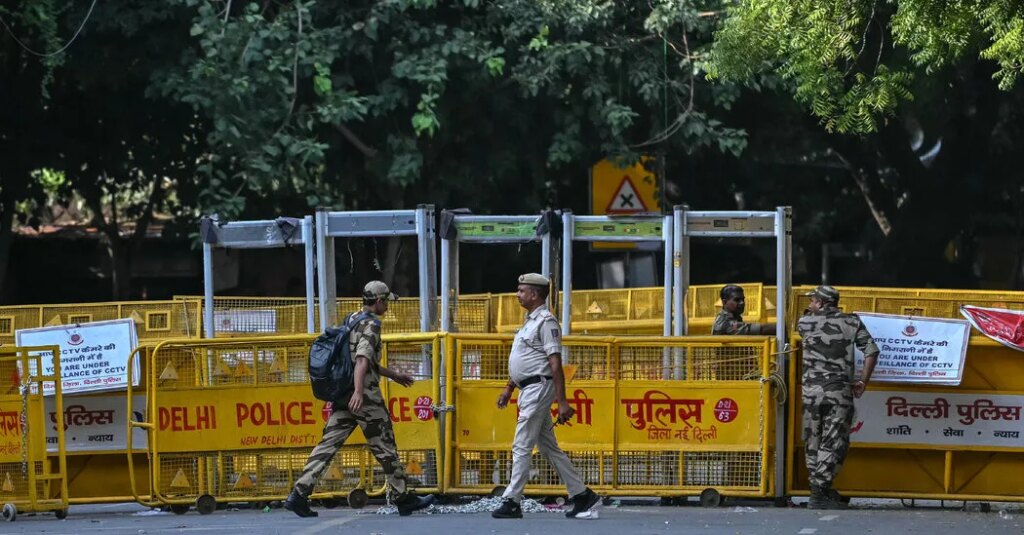
There was a heavy police presence in central Delhi on Friday. Around Jantar Mantar, tall yellow police barricades were chained together. Loudspeakers were erected at traffic circles, playing announcements warning people not to gather. “Violation may lead to legal action against you,” the announcements said.
India has long prided itself as a thriving democracy, even as space for dissent has shrunk in Mr. Modi’s 12-year tenure.
The government’s heavy-handed efforts this week go considerably further than recent attempts to stop anti-government agitation. This summer’s protests by the Cockroach party uncorked a generation’s rage over a dysfunctional college entrance exam system and won the rare ouster of a government minister. The government did not stop the protesters from gathering this summer but responded with force.
On Friday, Delhi police said they had denied permission for the rally, saying the organizers had not asked for permission sufficiently in advance and broke rules the last time they protested, without offering evidence of which rules they broke. In a news conference, Nupur Prasad, a senior police official, said “reasonable preventive restrictions” had been put in place. She warned legal action against those who violate the order.
Ashutosh Ranka, a leader of the Cockroach party, said in a voice note to The Times on Friday evening that the protest would go on. “The government is in complete panic,” he said in the voice note. “They don’t know how to deal with peaceful protesters, and that’s why they are resorting to absolutely dictatorial measures.”
“It’s a shame that in the world’s largest democracy you have to protest to even go and protest at a designated protest site,” he added, referring to Jantar Mantar.
Police tactics have succeeded, to an extent, in preventing protesters from reaching Delhi.
Kunal Choudhary, 26, was planning to lead a delegation of around 30 people to Delhi from a town three hours away by bus. But on Thursday evening, police officers showed up at his home and have not left, he said, offering no warrant for his arrest.
“They showed me a WhatsApp group where there was a list with my name also. They were given orders to go to all those people’s homes,” he said.
As he narrated the events by speakerphone, a police officer, Manvendra Singh, listened in, identifying himself on the call. He refused to say why he was there, only that Mr. Choudhary would be detained at home through Saturday evening.
Mr. Choudhary’s mother, Mitika, served the police officer tea and Oreo cookies for breakfast. “My mother is used to this now. She used to be quite scared,” he said. It was the third time in a month police had shown up at his house.
The post India Cancels Trains, Floods Capital with Police to Block Protests appeared first on New York Times.