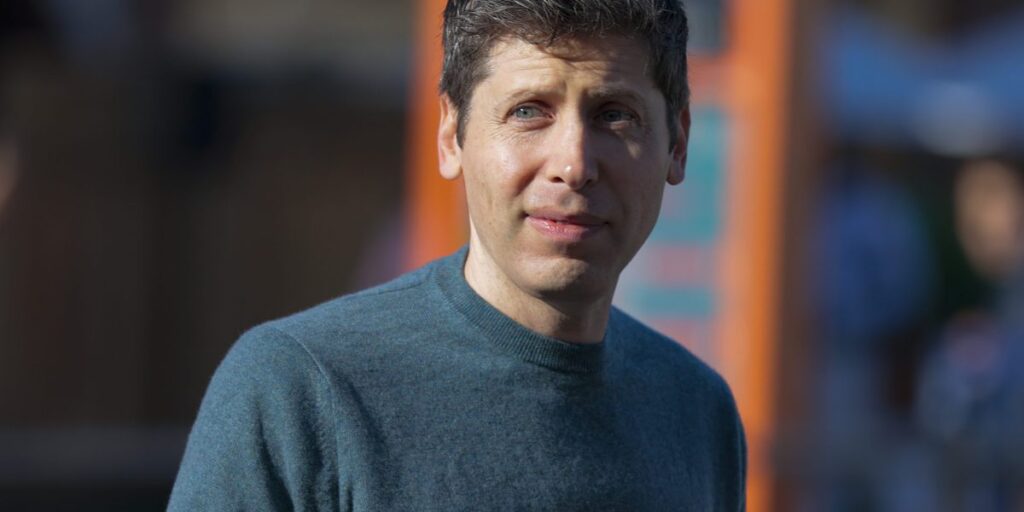
Sam Altman doesn’t understand history. His mistake is going to punish the world.
That’s the depressing takeaway from the OpenAI’s CEO’s September 23rd speech to the United Nations. He came out swinging, saying that “we,” as in humanity, “have a choice in front of us.” AI, he said, “can either be more like a new Renaissance of creativity and discovery, or more like a new Industrial Revolution of upheaval and disarray.” He ended by calling for international “cooperation” and “standards.” In short, an AI regulatory regime that brings us to the promised land of another Renaissance instead of the chaos of another Industrial Revolution.
But that’s backward. The Renaissance, for all its artistic beauty, was not a time of meaningful economic, social, and political progress. Humanity’s material condition did not meaningfully improve, nor did democracy advance apace. When Thomas Hobbes described life in the state of nature “as poor, nasty, brutish and short,” he may as well have been talking about post-Renaissance existence, as well. An English builder’s day wage bought less food in 1600 than it had in 1475. The magnificent art didn’t do much material good for those who mixed the plaster.
Don’t get me wrong: The Renaissance wasn’t a failure. Michelangelo’s David and the Sistine Chapel ceiling are treasures that all of humanity should appreciate. So are Leonardo da Vinci’s notebooks, filled with flying machines, batlike wings worked by a pilot pumping pedals. But frescos don’t put shoes on a poor child’s cold feet and sketches of flying machines didn’t put Orville Wright in the sky. True progress didn’t happen until—you guessed it—the Industrial Revolution.
What Mr. Altman describes as “upheaval and disarray” was, in fact, the beginning of the greatest and most sustained improvement in humanity’s material condition. Around 1800, one English child in three died before age 5; today it is about one in 200. Before the Industrial Revolution, only a relative handful of people had ever seen Michelangelo’s David. But in 1857, a full-size cast of the David went on view at London’s new South Kensington Museum, which soon lit its galleries with gas so working people could see it after their shifts. Life expectancy has doubled, giving us the miracle of great grandparents meeting their great grandchildren.
Why did the Industrial Revolution succeed far more than the Renaissance? The answer comes down to one word: Power.
For all its flowering of original thought and creativity, the Renaissance was ultimately a time of patronage, and the patrons both held the power and used it to enrich their own palaces and places of worship. What did they do to improve the plight of the great mass of people? Not much. But the Industrial Revolution shifted power to the masses, with democracy, individual rights, and the freedom to innovate. That era’s patrons, like Andrew Carnegie, still get the headlines. But it was everyday innovators like Wilbur and Orville Wright who showed that the masses really move humanity forward.
And that’s why Mr. Altman’s misunderstanding is so concerning. If adopted, his argument will hold humanity back. The regulatory regime that he hinted at in his United Nations speech, and that he and other AI company CEOs have called for in recent weeks, threatens the return of the Renaissance-style patronage. Despite their claims to the contrary, it will cement the power of existing companies—like Mr. Altman’s own—and give new and untold power to armies of bureaucrats. Davos Man will do just fine, because Davos Men will still be in charge. But what about the rest of us, the regular humans, who stand to gain the most from the cures and creations that AI could bring?
With artificial intelligence, we don’t need another Renaissance patronage story. Modern-day courtiers and princes–to say nothing of bureaucrats–should not be the ones deciding what gets made and who gets to see it. We need another Industrial Revolution diffusion story, with everyday people using technology to drive rapid and radical improvements in daily life. That’s the only way living standards have ever improved, and the past 200 years are the proof. Leonardo da Vince drew the flying machine at a prince’s court. But it took two bicycle mechanics in Dayton to build it 400 years later.
Sam Altman needs to learn his history, because he’s demanding a future that works first and foremost for elites like him.
The opinions expressed in Fortune.com commentary pieces are solely the views of their authors and do not necessarily reflect the opinions and beliefs of Fortune.
The post Sam Altman says we need another Renaissance. But we really need another Industrial Revolution appeared first on Fortune.