The Trump Administration has suspended several major tech companies, including Microsoft and Adobe, as well as IT outsourcing firms from a green card program as it expands its crackdown on visa fraud.
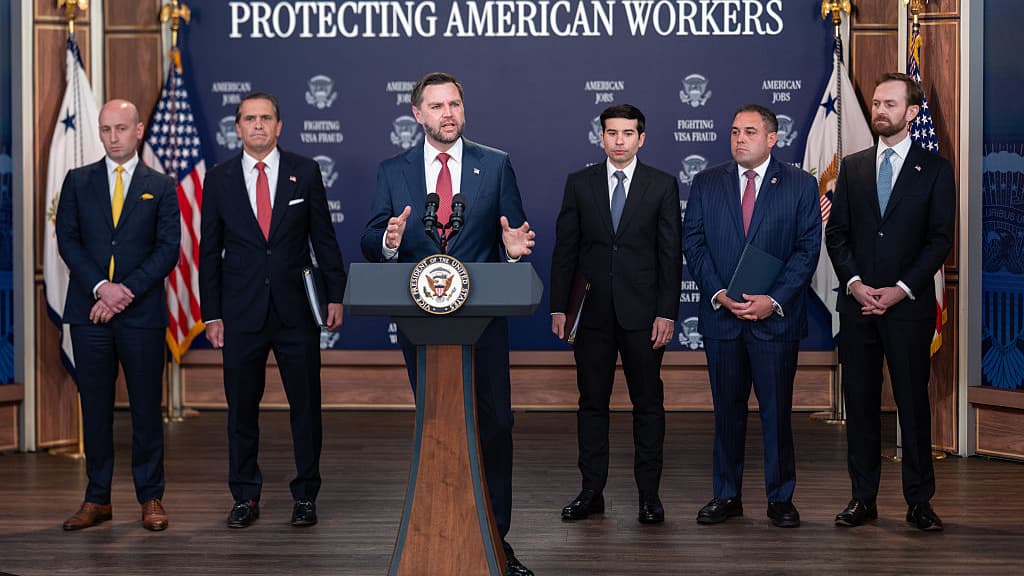
Vice President J.D. Vance said Thursday that the companies had “abused” H-1B visa and green card processes in order to “replace American workers with what is effectively foreign indentured servants.” At the same White House press conference, Trump officials announced probes into nine universities, including Harvard, Yale, and Stanford, that the Administration accused of misusing a program meant for temporary educational and cultural exchanges.
The twin moves mark an escalation in the Trump Administration’s scrutiny of skilled worker immigration programs. The Trump Administration has pursued a broad crackdown on immigration fraud, citing the need to protect American workers and accusing major technology companies and universities of using foreign workers to undercut U.S. wages.
Here’s what to know about the announcements.
How will the suspension impact companies?
Microsoft and software maker Adobe are among eight the companies that the Trump Administration will suspend from applying to sponsor employment-based green cards. The other companies are major information technology outsourcing firms: Cognizant; Infosys; Tata Consultancy Services; Wipro; HCL Technologies; and Capgemini.
“We will not accept any new or process any pending permanent labor certification applications involving these companies,” Labor Secretary Keith Sonderling said.
Sonderling cited ongoing federal investigations, suggesting that the firms were among the biggest beneficiaries of the H-1B program. The companies had sought to hire almost 3 million foreign workers, received more than 230,000 H-1B visa approvals, and obtained over 100,000 permanent labor certifications since 2009, he said.
In fiscal year 2026, Amazon was the biggest employer of approved H-1B beneficiaries, followed by Tata Consultancy Services, Infosys, Apple, and Microsoft, according to immigration data.
According to Labor Department data through June 2026, Microsoft was the largest filer of applications via the PERM program which is the first step in the U.S. permanent labor certification process. The application requires employers to demonstrate that a foreign hire will not hurt U.S. workers’ wages or jobs.
“There has been no company in the United States, unfortunately, that has abused the system more than Microsoft,” Vance said.
Vance said Microsoft laid off 6,000 American workers last year while obtaining 6,300 H-1B visas and nearly 3,000 green cards. The company announced in July that it would cut 4,800 jobs.
“If you do the math, for every worker that Microsoft laid off, they replaced that worker with one and a half foreign indentured servants,” Vance said. “Our message to Microsoft is: You’re a great American company, but you’ve got to hire great American workers.”
Microsoft said in a statement that 80% of its H-1B applications in the last fiscal year were to extend or change the status of current employees, not hire new workers.
“The remaining filings for new employees were for individuals already legally in the United States who decided to come work for us, and they equal only 1% of our U.S. workforce. They are not new arrivals to our country,” Microsoft said.
Microsoft said it pays its H-1B employees the same as other workers in comparable roles. It added that it only files H-1B petitions for “those who meet the rigorous standards of this visa category.”
Vance said the suspensions would last “as long as it needs to.” The Administration is seeking to compel the companies to change their behavior. Vance accused companies of deliberately posting ineffective job ads in order to justify hiring foreign workers.
“Maybe they’ll put an advertisement in a small-town newspaper. They’ll go out there and say that we have advertised for a position with our company, and nobody is responding to it. And they will use that lack of response to then go and replace American workers with what is effectively foreign indentured servants,” Vance said.
Tata Consultancy Services told Reuters that it did not expect the suspension to impact its workforce strategy or client engagements, noting that it had made single-digit PERM applications in the past two years.
TIME has reached out to the other companies for comment.
Probes over exchange visitor visas
Vance also accused nine universities of abusing the J-1 visa program that allows foreign nationals to temporarily study, teach, or conduct research in the U.S. through programs overseen by the State Department. The universities have already been served subpoenas, the officials said, and would face investigations for allegedly misusing the visa program to undercut American wages.
The nine universities were: Harvard; Yale; Stanford; Brown; the University of Pittsburgh; the University of California, Davis; the California Institute of Technology; Arizona State; and the Massachusetts Institute of Technology.
“Something weird is going on at these universities,” Vance said. “They’re using these visas way too much. They’re using them to undercut the wages of American grad students and American researchers, and it simply has to stop.”
Labor Inspector General Anthony D’Esposito said the “historic investigation into J-1 visa fraud” would focus on whether foreign influence, improper financial relationships, or visa abuse were compromising federally funded research.
“I don’t care how prestigious a university thinks it is,” he said. “Break the law and screw the American people, and I will personally cuff you in the university square. I don’t care how large your endowment is, how powerful your alumni are or how many politicians you have on speed dial.”
Harvard, Brown, Pitt, and MIT acknowledged receipt of the subpoenas. Stanford and UC Davis said they would cooperate with the investigations. Arizona State said it complies with U.S. law. Yale said it would review the investigation documents once it received them.
TIME has reached out to the universities for comment.
How will workers and students be impacted?
For employees at the eight companies, immigration lawyers say the PERM pause will delay a common route to obtaining a green card. Workers nearing the typical six-year limit for H-1B visas without an earlier green card filing face the greatest risk, according to immigration lawyer Lidice Samper.
Supporters of the move said it will enforce existing rules around H-1B and green cards meant to protect American jobs and wages. Opponents, however, said it could ultimately leave foreign workers more dependent on their employers and make it harder for U.S. companies to attract and retain talent.
“Our economy, our communities, and our families depend on immigrants in many sectors, including the tech sector, and heavy-handed attacks like this only hurt efforts to build a strong, stable, and diverse base of workers who have legal pathways to come and be in the United States while also protecting U.S. workers from unscrupulous employers,” Rep. Pramila Jayapal (D, Wash.) posted on X.
Doug Rand, formerly a senior adviser at U.S. Citizenship and Immigration Services under the Biden Administration, told the Associated Press that the policy is “incoherent,” noting that a green card gives H-1B workers more freedom to switch jobs and demand higher pay.
“If the Trump administration were truly concerned that H-1B workers are ‘indentured servants,’ then the last thing they would do is block companies from helping their own H-1B workers get green cards,” Rand said.
Nasscom, India’s IT industry group, said the pause would have a limited effect, given that the number of employees seeking permanent residency through PERM is “relatively limited.”
Dinesh Pai, vice president of investments at India’s largest brokerage Zerodha, noted on social media that the suspension would impact Indians seeking high-earning positions in the U.S.—and by extension remittances and angel investments back into India. But he added that if U.S. companies cannot bring talent to the U.S., “they probably will bring the work to India.”
Read More: How Trump’s H-1B Reform Could Harm American Tech Innovation
The investigations into the universities have not changed J-1 eligibility, but they add uncertainty for visiting scholars and the universities hosting them. Among the universities subpoenaed, Harvard sponsored 2,218 new J-1 exchange visitors in 2024, Stanford 1,436, Yale 1,169, and MIT 1,087, according to federal data.
The Administration’s ongoing crackdown on immigration has led to declines in international enrollment. Last year, new J-1 research scholars across the country fell 27% to 17,622. NAFSA also estimated that new international student enrollment fell 17% in fall 2025, contributing to more than $1.1 billion in lost revenue. A separate report found that international student enrollment for spring 2026 fell 20% from a year earlier. Last week, Columbia paused admissions to its journalism master’s program amid falling international applications.
Read More: As U.S. Enrolls Fewer International Students, Universities in Asia Are Going the Other Direction
Expanding crackdown
On Wednesday, the Department of Homeland Security proposed a $70,000 fee to apply for Optional Practical Training—a program that allows international students to work in jobs related to their major for a limited time during school or after graduation. The proposed rule would charge universities and colleges for every student who participates in the program.
In August, the Trump Administration announced plans for a $103,265 fee. The Administration said the fee would act as a “dedicated revenue mechanism to help recover a portion of the federal government’s costs of administering the lawful immigration system.”
If implemented, either fee is likely to face legal challenges. Last September, the White House imposed a one-time $100,000 fee to be paid by companies filing H-1B petitions to hire workers outside the U.S. That fee was struck down in June by a federal judge, who ruled that the charge functioned as an unauthorized tax. An appeals court declined to pause that ruling in July, although the government’s underlying appeal remains pending.
Also in September 2025, the Labor Department launched “Project Firewall,” an enforcement effort aimed at investigating employers suspected of abusing the H-1B program and displacing U.S. workers. The department said it has launched nearly 200 investigations under the initiative.
The Administration has also sought to overhaul the H-1B program by replacing the random lottery with a selection system favoring higher-paid applicants and proposing eliminating the grace period of up to 60 days that gives H-1B workers time to find a new sponsor after losing their jobs.
Meanwhile the probe marks the Administration’s latest attempt to scrutinize American higher education by targeting international students and scholars. In July 2025, DHS subpoenaed Harvard for records concerning international students and immigration compliance. The university said it would comply with the law but called the subpoenas “unfounded retribution.”
The Administration also tried to revoke Harvard’s authority to enroll international students and to bar new international students from entering the U.S. to attend the university. Courts blocked both measures while litigation proceeded.
The Administration has also tightened immigration rules for international students, including screening visa applicants’ social media, and targeting some Chinese students for heightened scrutiny and visa revocation. The Administration has revoked thousands of student visas.
The post Trump Admin Freezes Green Cards at Major Tech Firms, Probes Student Exchange Visas appeared first on TIME.