The party out of power typically makes gains in midterm elections. With President Trump unpopular and gas prices stubbornly high, both parties expect Democrats to win seats.
Will it be a blue wave, though? And if so, will it be strong enough to flip both chambers of Congress? Not all waves have the same gravitational force.
In 2006, when President George W. Bush and Republicans faced a backlash over the Iraq War, Democrats flipped 31 seats in the House and five in the Senate, winning both chambers. Mr. Bush called it a “thumpin’.”
In 2018, in Mr. Trump’s first term, the wave was even larger in House races, with Democrats flipping 41 seats. They failed to win control of the Senate, however, and actually lost two seats to Republicans.
Signs are now piling up that another Democratic wave may be coming. Many officials in both parties privately say that they expect Democrats to win back the House, and that the main question is how many seats will change hands. The Senate, long seen as easier for Republicans to hold, now appears to be a tossup. Polls suggest that the party is playing defense even in states Mr. Trump won by double digits two years ago.
Election forecasting is a dangerous business — Republican fortunes could still turn around — but history is often a useful guide. That is why officials in both parties wonder if these midterms will look like 2006, when Democrats flipped both chambers, or 2018, when Republicans were wiped out in House races but picked up two seats in the Senate.
“All these races that are showing we’ve got a two- or three-point lead or it’s a tossup, we could end up losing all of them by two points,” former President Barack Obama said on Wednesday at a fund-raiser for Senate Democrats. “It’s within the margin of error.”
Democrats currently face challenges that did not exist in those earlier midterms. Republican redistricting gains have narrowed the House battleground. The party also has a significant cash advantage. Most of this year’s battleground Senate races are in states Mr. Trump won easily in 2024. The country has only grown more polarized. And the Democratic Party’s brand remains diminished, with liberal voters mistrustful of its leaders.
“The fact that Democrats allowed Donald Trump to get elected twice is nuts,” said Representative Jason Crow of Colorado, a Democrat who was first elected in 2018. “We have more on our plate and more to do and more to prove now than we had in 2018.”
Some Republicans, for their part, worry that their messaging this year may not be as effective as it was in 2018.
“Trump is the larger-than-life character in this election,” said former Representative Steve Stivers of Ohio, who led House Republicans’ campaign committee in 2018. “There’s no Nancy Pelosi on the Democratic side. There are folks trying to use A.O.C. and the D.S.A., but I’m not sure it has the same knowledge with voters.”
This time, the economy is worse.
The Iraq War dragged down Mr. Bush in 2006, and Mr. Trump faced a mass defection of educated suburbanites from his party in 2018. But both years, Americans felt fairly confident about the economy.
That is not the case now.
With gas prices and interest rates up, inflation stubbornly refusing to yield and Mr. Trump’s tariffs causing a surge in prices in rural America, the country appears to be seriously angry about the cost of living.
The University of Michigan’s Index of Consumer Sentiment is down 33 percent since Mr. Trump returned to office in early 2025. In May, the index reached its lowest point since it began tracking monthly data in 1952.
“In 2018, people weren’t that sour on the economy,” said former Senator Heidi Heitkamp of North Dakota, a Democrat who lost her re-election bid that year as rural states turned hard toward Republicans. “They were shocked by the craziness, but they felt pretty good about the economy before the pandemic.”
Mr. Trump, she added, “still had much more good will than he has right now.”
But Republicans have a big money advantage.
Eight years ago, furious online donors powered a Democratic fund-raising surge that Republicans could not match.
Now Republicans have built a huge financial edge that has left Democrats begging for help.
The Democratic National Committee is effectively broke. The party’s House and Senate committees and their allied super PACs trail far behind Republicans in fund-raising. And Mr. Trump’s enormously powerful super PAC, funded in part by business executives and corporations looking to curry favor with his administration, has given his party an extra advantage.
The disparity between the parties is perhaps most acute in Texas.
Republican super PACs have directed more than $150 million to help their Senate nominee, Ken Paxton. Democratic super PACs have invested just $4 million so far for their party’s nominee, James Talarico, who has spent more than $60 million of his campaign’s money.
A bad environment is hard to overcome.
In just about every midterm election, candidates from the president’s party try to avoid national headwinds by making their elections about local issues.
It rarely works.
Congressional incumbents who have lost in past wave elections compared the experience to struggling through quicksand. Try as they might to dig themselves out from the downward pull of an unpopular president — as some Republicans have recently done by voicing opposition to the war with Iran or questioning immigration raids — the effort is usually futile.
“You can do everything right and if the environment is against you, you’re not going to win,” said former Representative Chris Chocola of Indiana, a Republican who lost his seat in the 2006 Democratic wave. “You’re not just swimming upstream, you’re almost drowning. There’s not much you can do to extract yourself.”
The Senate map is tough for Democrats, as it was in 2018.
Only one of the Senate seats Democrats are trying to flip is in a state, Maine, that former Vice President Kamala Harris won in 2024. The rest — in Alaska, Iowa, Kansas, North Carolina, Ohio and Texas — are in states Mr. Trump carried all three times he has run for president.
Former Senator Claire McCaskill of Missouri, a Democrat who lost in 2018, said her state had shifted toward Mr. Trump in 2016 in ways she could not arrest two years later.
“I’ll never forget — in 2016, I was seeing flags and bumper stickers and handmade signs saying, ‘I’m a deplorable,’” Ms. McCaskill said. “I remember just thinking, ‘This is different, I haven’t seen this.’ People were anxious to claim him as their guy, and that was still there in 2018.”
Mr. Trump has sought to rekindle that connection with Republican voters by telling them to pretend he is on the ballot this year.
Trump is at the center of things now.
In 2018, most Democrats did not make Mr. Trump the centerpiece of their campaigns. They ran instead on health care, attacking Republicans for a failed attempt to repeal the Affordable Care Act and for cutting taxes for the wealthy.
This time, the president has far less good will with voters and has done little to convey that he is concerned about their day-to-day economic concerns.
“Trump was the background music last time, and now he’s much more in the foreground,” said Howard Wolfson, a political aide to Michael R. Bloomberg, the former New York mayor who directed $112 million to back Democrats in 2018. “You’re seeing more Democratic candidates attempting to tie their opponents to Trump because his numbers are much worse.”
One such Democrat is Roy Cooper, who is leading polls of the Senate race in North Carolina. He released a video last week criticizing his Republican rival, Michael Whatley, for being a Trump acolyte.
Mr. Cooper said that his opponent was “pretty much going to do and say whatever this president tells him to do and say, regardless of whether it’s good for the people of North Carolina.”
The president is stumping in deep-red areas.
Twenty years ago, Mr. Bush was forced to campaign in deeply Republican districts because he would not be helpful to his party’s candidates in political battlegrounds.
Two days before the 2006 elections, Mr. Bush traveled to Grand Island, Neb., where he sought to motivate rural Republicans to vote in a suddenly competitive House district by celebrating Saddam Hussein’s conviction and death sentence by an Iraqi tribunal.
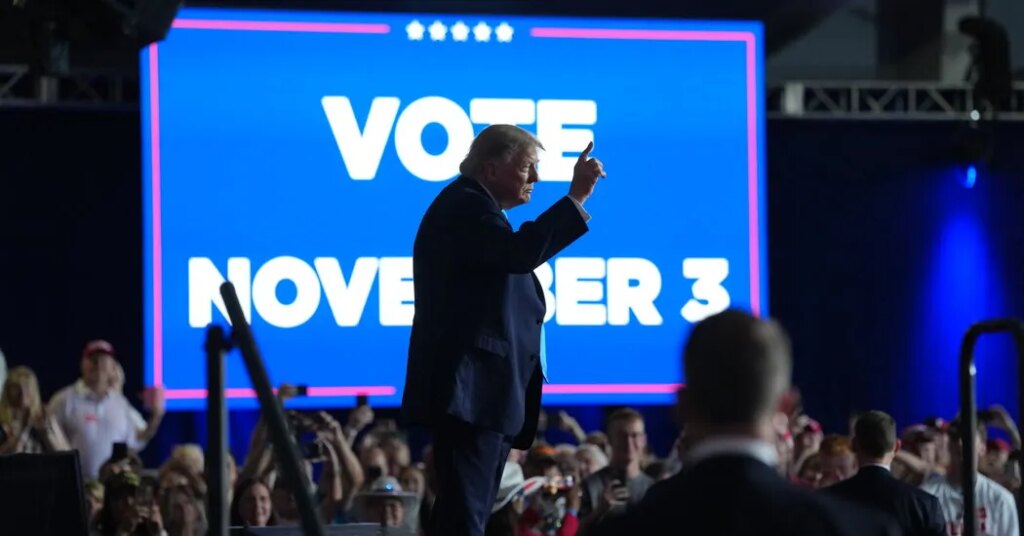
Mr. Trump went to Grand Island on Monday for a rally for Senator Pete Ricketts, a Republican whose seat had been considered safe. Mr. Trump won Nebraska by 20 percentage points two years ago.
Last week, the president rallied in Oklahoma, where he won by 34 points in 2024.
The president’s visits, combined with Republican advertising spending meant to shore up incumbent senators in Kansas and South Carolina, suggest that the political battleground has shifted from traditionally purple states to red ones.
For Republicans like Mr. Ricketts and Senator Roger Marshall of Kansas, who had expected to cruise to re-election but were now in competitive races, the political whiplash can be severe and put their campaigning skills to the test.
“In 2018, you had people whose districts that were not competitive suddenly becoming competitive,” said Matt Gorman, who was a senior aide on House Republicans’ campaign committee that year. “In a span of a year, they had to go from sitting in a ruby-red district to sitting in a purple district, and that is hard for some people to do.”
The post Why This Election Could Be More Complicated for Democrats Than Polls Suggest appeared first on New York Times.