A new type of cancer treatment — vaccines — is so promising that it demands a national effort to expedite discoveries, said the director of the National Cancer Institute, Dr. Anthony Letai.
“We can do things that would not otherwise be done,” he said of new resources being made available at the National Institutes of Health. “We can place big bets on new ideas.”
The big bet is a planned public-private partnership involving the N.I.H, the nonprofit Foundation for the N.I.H., researchers, pharmaceutical and biotech companies, advocacy groups, philanthropies and patients, all working together to develop and test the vaccines.
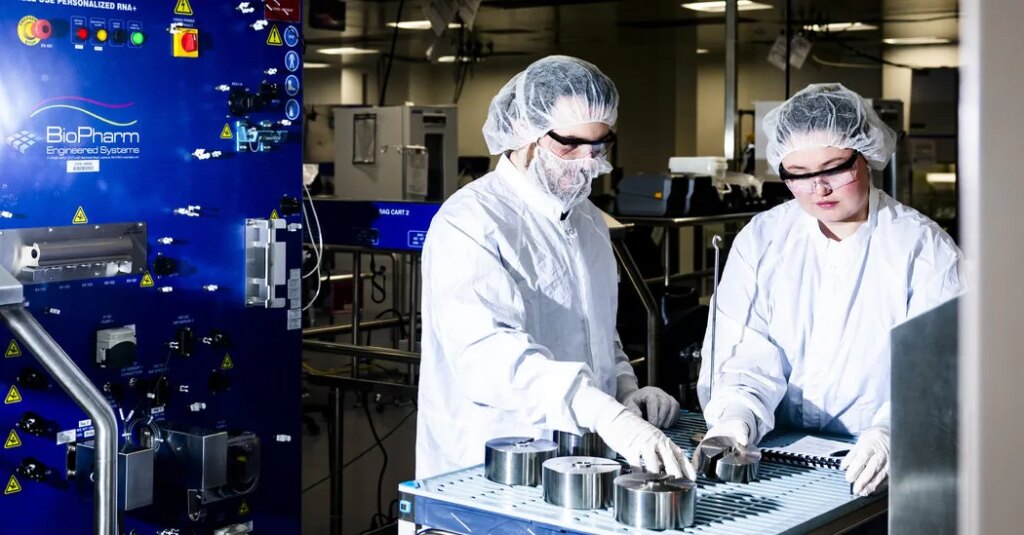
The vaccines are treatments that are unique to each patient by prompting the immune system to attack a patient’s specific cancer. The injections teach the immune systems’s T cells to home in on aberrant proteins found on a patient’s tumor and nowhere else.
“We hope this will be like Covid vaccines,” said Stacey Adam, a senior clinical officer at the Foundation for the N.I.H., referring to the public-private partnership that led to the rapid development of vaccines for the coronavirus.
She said the vaccine program was expected to begin in December, starting with a focus on pancreatic cancer, liver cancer and colorectal cancer, as well as a subset of pediatric tumors.
An unpublished white paper report, which was shared with The New York Times, explains the vaccine initiative and states that what is now possible with vaccines was “largely theoretical a decade ago.”
The project is still a bet: There is no guarantee that the early promise of cancer vaccines will pay off. The history of medicine is littered with tales of treatments that seemed incredible in early studies only to fail in larger tests.
Yet enthusiasm for the vaccines is running high.
“This is a completely new frontier,” said Karen Knudsen, the chief executive officer of the Parker Institute. The institute has two representatives working with the N.I.H. initiative and is also funding vaccine studies, positioning them as one of its main priorities.
Initial results from studies of vaccines for melanoma, pancreatic cancer, renal cell cancer and even glioblastoma — the brain cancer that has so far resisted all forms of treatment — are “incredibly encouraging,” Dr. Knudsen said.
Cancer vaccines are different from the Covid-19 vaccines or vaccines for other diseases like the measles or flu. Those vaccines prevent disease. Cancer vaccines, however, attack a cancer that is already present.
But they are similar to the Covid vaccine because most use mRNA technology, which had fallen out of favor with the Trump administration.
So far, just one vaccine study has been large enough to show definitive results. It involved 1,137 people with advanced melanoma.
Merck and Moderna, which conducted the study, reported in August that the vaccine increased the time before cancers recurred and increased the time before they spread. The companies plan to reveal the full data set later this month.
Dr. Adam was optimistic: “The science is there, the technologies are there,” she said.
“Everything is coming to a head,” she added. “Now is the time to jump start.”
Though the public-private partnership will draw inspiration and lessons from the global development of the Covid-19 vaccine, the timeline for the cancer vaccines will be nowhere near as fast. Phase 1 of the initiative, which will consist of small studies, is expected to take about three years and lead to “go-to information on different technical approaches to vaccines,” Dr. Letai said.
Larger trials in Phase 2 are expected to take at least four years, involve a national network of clinical trial sites and lead to definitive results. The ultimate goal, Dr. Adam said, is that “in seven to 10 years, anyone who walks into a doctor’s office can get a vaccine.”
That is still faster than would be expected without the initiative where it can take eight to 15 years to get F.D.A. approval, Dr. Adam said. And work would have been fragmented and uncoordinated.
It was small, fragmented studies with promising results that inspired the initiative.
They included, for example, one involving patients with kidney cancer that was led by Dr. Catherine J. Wu of the Dana-Farber Cancer Institute and her colleagues. The researchers took tumor cells from patients with advanced kidney cancer at the time of their initial surgery. Then, for each patient, they created a vaccine designed to attack the tumor’s unique mutations.
It is impossible to know if the patients were entirely cured in such a small study, but all nine were cancer-free after 40 months. Ordinarily, 30 to 50 percent would have relapsed within two years.
Dr. Wu and her colleagues are now developing vaccines for patients with glioblastoma, as well as for those with ovarian cancer.
Another encouraging early study focused on pancreatic cancer. Even with the best treatments, close to 90 percent of patients die within five years, said Dr. Vinod Balachandran of Memorial Sloan Kettering Cancer Center.
His group conceived the idea for a small study in 2017 and began it in 2019. When a patient had surgery to remove their pancreatic cancer, the investigators collected tumor tissue and shipped it to Genentech and BioNTech, a company that later produced Covid vaccines. The companies pinpointed the mutations unique to a patient’s cancer and then made a customized vaccine.
The investigators treated 16 patients and followed them for up to six years. Seven out of eight who responded to the vaccine are still alive, compared with just two out of the eight who did not respond.
That initial study, though — promising as it was — was not definitive.
“We cannot prove that vaccines are making patients live longer,” Dr. Balachandran said. His group and its industry partners began a much bigger study in 2023, enrolling 260 patients.
Based on what he has seen so far, Dr. Balachandran is hopeful about the future of vaccine therapy. With pancreatic cancer, he took on a cancer thought to be impervious to immune system attacks: “If we crack the toughest nut,” he said, “we can crack the rest.”
The post Cancer Vaccines Are the N.I.H’s Next ‘Big Bet’ appeared first on New York Times.