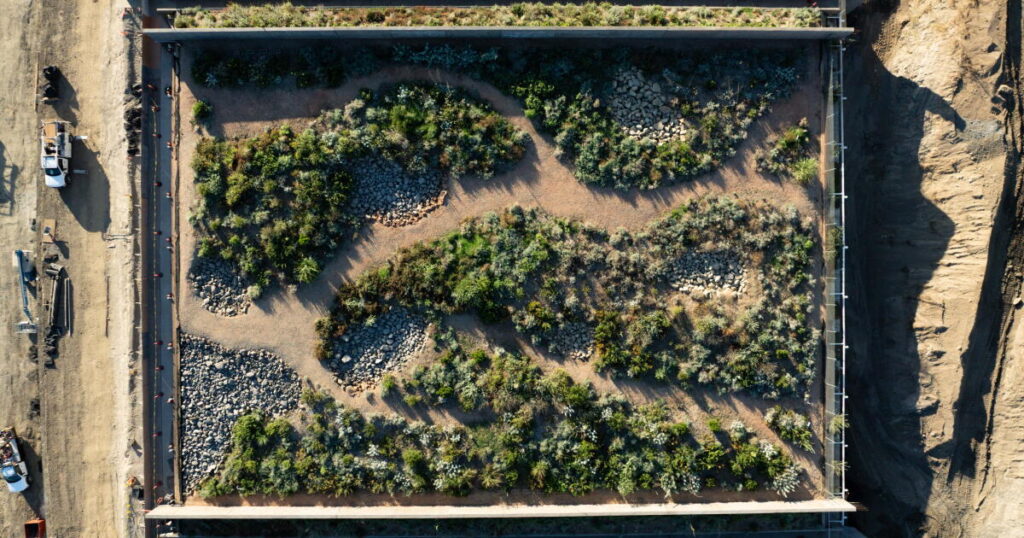
The world’s largest wildlife crossing over the 101 Freeway in Agoura Hills is barreling toward a Dec. 2 completion date. Perhaps the only thing that could stop it is a fierce winter storm.
Already a concrete bridge stretches across 10 lanes of whizzing traffic. Atop that, there’s a lush landscape sewn with 6,000 native plants. Recently, crews completed another overpass over adjacent Agoura Road. A big remaining to-do is to fill in the gap between the freeway and the road — and the freeway to the land to the north — with millions of cubic feet of soil to create a seamless pathway for animals.
The idea is to provide a lifeline for mountain lions in the Santa Monica Mountains, locked in by traffic and suffering from the effects of inbreeding.
“We’re just hoping El Niño‘s on our side,” said Beth Pratt, president of the Wildlife Crossing Fund and public face of the project. “I keep saying, ‘Mother Nature, we’re trying to help you. Let’s not throw any more complications our way.” A super-sized version of the climate pattern is looming, and there’s a good chance Southern California could be doused.
Some rain is not a big deal but flooding would shut down work for safety reasons. At a final construction update held near the crossing Thursday, Robert Rock, lead landscape architect and principal designer for the crossing, explained that the soil in the area is rich in clay and silt. When wet, it gets dangerously slick and slippery.
Heavy precipitation can also derail the soil compaction process, where crews lay down the soil in layers and go over each with a construction vehicle known as a roller. In the distance, workers were busy doing just that as the fierce late morning sun beat down.
“If you’re trying to compact a mud puddle, it wouldn’t really compact, right?” he said at a trailhead off of Agoura Road. “Because if you push that down, the mud just [splats] in either direction.”
In fact, something like that happened amid historic rains in the winter of 2022-2023. Construction workers were busy preparing to pour the concrete for the bottom layer of the north wall. But water collected in the trench that was dug for it as they were working to compact the soil.
That pushed back the original completion date of late 2025. Rightwing pundits and politicos in recent months have attacked the project over the delays and a high price tag that’s currently $114 million. A March post in an outlet published by a conservative think tank called it a “bridge to nowhere” and “jobs program for environmentalists.” U.S. Transportation Secretary Sean Duffy compared it with the state’s long-delayed, budget-busting high-speed train.
Around the time the outrage reached a fever pitch, however, the completion date was announced.
Pratt said “the hate” has worn on her. She’s been called a “fraud,” “retard” and worse, and she’s even afraid to post about the crossing on social media. “Of course we’re still going to celebrate” at the finish line, she said.
At stake is the survival of the Santa Monica Mountains’ isolated, beleaguered mountain lion population, which is listed as threatened. Seth Riley, wildlife branch chief for the Santa Monica Mountains National Recreation Area, said 41% of documented matings were between close relatives since 2002, the start of an ongoing study of mountain lions in and around the Santa Monicas.
Just a few months ago, the National Park Service caught a young collared male at the western end of the mountain range who had a kinked tail — a sign of inbreeding. It’s not the first such documented deformity but shows the problems persist, Riley said. If the situation gets to the point where their reproduction is affected, modeling has shown there’s “essentially a 100% chance of extinction” within 50 years, he added.
But he doesn’t think it’s too late. The soon-to-open crossing will let the big cats seek mates in the Simi Hills and beyond — and allow fresh blood to travel into their neck of the woods, he said. Genetic diversity is expected to go up, though not overnight.
In the past three weeks, a trail camera stationed close to the south end of the crossing has captured coyotes, deer, a female lion with two big cubs — even as construction churns on next door, said Jeff Sikich, a wildlife biologist at the Santa Monica Mountains National Recreation Area.
Recently, in the Simi Hills north of the crossing, his team marked three kittens, the first litter for the 3 ½-year-old lion known as P-113.
“These kittens might be — once they grow up and leave mom at roughly around 1½ — one of the first lions to actually use the wildlife crossing,” he said.
The post World’s largest wildlife crossing is on track to open this winter — unless El Niño intervenes appeared first on Los Angeles Times.