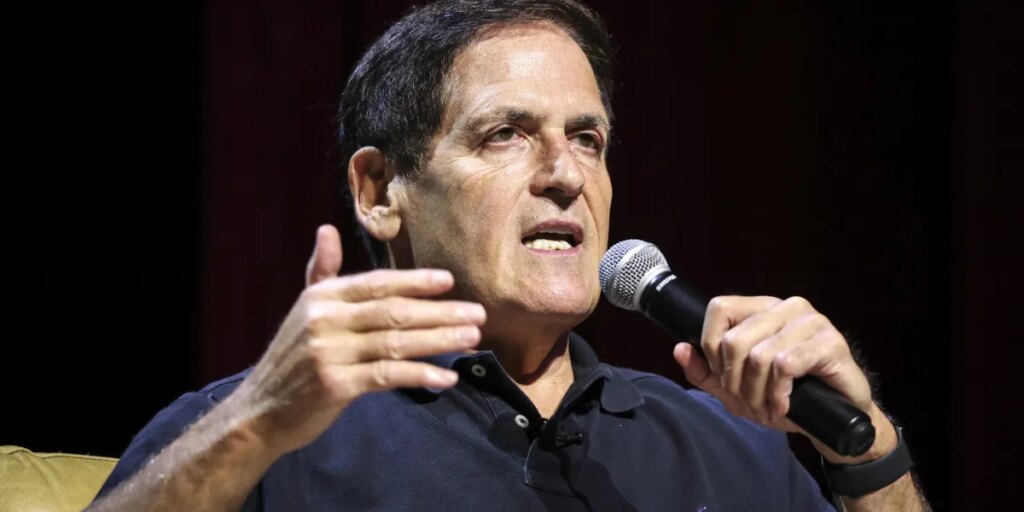
Billionaire Mark Cuban says skyrocketing healthcare costs, not AI, are the biggest threat to jobs.
While Cuban may be best known for his time as a former investor on the hit show Shark Tank, as well as for his more than two decades as an owner of the Dallas Mavericks, he has become deeply involved in the mechanics of the healthcare industry since founding his online discount pharmacy Cost Plus Drugs in 2022.
In an X post last month, Cuban wrote: “I hope people realize that for the foreseeable future, the cost of healthcare benefits will get more people fired, or not hired, than AI.”
His comments on AI and healthcare come as companies prepare to pass along rising healthcare costs to employees and increasingly scrutinize headcount thanks in part to the influence of AI tools.
The U.S. spends more on healthcare costs than any other country, and that sum has skyrocketed over the past two decades. As of the last available figures reported by the Centers for Medicare & Medicaid Services in 2024, U.S. spending on healthcare stood at $5.3 trillion, or about 18% of GDP. That’s more than double the $2.5 trillion the country spent in 2000.
Even among rich nations, the U.S. stands out. As of 2024, the U.S. spent $14,775 per person on healthcare—more than double the $7,860 per person spent in other high-income countries, even while some studies show Americans use less care on average. Healthcare costs have risen each year over the past five years, according to a survey of more than 1,800 employers by Mercer, a global consulting firm.
As these costs have risen, they have become a bigger and bigger weight on companies, cutting into wage growth and hiring. Mercer estimates healthcare costs per employee could increase 8.2%—the largest jump since 2003—in 2027.
To accommodate these higher costs, nearly half of large U.S. employers with 500 employees or more said they expect to make changes to their medical plans next year, such as raising deductibles or copays, that will increase employees’ out-of-pocket costs, Mercer found.
Yet, some workers may also pay for these higher costs with their jobs. A 2024 paper published by Yale’s Tobin Center for Economic Policy found that a 1% increase in healthcare prices translates to a roughly 0.4% decrease in payroll and employment at employers outside the health sector.
“Rather than cutting wages, employers respond to increases in insurance premiums by cutting the number of workers they employ,” the paper read.
Healthcare costs have increased in recent years partly because of a combination of increased labor costs, new technology, and pricier treatments like GLP-1s. But some experts have also said deeper structural factors in the U.S. healthcare system such as hospital consolidation and rising administrative costs are contributing as well.
For the last four years, Cuban has given people another option for buying lower cost drugs with Cost Plus Drugs. He says his company can give consumers lower prices by cutting out pharmacy benefit managers, the three largest of which manage about 80% of all prescription claims in the U.S, according to nonprofit KFF.
The billionaire has also brought attention to the increasing costs companies are facing for healthcare.
In a post from March, Cuban noted that rising healthcare costs are costing companies $30,000 per family for premiums and care, a figure that aligns closely with the average annual premium for family coverage, which hit $26,993 in 2025, according to the latest Employer Health Benefits Survey from KFF.
Most of that cost is paid by the employer, but Cuban noted in his March post that companies also have to invest in the overhead needed to deal with these costs, which ultimately creates a large burden for companies.
“It’s usually the 2nd largest expense after payroll. Which is insane,” he wrote.
He has previously argued that increased healthcare costs need to be tackled at the federal level.
Cuban in March stated his support for the Break Up Big Medicine Act, sponsored by Sen. Elizabeth Warren (D-Mass.) and Sen. Josh Hawley (R-Mo.), which would prohibit certain forms of vertical integration in the healthcare industry by preventing insurers, pharmacy benefit managers and major drug or medical-device wholesalers from also owning certain medical providers. The bill has been referred to the Senate’s Committee on the Judiciary and has not yet been passed.
While Cuban has highlighted how healthcare costs could be having an affect on the labor market, fears over AI job displacement are surging. A recent study by the McKinsey Global Institute found that 11 million workers, or about 7% of the workforce, may have to find new jobs as some occupations decline, even though McKinsey maintains AI and other economic shifts could ultimately create more jobs than they eliminate.
Still, as of last month, the Budget Lab, a nonpartisan policy research center at Yale, found that there is no “clear evidence of labor market disruption associated with AI.” In fact, the researchers found churn across occupations has continued along pre-AI trends.
That hasn’t stopped companies from blaming AI for layoffs. AI was the leading reason cited for layoffs this year, making an appearance in 21% of all layoff announcements year-to-date, according to global outplacement and executive coaching firm Challenger, Gray & Christmas.
Amid all the noise, Cuban argued in his March post that one of the biggest reasons for job losses is still being overlooked.
“It’s far easier to blame AI than it is to blame Healthcare costs,” he wrote.
The post Mark Cuban on why AI is the wrong job-killer target: it’s the healthcare costs, stupid appeared first on Fortune.