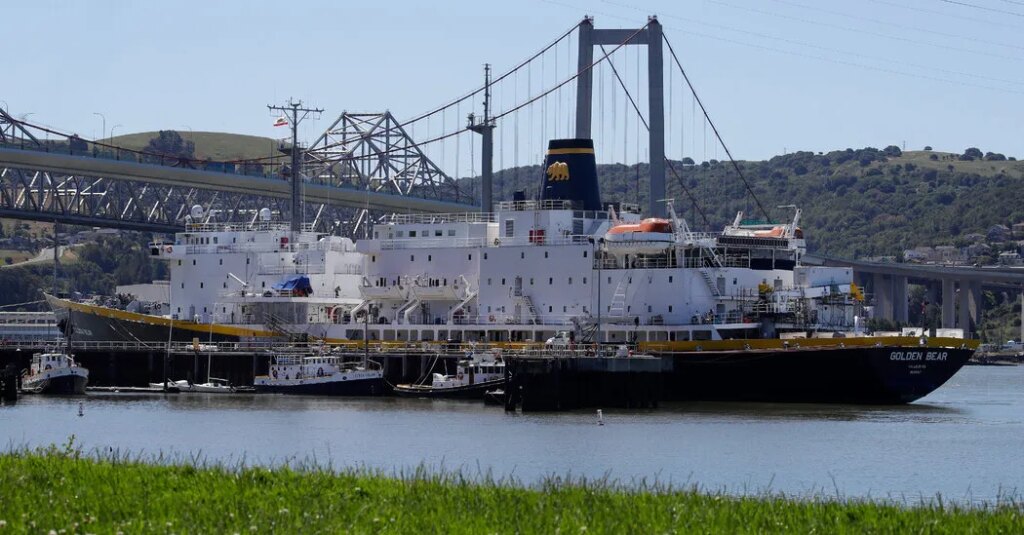
The Trump administration is considering using ships, including a 500-foot training vessel and ferries, to deport migrants to Central and South America on journeys that could take days and cost millions of dollars, according to two U.S. officials.
The discussions over recent weeks are still preliminary, but officials have identified possible ships, including the Training Ship Golden Bear, a maritime academy vessel docked in California, said one person who spoke on the condition of anonymity because of the sensitivity of the plan. Defense Department officials have also reached out to companies about ships in Europe, the official said.
A different official, from the Department of Homeland Security, which oversees deportations, cautioned that the plan was still hypothetical and that no decisions had been made.
It is not clear why officials are entertaining such an unusual plan, considering the logistical challenges, high cost and checkered history of deportations by sea. The plan could, however, offload some deportation costs from Homeland Security to the Defense Department.
“D.H.S. is assessing all our resources, to maximize efficiency and continue to deliver on President Trump’s mission of securing the homeland for all Americans,” the Homeland Security Department said in a statement. Secretary Markwayne Mullin, the statement added, “is 100 percent focused on ensuring the needs of our department are met while being the best possible steward of taxpayer dollars.”
The Defense Department did not comment on the proposal.
The plan would represent another escalation of the Trump administration’s evolving strategy for carrying out mass deportations using all available means. Those drastic steps have included flying people abroad using military planes, sending migrants to unfamiliar and often dangerous third countries, and housing people in Guantánamo Bay, Cuba. The administration has also embraced policies to deter immigrants from coming to the United States and persuade them to self-deport.
“What ICE is functionally contemplating is prison ships,” said Claire Trickler-McNulty, a former top official at Immigration and Customs Enforcement during the Biden administration. “That raises serious concerns at every step. Moving people through international waters and past other countries’ territory for days at a time raises hard questions about which laws apply and who has jurisdiction if something goes wrong.”
She added that “holding hundreds of people on a ship is also an enormous operational and safety challenge.”
Ms. Trickler-McNulty said that during her time at the Homeland Security Department, including as a career official in the Obama and first Trump administrations, agency staff considered various ideas to deport people, such as using ships or trains. But they never pursued them seriously, she said.
The journeys to countries like El Salvador, Honduras and Venezuela would take days by sea and require a large number of security personnel. It is unclear whether migrants would be detained for the duration of the trips or what their sleeping arrangements would be.
The U.S. government has estimated that using ships could cost millions of dollars per trip, whereas deportation flights are substantially cheaper. It is also unclear whether other countries would agree to such a plan.
The Golden Bear served as a training ship for the Cal Poly Maritime Academy, a school for those seeking careers at sea, as a key part of the school’s educational program. The vessel ended its 30-year run with the school this summer. It is not clear under what authority the ship could be used for deportations by the federal government.
“For three decades, Golden Bear has served as a floating classroom where thousands of cadets transformed classroom knowledge into practical experience at sea,” a July announcement from the school read.
Such a plan would also conjure memories of a controversial 1950s campaign in which hundreds of thousands of Mexicans were deported in a large-scale deportation drive referred to as Operation Wetback. The campaign, named for a slur for Mexican immigrants, included expelling people by sea.
In August 1956, chaos erupted aboard one of the ships near the Mexican border city of Tampico. The New York Times reported that 40 passengers jumped from the ship and that five drowned.
The Mexican government had shut down the operation by September, citing poor weather. The Times reported, however, that the “prevailing opinion” was that it was because of the incident near Tampico as well as “alleged unsatisfactory facilities on ship and maltreatment of involuntary passengers.”
John Ismay and Jazmine Ulloa contributed reporting.
The post Trump Administration Considers Using Ships to Deport Immigrants appeared first on New York Times.