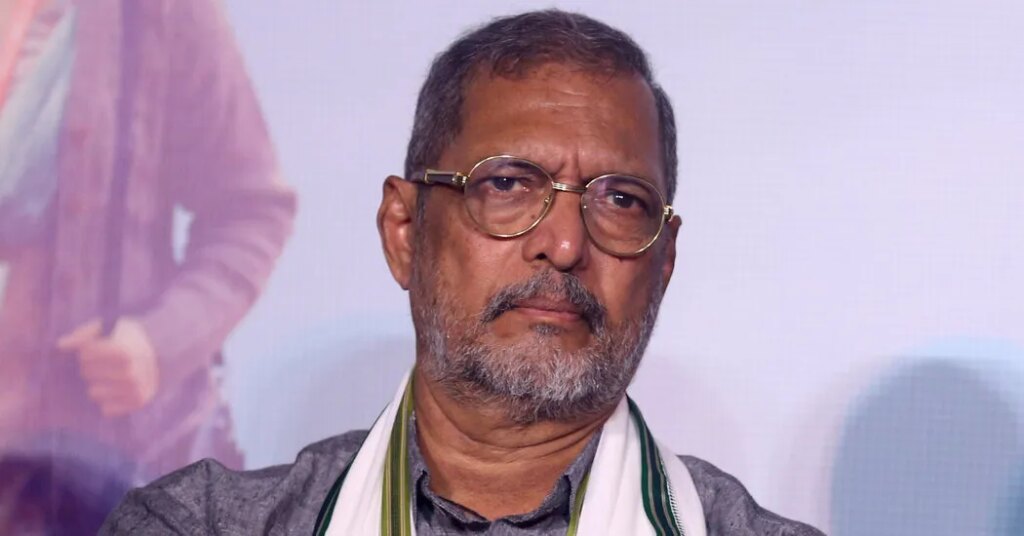
Nana Patekar, an Indian actor who became a star playing the Everyman but also was a figure in India’s fleeting #MeToo reckoning, died on Thursday in the state of Goa. He was 75.
The cause was cardiac arrest, Dr. Shekhar Salkar, a physician at Manipal Hospitals in Goa, told journalists. Mr. Patekar’s caretaker found him unconscious in his apartment in Panaji, the state capital, early on Thursday, Dr. Salkar said.
A theater actor who brought intensity and a coarse baritone to the screen, Mr. Patekar was a star in Hindi and Marathi films, with credits including Mira Nair’s “Salaam Bombay!” in 1988. He was one of the few actors to win awards for best actor, supporting actor and villain at India’s Filmfare Awards. His career also showcased how male actors escaped relatively unscathed from India’s #MeToo movement.
“He brought remarkable diversity and creativity to every role, creating characters that will remain in the memory of generations,” Prime Minister Narendra Modi of India said in a social media tribute.
In 2008, Tanushree Dutta, a Bollywood actress and former Miss India, said that Mr. Patekar had ordered changes to a dance sequence so that he could grope her on a film set. Ms. Dutta fled the set, but a mob later surrounded her car, smashed the windshield, flattened the tires and trapped her inside. Footage of the incident aired on Indian television, and Ms. Dutta continued to speak out. She filed a police complaint against Mr. Patekar, who denied the allegations.
Nothing came of it until a decade later, when Ms. Dutta revived her complaint as the #MeToo movement spread to India and other women began voicing accusations about prominent men. A witness corroborated her account, and other actors spoke out in support. Ms. Dutta filed a new complaint with the police in 2018, but they cleared Mr. Patekar in 2019, saying investigators had found no evidence to support the complaint. Mr. Patekar’s career quickly rebounded, but Ms. Dutta’s sputtered.
Ms. Dutta released a video statement on Thursday amid an outpouring of grief in India over Mr. Patekar’s death. “I’m worried that in the evening, that’s all the media’s going to be interested in is evil dead,” she said. She said she would speak “once I figure out what kind of reaction I should have” and added, “Condolences to the family.”
Vishwanath Patekar was born in 1951 in Murud Janjira, a village near the coastal town of Alibag in India’s western state of Maharashtra. As a child, his mother’s close friend called him Nana, and the name stuck. His family fell into poverty after his father, a textile merchant, lost his business and his property, Mr. Patekar said in a 2015 interview with the Times of India.
At 13, he got a job painting film posters. At school, he fell in love with the theater, and he went on to study at the Sir J. J. School of Art, Architecture and Design in Mumbai.
His first film role was in 1978 in “Gaman,” about migrants trying to build better lives in Mumbai. After a brief stint in advertising, a fellow actress took him along to a film audition where he turned down “a lousy role of one of the rapists,” he told The Times of India in 2015. Instead, he said, he landed a role that would get him noticed, in the 1984 film “Aaj Ki Awaaz.”
At 27, he married Neelakanti, a theater actress who supported them through her work in a bank, he told The Times of India. The couple had a son, Durvasa, who died at age 2, and later another son, Malhar. Ms. Patekar wrote and directed a Marathi film and returned fully to acting in the 2025 historical TV drama “Chhaava.”
Mr. Patekar’s wife and son survive him. Full information on his survivors was not available.
Mr. Patekar’s career took off with “Parinda” (1989). His portrayal of a Mumbai gangster earned him his first National Film Award for best supporting actor. A year earlier, he starred in “Salaam Bombay!,” which won the Camera d’Or prize for best first feature at the Cannes Film Festival. He won another National Film Award in 1994, this time for best actor for his role as a disillusioned drifter turned activist in “Krantiveer.”
In the 2007 film “Welcome,” he played with the gangster archetype, creating one of his most popular comic characters — a gangster less interested in violence than in finding a suitable husband for his sister.
His characters were often men who felt thwarted — by bureaucracy, poverty, crime, family or the state. The roles gave form to a kind of middle-class frustration that was seldom the stuff of conventional Bollywood stardom. With his signature gravelly baritone, he was lauded by critics for his vulnerability on camera and his willingness to play frustrated or compromised men.
Mr. Patekar was also known for his outspoken political voice, and Mr. Modi praised him for his “forthright views.” He also worked with rural communities in his home province, raising funds for farmers facing drought.
The post Nana Patekar, Indian Actor Who Embodied the Everyman, Dies at 75 appeared first on New York Times.