Illustrations by Hannah Robinson
Whenever I receive a text, this is what happens. I pick up my phone. So far, so good. I experience whatever emotion the message elicits—the pleasant warmth of being reached out to, possibly the annoyance of being interrupted. Then, if conditions are right, if I’m not too busy or in the middle of talking with someone else, if my mind is at peace, if my anxiety is at no more than a low hum, if Mercury is not in retrograde, I will respond right then and there. If conditions are not right, it will be as though the text never existed at all.
Right now, I have 30 unopened texts. Scrolling through my messages, I find several more that I opened but forgot to respond to for anywhere between a few hours and a week and a half—from my parents, my sister’s fiancé, old friends who are accustomed to this kind of behavior, and new friends who are just beginning to be disappointed in me. At least two people texted me so long ago—more than a month—that to respond now and remind them how long they’ve been waiting would be worse than not responding at all.
I’m not proud of leaving people hanging. Every text I owe is a tiny siren in the back of my mind, blaring intermittent pulses of guilt. Unless I forget about it entirely, in which case I’ll remember it with a shameful jolt some days or weeks later. I’m not one of those modern hermits who thinks you don’t owe anyone anything, who likes every Instagram post she sees about boundaries and thinks that flaking on plans is self-care. I write about relationships for a living, and I believe that showing up for one another is the purpose of our existence. That’s, like, my whole brand. And so this is my greatest shame: I am a Bad Texter. I am slow to respond. I am forgetful. I get overwhelmed. My own mother has said I’m “probably worse than 90 percent of the other people that I text with.”
This might seem like a trivial pathology, but it isn’t. Texting is the currency of modern relationships. In 2024, Americans exchanged more than 2 trillion text messages, about 42 billion more than the year before, according to CTIA, a trade group representing the wireless industry. Some of those texts are probably spam. Some are advertising. Some are bits of automated busywork (click this link to confirm your appointment ). But many of them, hopefully most of them, are between people who know one another, reaching out for connection over the waves of the wireless spectrum.
According to a 2023 survey, texting is the No. 1 way that people prefer to communicate with their loved ones, beating out mobile-phone calls and absolutely crushing face-to-face conversations, which got only 8 percent of the vote. Texting came out ahead in every age bracket except the oldest; those 55 and older ranked texting and mobile-phone calls equally. No age group preferred anything over texting.
Yet at the same time, texting stresses people out. A third of Americans report feeling overwhelmed by the number of texts they need to respond to, and a majority say they struggle to keep up with their group chats. As Pranav Malhotra, who studies communication and media at the University of Michigan, told me, texting “is what the people want, but it’s not doing them any good.” And so, many of us end up feeling like Bad Texters. We are here, we are legion, and we are sorry for our delayed response.
Texting dominates our social lives like nothing else. According to the research firm Nielsen, American cellphone users started texting more than they called in 2007. Since then, unlimited phone plans and widespread Wi-Fi have removed many of the barriers that once led people to restrict their texts.
The ubiquity of text-messaging hardly seems worth questioning—it’s simply the way things are. But when you think about it, the modern predilection for managing all of our relationships by typing on a tiny touch screen is a bit odd. “For darn sure, it’s a lot faster to talk about things than it is to text them,” Naomi Baron, who studies language and technology at American University, told me. “Particularly if you have more than, let’s say, 100 characters’ worth to say. But it’s become the way of doing things.”
Texting achieved domination because it’s convenient—you can message someone at any time without waiting to see if they’re available first—and because it offers a sense of control. You don’t need to risk the uncertainty that comes with live conversation; you can plan out exactly what you want to say, and people won’t see how you react to their response. This is one of the things that people say they like best about texting. But the ease of sending messages means, on the flip side, that people are receiving more.
[Listen: Would you go back to a time before smartphones if you could?]
As texting became our default mode of communication, messages that once might have taken another form—your hair salon calling to confirm an appointment, an email invite to your best friend’s birthday party, a paper medical bill—started arriving as texts. And the act of texting is no longer confined to whatever mobile app processes your SMS messages. I have four different texting-specific apps on my phone: the standard iPhone Messages, WhatsApp, Signal, and KakaoTalk—a Korean messaging app where my in-laws’ family group chat lives. Then there are social-media DMs, which function much like texting, and Slack, where my colleagues send me DMs that would have been emails not so long ago. These show up on my home screen as notifications, and when I respond on my phone, the feeling is very similar to texting.
I have sometimes attempted to deal with my texting overwhelm by communicating in other ways. Lately, I’ve been trying to call people more to catch up, which is wonderful, but it can also cause alarm. One British survey from 2024 found that more than half of young adults said they assumed unexpected calls meant bad news. (Surely you would just text anything else you want to say.) Sometimes I’ll send my friends voice messages when I want to tell them a story that’s too long to type, but this, too, is controversial. I love voice messages—I think they feel so much more intimate than a text—but many people think that expecting a friend to take five minutes out of their day to listen to a mini-podcast you recorded is annoying, or even selfish. For party invitations, vacation planning, or anything logistical, I prefer to use email, but I’ve received explicit feedback from my husband and many of my friends that I should be texting instead, because “no one checks their email.” (Can this possibly be true?) Whenever I try to escape, social pressure always seems to push me back to texting.
And so the texts multiply, taking up more and more space in our relationships, until to be called a Bad Texter feels like being accused of being a bad spouse, sibling, child, parent, or friend.
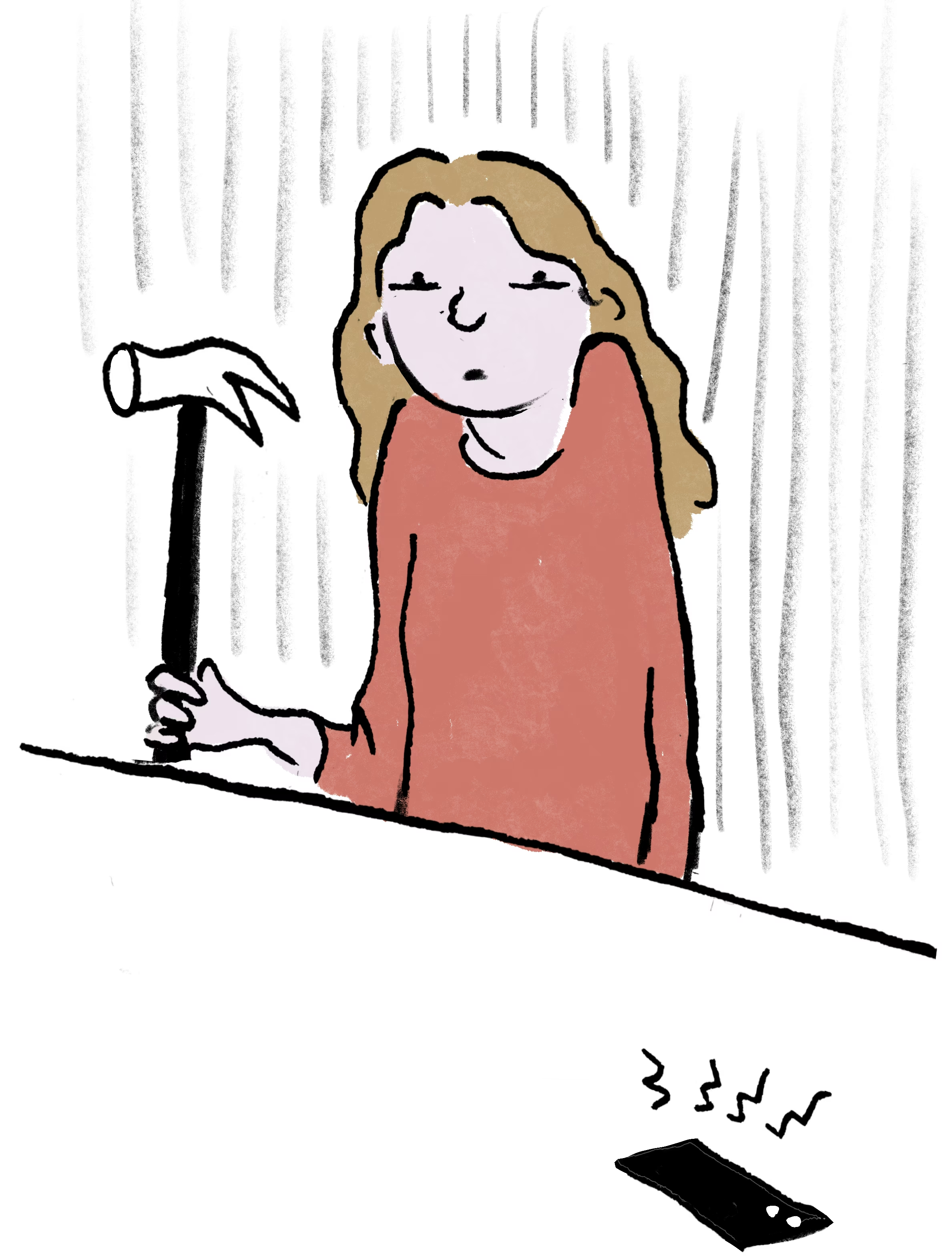
Instagram’s algorithm must have me figured out because it recently served me a video of an episode of “SubwayTakes,” in which the comedian Delaney Rowe shared her take: “There’s no such thing as a bad texter; they just don’t want to respond.” Claiming to be bad at texting, she said, is a “cop-out,” because a lack of responsiveness is conditional. “When a bad texter gets a crush? Best texter in the world,” she said.
This is what I fear my loved ones think: that my response time is directly correlated with how much I care about them. What else could it be? Americans check their phone nearly 200 times a day on average, and the overwhelming majority keep their phone on them “almost all the time,” according to recent surveys. The modern expectation that everyone is constantly reachable is unreasonable, but it’s not that unreasonable, given how attached people are to their phones.
Lizzie Post is a great-great-granddaughter of the early-20th-century etiquette writer Emily Post, and a co-president of the Emily Post Institute, where she writes about modern manners. Unfortunately, she confirmed that politeness requires responding to texts promptly, and that too long a delay is rude. (Though the meaning of promptly can vary depending on the context.) “I hate to say it,” she told me, but “I would really try to prioritize it a bit more.”
She was not the only expert I spoke with who said I needed to shape up. “Get one with the idea that people who text expect fast responses,” Paul Leonardi, a technology-management professor at UC Santa Barbara and the author of Digital Exhaustion, told me. You don’t have to meet that expectation, but there are consequences for not doing so. He pointed out that, especially with long-distance loved ones, a text thread is “the meat of our relationship.” A shared experience is happening there, and you’re either contributing to it or you’re not. Often, he advised, it’s better to just say something—anything—quickly, rather than waiting to form the perfect response later. (I do sometimes delay texting people because I want to wait until I can put more thought into my message. But the longer I wait, the better I feel the message needs to be to justify the delay. The pressure builds.) Post agreed. By responding too slowly, I’m at risk, she said, of making people think I don’t want to connect with them—even if that’s not true.
One of the costs of conducting so much of our relationships via text is the loss of context. In exchange for convenience, we give up tone of voice, eye contact, and body language. When all we have to go on are the words in front of us (or the lack thereof), we tend to “overinterpret very minor cues as signals of rudeness or as signals of Oh, this person doesn’t care about me,” Gretchen McCulloch, a linguist who studies online communication and the author of Because Internet, told me. Hence the unwritten rule that putting a period at the end of a text is passive-aggressive. My mom recently had a serious dustup with a friend, seemingly just because my mom put the word not in all caps in a text. Gaps in information too often get filled in with projections and insecurities.
I know my haphazard approach to texting risks fanning just such insecurities. And I’ve tried to be better. I put responding to texts on my to-do list. I’ve tried not opening any texts until I’m ready to write back, letting the notifications pile up and remind me every time I open my phone. I made a calendar reminder for every day at 4 p.m. that says “RESPOND TO TEXTS!!!,” following the advice of several experts who suggested setting aside time to deal with all my texts at once, rather than taking them as they come. This helps, although it also makes me feel like I’m treating my loved ones like a productivity problem instead of a source of joy. And there’s nothing to stop me from ignoring the reminder the same way I would a text.
Social obligation is as old as human society. In the 19th century, the practice of making social “calls” seems to have produced a feeling similar to the anxiety I get when I open my texts. An 1895 column in the Rocky Mountain News declared that the problem was one of volume—there were simply too many calls that one was expected to pay. “It may certainly be a pleasure to visit one’s friends,” the anonymous author wrote, but the pleasure fades “when you are meeting them every day almost, by dozens and scores and hundreds.” One woman quoted seemed to be on the verge of a nervous breakdown: “The calls I owe haunt me. They rise up in my dreams and chase me with spectre fingers.”
Falling behind on your correspondence is nothing new, either. “The guilty message—‘I’m sorry it took me so long to respond’—has a very long history,” Steven Mintz, a historian at the University of Texas at Austin, told me. Indeed, in the 1922 edition of Emily Post’s Etiquette, the author writes, “One of the frequent difficulties in beginning a letter is that your answer is so long delayed that you begin with an apology, which is always a lame duck.”
The difference is that although an unanswered letter may have caused guilt and anxiety, you weren’t expected to respond to it within five minutes. Technology has taken our sense of social obligation, accelerated it, amplified it, and splintered it into billions of little green and blue bubbles, each one both a point of connection and a task hanging over our heads.
“People always say we’re wired to connect, but this isn’t the kind of connecting that we’re wired for,” Lori Gottlieb, a psychotherapist and the author of Maybe You Should Talk to Someone, told me.
Being a Bad Texter might harm your relationships, but being a Good Texter will not necessarily help them. Research is unclear on this front. In terms of connection, texting seems to be better than nothing, but nowhere near as beneficial as phone calls or face-to-face conversations. The latter are definitely good for us, and they’re declining. Time-use data show that over the past couple of decades, Americans have been spending less time socializing in person. One study even found that the number of words people speak out loud each day has decreased.
[From the February 2025 issue: Derek Thompson on the anti-social century]
Some research has suggested that the more someone texts, the lonelier and less satisfied they feel. In one study, researchers theorized that people found texting exasperating because they were using it with the intention of keeping in touch, but it didn’t actually do all that much to maintain relationships. And every text message is a little interruption, taxing your attention and taking focus from the people who may be right in front of you.
Nothing in the research definitively says we shouldn’t be texting one another—but nothing says we should prioritize it the way we do, either. “The one thing that’s consistent about it is that it’s inconsistent,” Jess Dominguez, who researches communication at the University of Kentucky, told me. Technology, she said, “is always good and bad, and always at the same time.”
The overwhelming emotion associated with texting seems to be ambivalence. The same things that make texting appealing also make it stressful. It’s easy; it’s convenient; it can be done anytime, anywhere. But that means you can end up feeling like you should be available to respond all the time, everywhere. Texting allows you to keep up with more people at once than phone calls or letters ever did. But those exchanges are shallower and less fulfilling. It gives welcome control over communication, but that can lead to pressure to draft the ideal response, or to using texting as a shield to hide from the messiness of real-time conversation. It is fun and it is frustrating, and it doesn’t really matter if you like it, because it is more powerful than you are, and it’s not going anywhere.
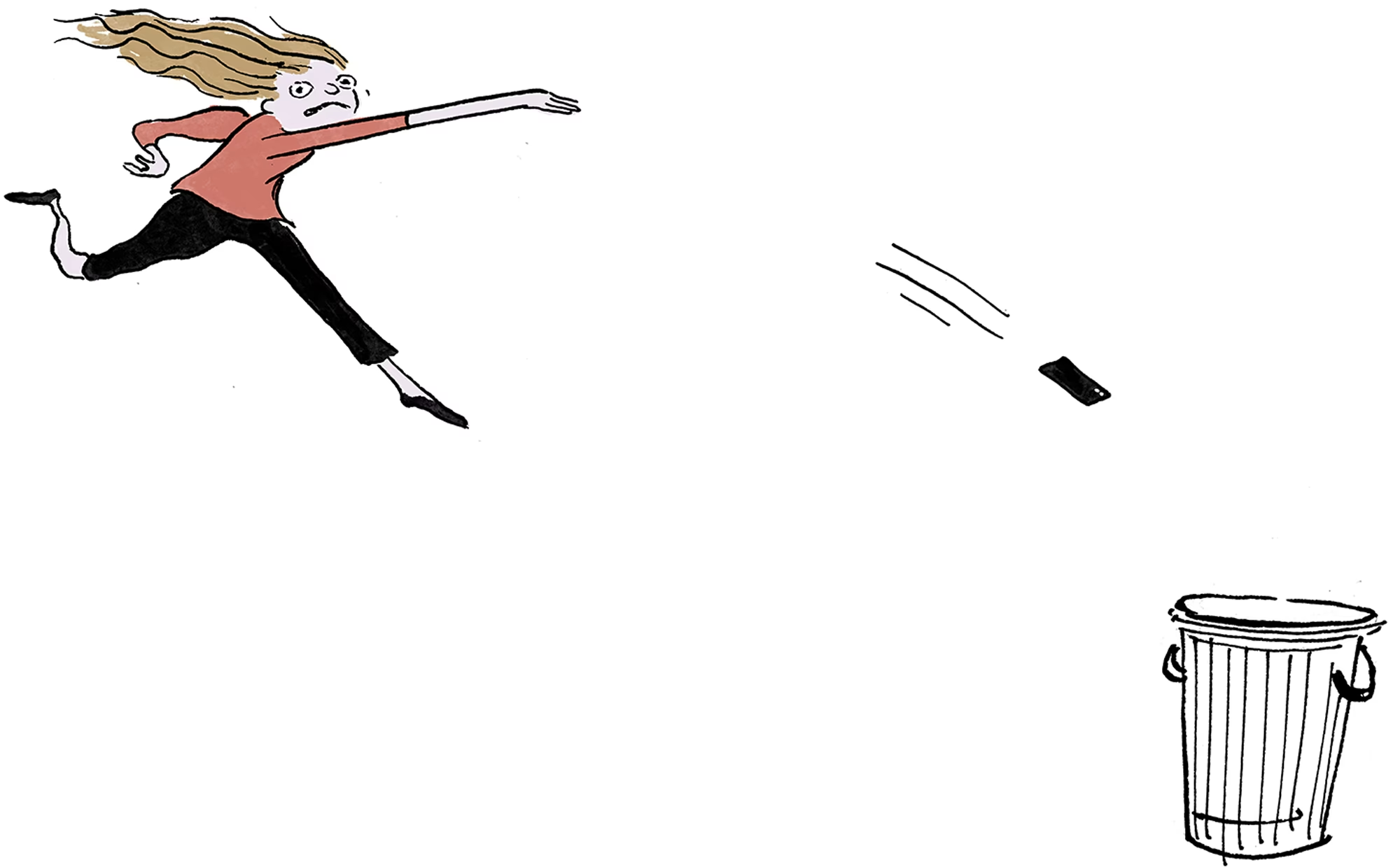
Eventually, we all must do things we have been dreading, whether it is apologizing for not texting someone back for a month or, in my case, interviewing my friends and family for this article. A story like this requires a reckoning, and narratively, I recognized that I must face up to who I am and what I have done to those I love. But I didn’t want to, and I put it off as long as I could, until just before my deadline.
Feedback was kind, but mixed. “I have no complaints,” my husband said. Vindication?! But “my bar is very low.” Oh. A friend of mine called my failure to respond to a dinner invite until the day of “chaotic.” When I asked my parents how their experience texting with me has been, my dad immediately said, “Poor.” He had recently sent me a Mountain Goats song he likes; I hadn’t responded. “A little too much to ask that you put a heart?” he said, only half-joking. “Couldn’t do it, could you?”
My mom said she’s never been offended, only confused. “I always walk this line between: Did she see the text, couldn’t answer it, and then forgot about it? Or did she see the text and she’s still going to answer it? It’s, like, this waiting thing,” she said. “Should I remind her? Should I not remind her?” Several people told me they didn’t think of me as a notably Bad Texter, or at least they weren’t bothered by my slowness. My friend Morgan pointed out that a text, like any other form of communication, is a “bid for connection.” But it’s different than if someone opened their arms for a hug and I just walked away. Although I may drop the ball on responding sometimes, Morgan said, “I don’t feel like you’ve ever dropped the ball on maintaining a connection.”
I once read somewhere that trying to keep up with your work emails is a trap. The emails will never stop coming, and your only reward for responding quickly will be more emails. So you have two choices: You can be good at responding to email or you can be good at your job.
[Listen: What it takes to reclaim your attention span]
I feel a similar way about keeping up with my texts. I suppose I could opt out entirely and throw my phone into the sea. But opting out of texting would mean, to some degree, choosing isolation. I don’t want people to stop reaching out to me; I don’t want to give up on the good parts of texting, even if they’re inextricable from the bad. So I will try to carve out the occasional hour to attend to my correspondence. But I also want to let go of some of the guilt that tells me every delayed response means I’m being a bad friend, daughter, sister, wife.
I bring other things to the table, after all. If you need practical help—someone to feed your pets, watch your kids, help you move—I would be delighted to provide it. I’ll make spreadsheets to plan our vacations. I’ll buy you little gifts, and alarm you with cold calls just to catch up. If we’re together, I’ll put my phone away and give you my full attention. But if you text me, you may not hear back for a while.
You can be good at texting. You can be good at your relationships. Maybe for some people, it’s possible to be both. But they are not the same thing.
We want to hear from you: Tell us how many unread messages you have—or send a screenshot!—along with your name and the reason you’re not-so-great at responding promptly. Text your response to (202) 266-7715. (By participating, you agree to grant The Atlantic permission to use, modify, and distribute your submission text in all media.)
This article appears in the November 2026 print edition with the headline “Confessions of a Bad Texter.” When you buy a book using a link on this page, we receive a commission. Thank you for supporting The Atlantic.
The post Confessions of a Bad Texter appeared first on The Atlantic.