Creativity in the context of marriage is a fraught and fascinating subject. The Lee Krasner and Jackson Pollock exhibition at the Metropolitan Museum of Art in New York is not the first major show devoted to a married couple. Previous exhibits have featured, among others, Frida Kahlo and Diego Rivera, Georgia O’Keeffe and Alfred Stieglitz, and Sonia and Robert Delaunay. But the Met, as only the Met can, has given “Krasner and Pollock: Continuous Present” the full blockbuster treatment: stupendous loans, beautiful installation, a narrative both compelling and cleanly told. Better yet, it does each artist the honor of representing them at their best.
The exhibition establishes beyond a doubt what many in the art world have long mumbled but few have avowed full-throatedly: that Krasner (1908–84) was not only more richly endowed with training and talent, but was as accomplished and original as her more famous husband. It also makes a powerful case, through their partnership, for abstract expressionism as an unassailable peak of 20th-century American visual expression.
Unlike Pollock (1912–56), a tormented and recalcitrant misfit, Krasner was a go-getter from the start. She received the best possible education at some of New York’s finest art schools. She benefited from practical training in large-scale mural painting under the Works Progress Administration in the 1930s and three years of training in modernism under Hans Hofmann, the émigré teacher versed in Matisse, Mondrian, and Kandinsky.
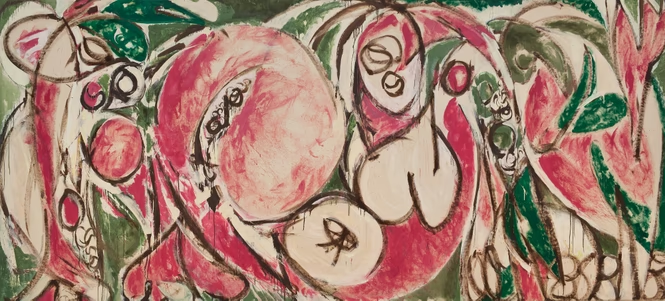
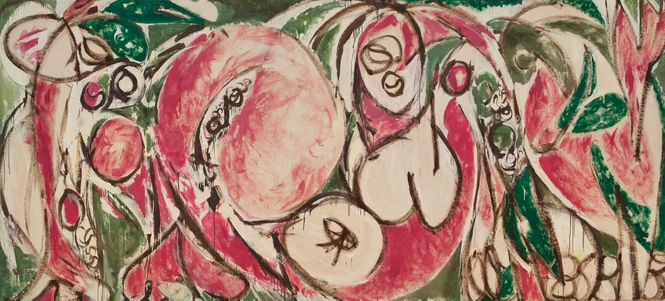
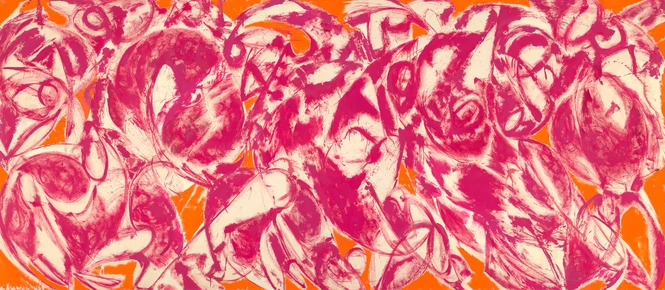
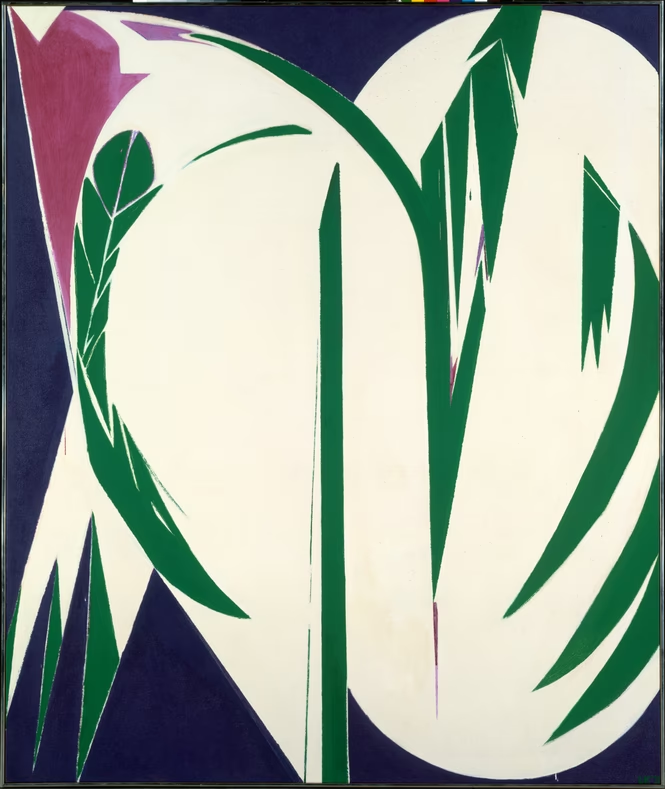
Krasner could draw; she could manipulate paint; she could work on any scale—and she was modern. Her great period—roughly from ’57 to ’65, with an exciting burst again in the early ’70s—came late and was regrettably brief. But during these peak years, she produced a series of tremendous, richly colored paintings, several of which—including Polar Stampede, Combat, and The Seasons—look better to me than anything painted by her contemporaries.
What’s dismaying is that, having found her way to a triumphant new mode of painting, she turned out so few of these works. Was something holding her back?
No single reason can ever explain why creativity flows, slows, or stops. But yes, something was holding her back. And it was the same thing that had helped push her forward. It was the brute fact of her marriage to Jackson Pollock.
Together, Krasner and Pollock represent a high point of 20th-century American art. No one had ever made abstract paintings in this way, on this scale, and with this level of visceral impact. The rhetoric about the abstract expressionists was, from the beginning, absurdly grandiose. “What was to go on the canvas was not a picture,” wrote the critic Harold Rosenberg in “The American Action Painters,” a key essay from 1952, “but an event.” The movement, though, is best understood in terms of energy.
Standing in front of a great Pollock or Krasner is thrilling. You can almost feel air moving at a frightening velocity through and around the forms on the canvas. (I had the sensation, in the middle parts of this show, of sticking my head out of a car window on an interstate highway and an accompanying urge to shout stupid things at the universe.)
The wind coursing through Krasner’s paintings is terrestrial. It brushes the contours of hills and bodies. It rustles the branches of tropical foliage and long winter grasses. The wind generated by Pollock, by contrast, is celestial, like solar wind. Its charged particles are sparsely scattered but fast, frictionless, inhumanly distant.
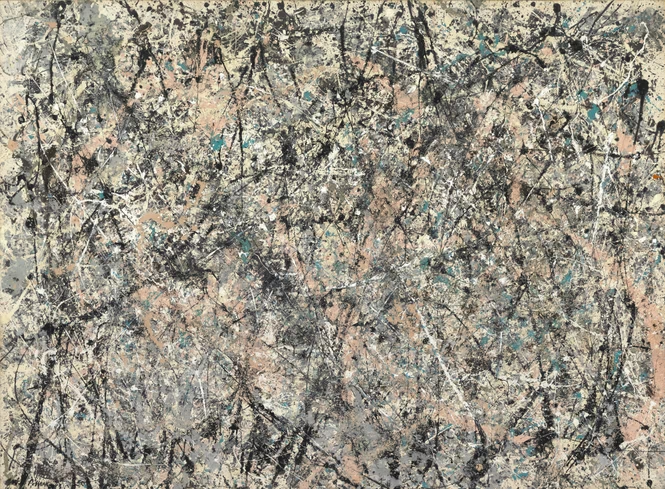
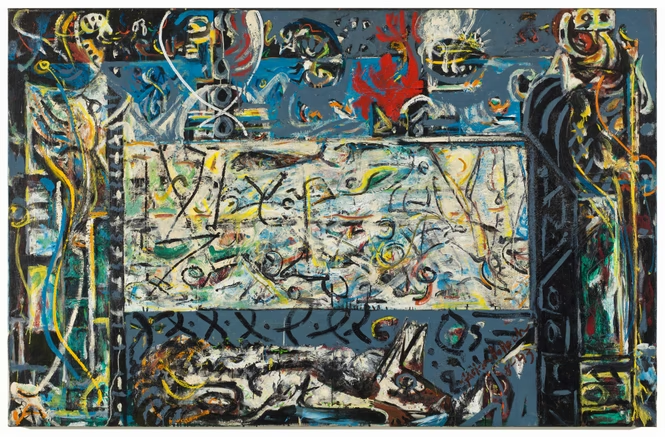
Never more than an earnest draftsman, Pollock had labored for years to synthesize disparate influences, both spiritual and artistic. Schooled in the complex figurative compositions of his mentor, the regionalist Thomas Hart Benton, he grew to love the scale and political urgency of the Mexican muralists (especially David Alfaro Siqueiros, who encouraged technical experimentation); the surrealism of Joan Miró, André Masson, and Roberto Matta; and the totems and sand painting of Native American art. In 1947, Pollock hit upon an ingenious new method: Laying his canvases on the studio floor, he moved around them, dripping liquid enamel paint in loose, spattery patterns by means of a brush, stick, or turkey baster that he waved about like a wand.
[Read: The artist who ripped up the rules of drawing]
He did this with surprising delicacy and a preternatural feeling for the space between things. He adopted an “allover” approach that dissolved distinctions between figure and background and did away with compositional hierarchy, implying infinite expansion in every direction.
People either adore Pollock or claim that a child could do just as well. But his method entails more artfulness than his detractors are willing to acknowledge. There’s also a lot of chance involved. Although Pollock’s skeins of paint are like traces of an energetic dance, they are as much the product of gravity as of a painter’s direct touch, and they incline toward decoration. (The painter Francis Bacon rather devastatingly compared them to “tired old lace.”) For all of the energy they record, the paintings are surprisingly calm, in the same way that stars, those giant balls of hot gas and plasma, can seem tranquil in the night sky. Chromatically, the overall impact is of soft, atomized color (as captured in the title of one of his masterpieces, Lavender Mist) twinkling through a scrim of black, beige, and white.
Krasner, by contrast, worked with large areas of saturated color. She painted with big arm gestures, applying bright hues directly to upright canvases. She also flicked and sprayed paint, letting it explode diagonally across her surfaces, often against gravity. She combined her rich repertoire of painterly effects with confidently drawn armatures that set giant curves in tension with acute-angled shards. Her muscular compositions are tremendously dynamic. The forms are abstract, but they suggest eyes, body parts, fruits, foliage, rolling landscapes. No artist has more successfully combined the shallow pictorial space of Picasso and Braque (who dissolved the boundaries separating “figure” from “background”) and the saturated color of late Matisse (especially his cutouts).
Abstract expressionism was the product of a moment, during and after World War II, when the West’s center of gravity shifted—militarily, economically, and culturally—from Europe to North America, and the art world’s center moved from Paris to New York. The movement was fueled by émigrés, but it was unmistakably American. A measure of its impact is that almost every major artist who came after Pollock, Krasner, and other prominent abstract expressionists was somehow engaged with them. Whether they amplified abstract expressionism, ironized it, or rejected it, succeeding generations of artists were all, to some degree, operating in its force field.
[Read: The irrepressible emotion of Lee Krasner]
It wasn’t just artists. Dancers, performance artists, and composers also drew from this force field, and so did writers. In an interview with David Remnick, Philip Roth once said that in his late novels, he had tried “to cover every square inch with real stuff” in the same way that Pollock had “dramatized” every square inch of his paintings.
Marriage is also a force field, a weather system, formed by shifts in pressure and sometimes giant displacements of energy. Krasner and Pollock met in 1941. They both had been chosen to present their work in an exhibition organized by the Ukrainian émigré John Graham and dominated by European modernists, including Picasso, Matisse, Modigliani, and Bonnard.
Pollock was the younger brother of a successful painter, Charles Pollock. Krasner found him handsome and echt-American (she was the daughter of Russian Jewish immigrants). Yes, he was troubled—but she felt she could handle him.
She might have been right. But the more pertinent question soon became: Could he handle the success that she had helped him achieve? She had supported him in staying sober for several years. But when word of his breakthrough spread, he became more famous than any American painter before him. He was unprepared for so much notoriety. “I feel like a clam without a shell,” he once said. He also felt like an imposter.
Pollock tried to go beyond the drip method, which was on one hand a grand manner but, on the other, a slender achievement by a man of narrow talents. Yet his attempts spluttered and failed, his drinking got out of hand, his former champions abandoned him, and he began to unravel.
The premise of the Met show is that Krasner’s and Pollock’s works “cannot be understood in singularity, but only in relation to each other.”
This strikes me as an unnecessarily deterministic position to take. (Must we always think of Diego Rivera when looking at Frida Kahlo?) But even as they emphasize the intertwined nature of Pollock’s and Krasner’s creativity, the exhibit’s curators, David Breslin and Brinda Kumar, in their catalog introduction, want us to distinguish between biographical interpretations (how did the conditions of the marriage affect what was made?) and artistic influence (how did the paintings of one affect those of the other?).
The show is so deftly and intelligently installed that you need only to open your eyes to see how closely each artist looked at the other’s work, and how such close looking stimulated further innovations.
But Breslin and Kumar caution against dwelling too much on biography. Biography “is not enough to understand a person,” they correctly contend. “As closely as we may attempt to approach the historical figures we study, we can never close the door and be truly alone with them and those they love.” Their introduction concludes with the assertion, “Like love, we don’t need to know what or why it is as long as we feel it.”
This is where I rebel. The “what” and “why” of biography really do matter in the case of Krasner and Pollock. Moreover, there’s more to a marriage than love.
Think about it: Pollock made his big breakthrough after he and Krasner had moved to Springs, East Hampton. They would not have moved to Long Island—away from all of the dynamism of downtown New York and the scene Krasner had done so much to cultivate—had she not realized that she needed to remove Pollock from easy access to alcohol. They moved into a farmhouse, and Pollock soon got to work in a big barn tailored to his needs, while Krasner painted in the house’s upstairs bedroom. This—the “what” and the “why”—explains the reason that, during this period, Pollock’s paintings were so big and Krasner’s were so small.
Krasner’s paintings became big, and she entered her great period, only in 1957, when she moved her things into the barn. She could do this because, in 1956, Pollock ended his drawn-out, slow-motion decline by getting drunk and taking Ruth Kligman, the younger woman for whom he had recently abandoned Krasner, for a spin in his car, which he plowed into a tree, killing himself and Kligman’s friend, Edith Metzger.
Krasner’s creative output was affected, in other words, not just at the aesthetic level but at every other level by her marriage to Pollock. We wouldn’t have this understanding were it not for the flawed project we call biography. What we learn from biography is often unpleasant, even embarrassingly melodramatic, but we shouldn’t affect so much white-gloved urbanity as to find it distasteful.
The Pollock-Krasner marriage was not a marriage of equals. It was unequal, primarily because Pollock was weak and Krasner was strong. Pollock had a sweet and charismatic side, and Krasner definitely fell hard for him. But he was also insecure, chaotic, and bullying. Plagued by alcoholism, he hurt not only Krasner but others in their orbit too.
Krasner used her personal strength to shelter her husband and tend to his needs. She created an environment where he could feel good about himself and paint freely. Her strength came into play after his death, too, when she dedicated time and energy to managing his reputation, at the expense of her own creative output. His fame, and the explosion of the postwar art market, made this a full-time undertaking, surely made bitter by everyone’s knowledge that her husband had died in a car with his younger lover (who survived and of course wrote a memoir, Love Affair).
The Pollock-Krasner marriage was also unequal for the obvious reason that she was a woman and he was a man. In the 1940s and ’50s, as Robert Hughes wrote in a review of a 1983 Krasner show for Time magazine, “the ruling assumptions about the inherent weakness, derivativeness and silly femininity of women painters were almost unbelievably phallocentric.” Krasner’s innate toughness meant she never played the victim. Mary Gabriel’s 2018 book, Ninth Street Women, reveals in detail just how much she, along with Elaine de Kooning, Joan Mitchell, Grace Hartigan, and Helen Frankenthaler did to break down the entrenched chauvinism of the mid-century art world. For Krasner, nonetheless, being married to Pollock meant being relegated to second place.
Was Pollock more than a one-hit wonder? This show suggests otherwise. A gallery devoted to the paintings he made from 1942 to ’46 makes it easy to see why Krasner was so convinced of his genius. Something powerful is brewing in these works, which combine lively texture, bright color, and sporadic bursts of calligraphy. They led right into the drip-painting breakthrough. But even as you admire the lacy skeins of volatilized paint that cover the surfaces of Pollock’s thrilling, mythic canvases, you can sense the expressive limitations of his manner.
While he was still alive, Krasner, for her part, cycled through a number of styles that emulated her husband’s pattern-based, allover compositions, though on a much smaller scale. Then, in 1955, under the spell of Matisse’s cutouts, she made a series of bright, large-scale collages, slicing up old drawings (hers and his) and placing them over painted grounds. These were exhibited at the Stable Gallery—only her second solo show—and they helped her generate the extraordinary synthesis of form and color, of Picasso, Matisse, and Pollock, that constitutes the paintings she made in her great period.
These, to reiterate, are the ones she began after moving into Pollock’s studio and making it her own.
The post The Marriage That Captures a High Point of American Art appeared first on The Atlantic.