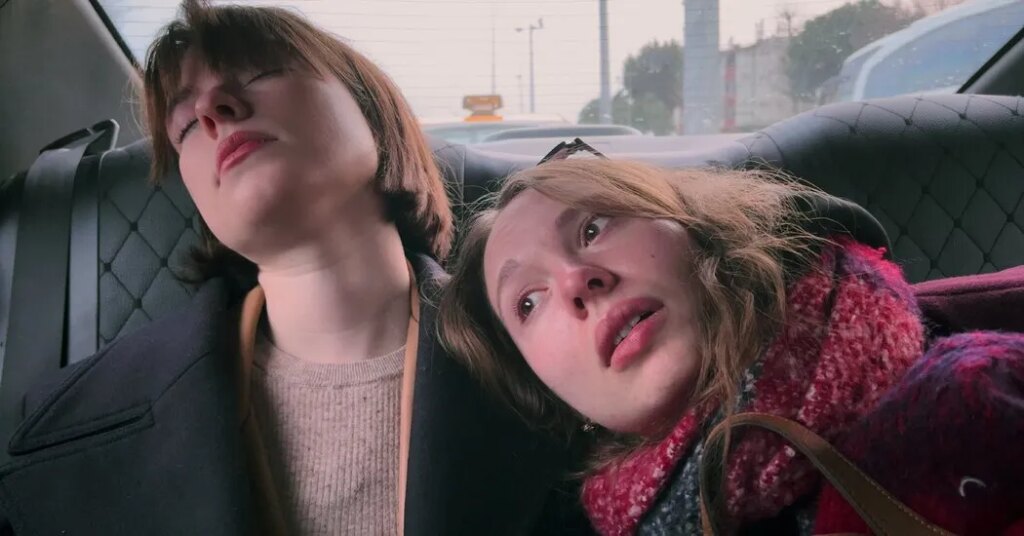
Fighting to stay awake in the back seat of a cab, the Russian journalist Elena Kostyuchenko — who has slipped out of Ukraine, fearing for her life — is mulling over what she saw on the ground. A sharp critic of Russia’s military action in Ukraine and President Vladimir V. Putin, she sees the 2022 invasion as a worthy reason for Ukraine’s people to never forgive Russians.
“Why should we be forgiven?” she says to Julia Loktev, who is filming her. “I mean, it’s true we didn’t stop him, right? And not because we couldn’t, but because we just wanted to have a nice life. We didn’t want to sacrifice our comfort.”
“And look what bloodshed it led to, this desire for comfort,” she continues.
It is one moment among many in the essential, absorbing “My Undesirable Friends: Part II — Exile,” in which a group of dissident Russian journalists, now scattered across Europe and Asia, express a feeling of responsibility for the war and their country’s rapid descent into what they describe as fascism. The next year Kostyuchenko will publish the best-selling book “I Love Russia: Reporting from a Lost Country” to explain how they got to this place. But for now, she is trying to stay alive long enough to write it.
At nearly six hours long, “My Undesirable Friends: Part II — Exile” is the riveting second half of Loktev’s epic chronicle of a country’s shift toward authoritarian control, as seen by journalists risking their lives to keep reporting on it. The Oscar-shortlisted first part, subtitled “Last Air in Moscow,” exists more or less by accident. In October 2021, Loktev went to Moscow to follow journalists who were declared “foreign agents” by the government. By February, the country was cracking down on anyone who described what was happening in terms the government did not prefer.
Loktev’s subjects went wherever they could, many to Istanbul, as Turkey was one of the few countries where Russian passport holders could travel without a visa. This all happens in the extraordinarily tense final moments of the first film; “Exile” picks up two days later.
The narrative in “Exile” is more spread out, since the subjects are as well. (Like the first half, this film screens theatrically in two parts.) Anna Nemzer (who is credited as co-director) is stranded in Tel Aviv, uncomfortable over accepting the hospitality of a country that she has criticized in her reporting. Irina Dolinina and Alesya Marokhovskaya are in Prague, where their editor at Important Stories, Roman Anin, fled six months earlier. Ksenia Mironova has gone to Istanbul, along with Valeria Ratnikova, the youngest anchor at TV Rain. The journalist Sonya Groysman is also there.
And the TV Rain host Peter Ruzavin, who is married to the Ukrainian journalist Nataliya Gumenyuk, is not able to return to Russia from their home in Kyiv, but not sure that he can stay. As he puts it, “The army of my native country started a full-scale invasion of my chosen homeland.”
“Exile” is a movie about members of a free press trying to remain free, to stay connected to a country they’ve been forced to leave. The journalists move around a lot, and Loktev manages to keep track of them all. We see them cry and laugh, gather for meals and spend grueling hours trying to keep their work going. We watch them yearn to return to their homeland, and come to terms with the fact that they may never be able to do so.
But even if they’re geographically spread out, their trains of thought are remarkably similar. Many of the conversations in “Exile” revolve around a set of themes that, to audiences facing rising authoritarian and fascist movements in their own countries, play like giant revolving sirens.
The journalists frequently express amazement about how swiftly and conclusively the hammer fell on them, once the war started. “You don’t believe it till it happens,” Ratnikova says. Yet they continually say they are, in a sense, the lucky ones: In Ukraine, people are being bombed. They’re just having to move to a different country every few months.
As Russians, they also face the ire of people in other countries, who are outraged at the war and incensed at Russians for not stopping, as some put it, “your [expletive] Putin.” Nemzer is anxious to move her family to Tbilisi, but says that many Georgians don’t want to rent to Russians — even though her career has been devoted to criticizing her own country’s government. As several readily note, it’s hardly surprising. “Imagine it’s 1939,” Anin says, “Germany is invading Poland, and German reporters come to Poland and say, ‘Hey, we want to do a story about what’s going on here.’” Who could blame anyone for the mistrust?
The journalists reserve their harshest criticisms for — aside from Putin — those who easily yielded to governmental censorship demands once the war began. Dolinina and Marokhovskaya discuss with Anin a recent move to meddle with university curriculums and outlaw the term “liberal arts.” They talk about a recent letter written by university presidents: “They’re all coming out in support of the war now and firing all the professors who leave the country,” Dolinina notes, with disgust.
Some of the subjects call their parents and, after hanging up, express frustration at an older generation’s apparently willful blindness. The parents are perplexed at why their children fled. Some insist that the invasion of Ukraine is, in essence, fake news. Kostyuchenko’s mother told her that it was “proved that this was a Ukrainian fake, there was no bombing,” she says. Kostyuchenko started sending her photos from Ukraine, but she didn’t change her mind.
This is the most chilling aspect of the film. The journalists are no longer in Russia, and they fear “losing touch with reality” because of it. But they’re more keenly aware of the ways that government manipulation of the media has caused people to do just that. Putin’s destruction of trust in independent reporting was deliberate and effective. Marokhovskaya says that propaganda is not really aimed at getting people to support his agenda but to feel helpless. “Doing nothing stems from believing no one,” she says. “Because if you don’t trust anyone, you don’t do anything one way or the other.”
They are the ones who’ve left Russia and yet feel abandoned. What do you do when your country leaves you behind? How do you exist when your purpose is to tell the truth, but people increasingly don’t believe there is such a thing?
“Exile” does not answer these questions, but the journalists in it are stumbling toward ways to keep going. For some, it’s the knowledge that people are still reading and watching their reporting; perhaps those people need to feel that they’re not alone, not crazy.
For others, it’s the prospect of, some day, once again living in the country they love. But recent events have made them skeptical that the Russia they remember is what they thought it was.
“We lost our homeland,” Dolinina says. “But did it even exist in the form we imagined it?”
My Undesirable Friends: Part II — Exile Not Rated. Running time: 5 hours 55 minutes. In theaters.
The post ‘My Undesirable Friends: Part II — Exile’ Review: What Is Truth? appeared first on New York Times.