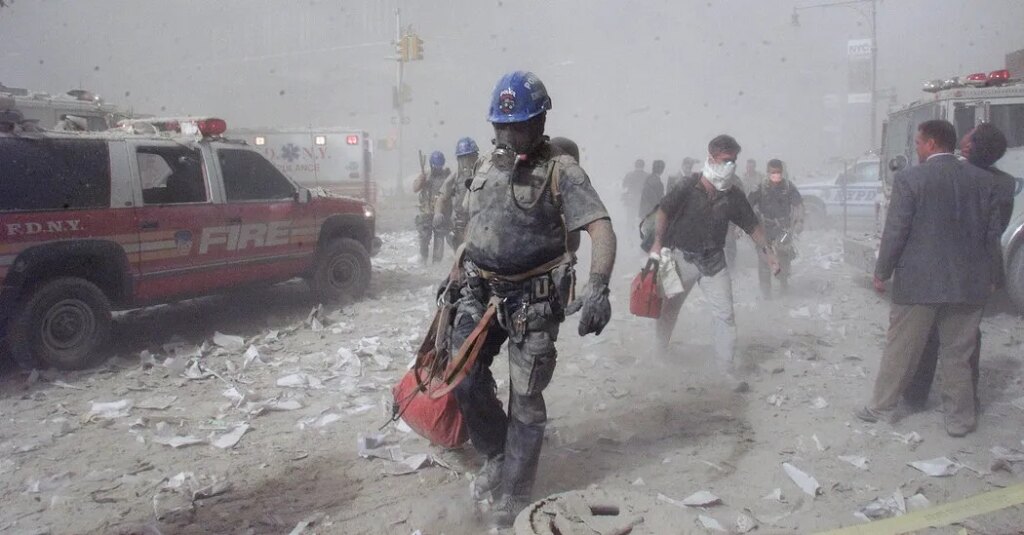
In the days after the terrorist attacks of Sept. 11, 2001, New York City and federal agencies focused on the most immediate toxic hazard: the air, still hazy with dust and smoke. A week later, the administrator of the Environmental Protection Agency reassured New Yorkers that the air was safe to breathe, though there wasn’t sufficient data to justify the claim.
The same day as that pronouncement, public health experts began identifying another problem: the dust that had settled inside homes. Two industrial hygienists, acting at the request of New York elected officials, sampled the air and dust in two apartments, one immediately near ground zero and the other a few blocks north.
The results were alarming. Both apartments had elevated concentrations of asbestos in dust and air samples. In a report for the officials, the scientists warned that residents who dusted and vacuumed their homes would end up breathing toxic air.
The fine gray dust — a caustic brew of pulverized concrete, fiberglass, asbestos, lead and a long list of toxins spawned by burned plastic and jet fuel — seeped into homes. It stole in through windows, air-conditioning units and rooftop vents. It settled on countertops, embedded in carpets and piled up on window sills. And when disturbed, it became airborne again, a reservoir of contaminants that were inhaled for months.
New York City officials did not come to grips with the problem until months after the terrorist attacks, newly released documents show. They allowed residents to return home, supplying little more than advice to clean up the dust with wet mops.
The new tranche of documents includes more than 170,000 pages of air quality reports, contamination records and correspondence among city officials that had been stored in 68 boxes in a city office for more than two decades. The documents reveal the confusion and, occasionally, finger-pointing among local and federal officials over how to quickly clean up Lower Manhattan — as well as the city’s halting realization that the indoor dust posed a health threat.
A quarter century later, more than 40,000 people who lived, worked or studied downtown are enrolled in the World Trade Center Health Program and have been diagnosed with respiratory ailments, cancer or another condition linked to the toxic effects of the towers’ collapse.
The documents released so far show that city officials were reluctant to grapple with the prospect that homes had become contaminated with toxins, said Andrew Carboy, a lawyer for 9/11 Health Watch, an advocacy organization that sued to force the release of the documents.
“You see the wishful thinking of decision makers saying, ‘Let’s get back to normal,’” Mr. Carboy said.
The city’s Department of Environmental Protection, which was entrusted with overseeing the cleanup beyond ground zero, left building owners in charge of testing and cleaning interiors. Landlords were advised to sample debris-containing dust for asbestos and handle it appropriately, but compliance appeared to vary widely. The department this week did not respond to a request for comment.
Often, residents cleaned their own apartments. “The best way to remove dust is with a wet rag or wet mop,” the Health Department had advised, cautioning against dry sweeping that could send dust aloft. Carpets could be shampooed, and then cleaned with a vacuum equipped with a HEPA filter for particles. There was no mention of wearing masks or respirators, or hiring work crews with hazardous materials experience.
At the time, asbestos was a main focus of public concern, but the documents and subsequent research also refer to other dangerous chemicals. Additionally, the harmful properties of some other contaminants, such as PFAS, or “forever chemicals,” were less well understood 25 years ago.
After the attacks, Lower Manhattan had become a frozen zone. Questions over which blocks to reopen, and when, received considerable attention at City Hall. Much of the debate focused on Battery Park City, a neighborhood of more than 20 high-rise apartment buildings, some with windows shattered from the towers’ collapse.
Residents returned in phases. They found dust everywhere, even in air-conditioning vents.
In late September and early October of 2001, Steven Spinola, the head of the Real Estate Board of New York, a trade organization of developers and landlords, sent missives to top aides of the city’s mayor at the time, Rudolph W. Giuliani, about reopening more of the development. “We have to try to convince the residents that things have returned to normal,” Mr. Spinola wrote on Oct. 3, 2001.
He complained that the Health Department was frightening residents with warnings about toxic exposures. The department had warned residents to wear long sleeves when first entering their homes and to avoid strenuous outdoor activity. In a memo to City Hall aides, Mr. Spinola criticized this advice for being “very threatening in tone.” In another memo, he urged the city to “change the message.”
It’s difficult to know whether the Real Estate Board and the developers influenced City Hall’s decisions. But an Oct. 6 memo from an associate health commissioner, Kelly McKinney, made clear that “the mayor’s office is under pressure from building owners and business owners in the red zone to open more of the city to occupancy.”
In a recent interview, Mr. Spinola said that his staff had told him that air quality testing showed the air to be safe. “We believed it was safe based on the information we had,” he said. “We’re looking back after 25 years with a lot more experience and a lot more scientific facts than we had 25 years ago.”
Starting Oct. 25, the Health Department conducted a door-to-door survey of households in Battery Park City and elsewhere in Lower Manhattan. More than 80 percent had a cough or symptoms such as nasal irritation that developed or worsened after Sept. 11. About half felt safe in their apartment. “Those not feeling safe were most concerned about air quality and surface dust,” the Health Department concluded.
Less than half of the surveyed residents reported that their apartments had been cleaned according to recommended methods.
The Health Department and the federal Agency for Toxic Substances and Disease Registry sampled 30 residential buildings in Lower Manhattan from Nov. 4 to Dec. 11, 2001. They found asbestos in 18 percent of indoor samples and more than 40 percent of outdoor samples. They also found fiberglass and minerals such as quartz and gypsum that can cause lung problems and warned of possible “synergistic effects” among the contaminants. They shared the results with residents in February 2002, but debated whether to publicize their findings more broadly.
In March 2002, a city inspector encountered tenants cleaning their apartments at 125 Cedar Street, the residential building nearest ground zero. “The apartments were heavily contaminated with WTC debris,” the inspector, Carlstien Lutchmedial, wrote in his inspection report. “I observed they were not wearing masks.”
The tenants told Mr. Lutchmedial that as far as they knew, no one had tested the debris in their homes. “They had decided they would forego the sampling and clean their apartments on their own,” he wrote.
A complaint hotline run by the city also put the indoor dust issue on officials’ radar. One mother with two young children called on April 1, 2002, to ask if the city would force her landlord to replace the carpets in her apartment. She had moved back in October and later paid $1,500 to have her apartment tested for asbestos. The results showed a high concentration in her carpet. She had bought a HEPA vacuum and begun cleaning the carpet daily, according to notes from her call.
The call provoked a detailed discussion among senior health officials, but few answers, according to their correspondence.
On April 9, 2002, a lawyer for the city expressed alarm that the E.P.A. was now asserting that even minimal amounts of dust inside residences should be regarded as a potential asbestos hazard. That ran counter to what the city Health Department had told residents: Use a wet mop.
City officials realized the advice they had provided to thousands of downtown residents was under scrutiny, and the E.P.A. wasn’t backing them up.
In May 2002, the E.P.A. and city officials announced a residential testing and cleaning program for any household that requested it, paid for by the Federal Emergency Management Agency. Internally, city officials wrestled with the conflicting messages they had issued.
“How do we reconcile telling people they now have to do testing or cleanup, if we’ve been telling everyone things are OK?” asked Mark Hoffer, the general counsel for the city Department of Environmental Protection, according to notes of a meeting leading up to the announcement. Reached by phone recently, Mr. Hoffer said he didn’t recall the episode and didn’t want to discuss it.
Just over a year later, about 4,000 homes, of the more than 20,000 eligible, had participated in the cleanup program. By then, it might have been too late. As the E.P.A.’s inspector general noted in a 2003 report, many people had already returned and cleaned their own residences.
The post Toxic Dust Was Everywhere After 9/11. Little Was Done for Months. appeared first on New York Times.